



 Chat with AI
Exam 16: Capital Expenditure Decisions

Exam 1: The Changing Role of Managerial Accounting in a Dynamic Business Environment62 Questions
Exam 2: Basic Cost Management Concepts85 Questions
Exam 3: Product Costing and Cost Accumulation in a Batch Production Environment80 Questions
Exam 4: Process Costing and Hybrid Product-Costing Systems84 Questions
Exam 5: Activity-Based Costing and Management85 Questions
Exam 6: Activity Analysis, Cost Behavior, and Cost Estimation93 Questions
Exam 7: Cost-Volume-Profit Analysis89 Questions
Exam 8: Variable Costing and the Costs of Quality and Sustainability64 Questions
Exam 9: Financial Planning and Analysis: the Master Budget95 Questions
Exam 10: Standard Costing and Analysis of Direct Costs80 Questions
Exam 11: Flexible Budgeting and Analysis of Overhead Costs91 Questions
Exam 12: Responsibility Accounting, Operational Performance Measures, and the Balanced Scorecard72 Questions
Exam 13: Investment Centers and Transfer Pricing95 Questions
Exam 14: Decision Making: Relevant Costs and Benefits90 Questions
Exam 15: Target Costing and Cost Analysis for Pricing Decisions99 Questions
Exam 16: Capital Expenditure Decisions104 Questions
Exam 17: Allocation of Support Activity Costs and Joint Costs81 Questions
Exam 18: The Sarbanes-Oxley Act, Internal Controls, and Management Accounting14 Questions
Exam 19: Compound Interest and the Concept of Present Value24 Questions
Exam 20: Inventory Management14 Questions
Select questions type


Raymon Company received $7,000 cash from the sale of a machine that had an $11,000 book value. If the company is subject to a 30% income tax rate, the net cash flow to use in a discounted-cash-flow analysis would be:
(Multiple Choice)
4.8/5  (87)
(87) The net-present-value method assumes that project funds are reinvested at the:
(Multiple Choice)
4.8/5 (75)
(75) Mark Industries is currently purchasing part no. 76 from an outside supplier for $80 per unit. Because of supplier reliability problems, the company is considering producing the part internally in an idle manufacturing plant. Annual volume over the next six years is expected to total 300,000 units at variable manufacturing costs of $75 per unit.
Mark must acquire $80,000 of new equipment if it reopens the plant. The equipment has a six-year service life, a $14,000 salvage value, and will be depreciated by the straight-line method. Repairs and maintenance are expected to average $5,200 per year in years 4-6, and the equipment will be sold at the end of its life.
Required:
Rounding to the nearest dollar, use the net-present-value method (total-cost approach) and a 12% hurdle rate to determine whether Mark should make or buy part no. 76. Ignore income taxes.
(Essay)
4.9/5 (74)
(74) Preston Company is considering the use of accelerated depreciation rather than straight-line depreciation for a new asset acquisition. Which of the following choices correctly shows when the majority of depreciation would be taken (early or late in the asset's life), when most of the tax savings occur (early or late in the asset's life), and which depreciation method would have the higher present value? 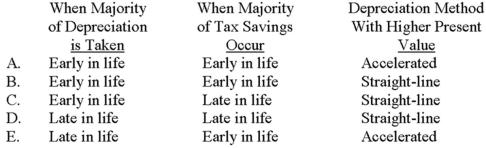
(Multiple Choice)
4.7/5 (82)
(82) 
Filters
- Essay(0)
- Multiple Choice(0)
- Short Answer(0)
- True False(0)
- Matching(0)