



 Chat with AI
Exam 16: Capital Expenditure Decisions

Exam 1: The Changing Role of Managerial Accounting in a Dynamic Business Environment62 Questions
Exam 2: Basic Cost Management Concepts85 Questions
Exam 3: Product Costing and Cost Accumulation in a Batch Production Environment80 Questions
Exam 4: Process Costing and Hybrid Product-Costing Systems84 Questions
Exam 5: Activity-Based Costing and Management85 Questions
Exam 6: Activity Analysis, Cost Behavior, and Cost Estimation93 Questions
Exam 7: Cost-Volume-Profit Analysis89 Questions
Exam 8: Variable Costing and the Costs of Quality and Sustainability64 Questions
Exam 9: Financial Planning and Analysis: the Master Budget95 Questions
Exam 10: Standard Costing and Analysis of Direct Costs80 Questions
Exam 11: Flexible Budgeting and Analysis of Overhead Costs91 Questions
Exam 12: Responsibility Accounting, Operational Performance Measures, and the Balanced Scorecard72 Questions
Exam 13: Investment Centers and Transfer Pricing95 Questions
Exam 14: Decision Making: Relevant Costs and Benefits90 Questions
Exam 15: Target Costing and Cost Analysis for Pricing Decisions99 Questions
Exam 16: Capital Expenditure Decisions104 Questions
Exam 17: Allocation of Support Activity Costs and Joint Costs81 Questions
Exam 18: The Sarbanes-Oxley Act, Internal Controls, and Management Accounting14 Questions
Exam 19: Compound Interest and the Concept of Present Value24 Questions
Exam 20: Inventory Management14 Questions
Select questions type


James Company has an asset that cost $5,000 and currently has accumulated depreciation of $2,000. Suppose the firm sold the asset for $2,500 and is subject to a 30% income tax rate.
The loss on disposal would be:
(Multiple Choice)
4.9/5  (70)
(70) Green Way Packaging is considering a $600,000 investment in new equipment that is anticipated to produce the following data over a five-year life: Year Cash Inflows Cash Outflows Depreciation 1 \ 350,000 \ 130,000 \ 120,000 2 450,000 190,000 120,000 3 450,000 170,000 120,000 4 340,000 150,000 120,000 5 300,000 130,000 120,000 Ignoring income taxes and assuming that cash flows occur evenly throughout a year, the equipment's approximate payback period is:
(Multiple Choice)
4.9/5 (81)
(81) Which of the following is taken into account by the net-present-value method? A Project's Immediate Cash Flows Cash Flows During a Project's Life Time Value of Money A. Yes No No B. Yes Yes No C. Yes Yes Yes D. No Yes Yes E. No Yes No
(Multiple Choice)
4.9/5 (96)
(96) Which of the following is the proper calculation of a company's depreciation tax shield?
(Multiple Choice)
5.0/5 (72)
(72) The decision process that has managers select from among several acceptable investment proposals to make the best use of limited funds is known as:
(Multiple Choice)
4.9/5 (85)
(85) If income taxes are ignored, which of the following choices correctly notes how a project's depreciation is treated under the net-present-value method and the internal-rate-of-return method? 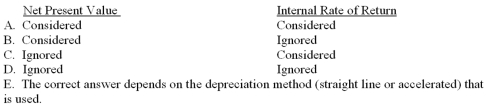
(Multiple Choice)
4.9/5 (82)
(82) Consider the following statements about the total-cost and the incremental-cost approaches of investment evaluation:
I. Both approaches will yield the same conclusions.
II. Choosing between these approaches is a matter of personal preference.
III. The incremental approach focuses on cost differences between alternatives.
Which of the above statements is (are) true?
(Multiple Choice)
4.9/5 (75)
(75) Eagle Airways Company is planning a project that is expected to last for six years and generate annual net cash inflows of $75,000. The project will require the purchase of a $280,000 machine, which is expected to have a salvage value of $10,000 at the end of the six-year period. The machine will require a $50,000 overhaul at the end of the fourth year. The company presently has a 12% minimum desired rate of return.
Based on this information, an accountant prepared the following analysis: 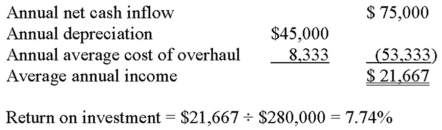 The accountant recommends that the project be rejected because it does not meet the company's minimum desired rate of return. Ignore income taxes.
Required:
A. What criticism(s) would you make of the accountant's evaluation?
B. Use the net-present-value method and determine whether the project should be accepted.
C. Based on your answer in requirement "B," is the internal rate of return greater or less than 12%? Explain.
The accountant recommends that the project be rejected because it does not meet the company's minimum desired rate of return. Ignore income taxes.
Required:
A. What criticism(s) would you make of the accountant's evaluation?
B. Use the net-present-value method and determine whether the project should be accepted.
C. Based on your answer in requirement "B," is the internal rate of return greater or less than 12%? Explain. (Essay)
4.8/5 (72)
(72) The systematic follow-up on a capital project to see how the project actually turns out is commonly known as:
(Multiple Choice)
4.9/5 (83)
(83) A profitability index can be used to rank investment proposals.
Required:
A. Define the profitability index.
B. Two projects are under consideration. Project I has a net present value of $20,000 whereas project II has a net present value of $200,000. Which project is better? Explain. What weakness in a net-present-value analysis does the profitability index address?
(Essay)
4.8/5 (75)
(75) Bath Works Company has $70,000 of depreciation expense and is subject to a 30% income tax rate. On an after-tax basis, depreciation results in a:
(Multiple Choice)
4.8/5 (81)
(81) If a company desires to be in compliance with current income tax law and write off the cost of its assets rapidly, the firm would use:
(Multiple Choice)
5.0/5 (74)
(74) Consider the following statements about the accounting for inflation in a capital budgeting analysis:
I. An analyst can use nominal dollars in conjunction with a nominal interest rate.
II. An analyst can use real dollars in conjunction with a real interest rate.
III. An analyst can use nominal dollars in conjunction with a real interest rate.
Which of the above statements is (are) correct?
(Multiple Choice)
4.8/5 (92)
(92) Grey is considering the replacement of some machinery that has zero book value and a current market value of $2,800. One possible alternative is to invest in new machinery that costs $30,000. The new equipment has a four-year service life and an estimated salvage value of $3,500, will produce annual cash operating savings of $9,400, and will require a $2,200 overhaul in year 3. The company uses straight-line depreciation.
Required:
Prepare a net-present-value analysis of Grey's replacement decision, assuming an 8% hurdle rate and no income taxes. Should the machinery be acquired? Note: Round calculations to the nearest dollar.
(Essay)
4.8/5 (76)
(76) The Modified Accelerated Cost Recovery System (MACRS) assumes that, on average, assets will be placed in service:
(Multiple Choice)
4.8/5 (80)
(80) Ivory Corporation is reviewing an investment proposal that has an initial cost of $52,500. An estimate of the investment's end-of-year book value, the yearly after-tax net cash inflows, and the yearly net income are presented in the schedule below. Yearly after-tax net cash inflows include savings from the depreciation tax shield. The investment's salvage value at the end of each year is equal to book value, and there will be no salvage value at the end of the investment's life. 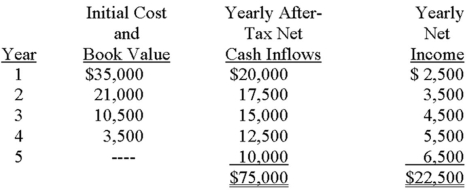 Ivory uses a 14% after-tax target rate of return for new investment proposals.
Required:
A. Calculate the project's payback period.
B. Calculate the accounting rate of return on the initial investment.
C. Calculate the proposal's net present value. Round to the nearest dollar.
Ivory uses a 14% after-tax target rate of return for new investment proposals.
Required:
A. Calculate the project's payback period.
B. Calculate the accounting rate of return on the initial investment.
C. Calculate the proposal's net present value. Round to the nearest dollar. (Essay)
4.8/5 (81)
(81) Consider the following statements about the payback period:
I. As shown in your text, the payback period considers the time value of money.
II. The payback period can only be used if net cash inflows are uniform throughout a project's life.
III. The payback period ignores cash inflows that occur after the payback period is reached.
Which of the above statements is (are) correct?
(Multiple Choice)
4.8/5 (70)
(70) When income taxes are considered in capital budgeting, the cash flows related to a company's advertising expense would be correctly figured by taking the cash paid for advertising and subtracting the result of multiplying [advertising expense × (1 - tax rate)].
(True/False)
4.8/5 (88)
(88) Ruiz Company purchased equipment for $30,000 in December 20x1. The equipment is expected to generate $10,000 per year of additional revenue and incur $2,000 per year of additional cash expenses, beginning in 20x2. Under MACRS, depreciation in 20x2 will be $3,000. If the firm's income tax rate is 40%, the after-tax cash flow in 20x2 would be:
(Multiple Choice)
4.8/5 (75)
(75) 
Filters
- Essay(0)
- Multiple Choice(0)
- Short Answer(0)
- True False(0)
- Matching(0)