



 Chat with AI
Exam 16: Capital Expenditure Decisions

Exam 1: The Changing Role of Managerial Accounting in a Dynamic Business Environment62 Questions
Exam 2: Basic Cost Management Concepts85 Questions
Exam 3: Product Costing and Cost Accumulation in a Batch Production Environment80 Questions
Exam 4: Process Costing and Hybrid Product-Costing Systems84 Questions
Exam 5: Activity-Based Costing and Management85 Questions
Exam 6: Activity Analysis, Cost Behavior, and Cost Estimation93 Questions
Exam 7: Cost-Volume-Profit Analysis89 Questions
Exam 8: Variable Costing and the Costs of Quality and Sustainability64 Questions
Exam 9: Financial Planning and Analysis: the Master Budget95 Questions
Exam 10: Standard Costing and Analysis of Direct Costs80 Questions
Exam 11: Flexible Budgeting and Analysis of Overhead Costs91 Questions
Exam 12: Responsibility Accounting, Operational Performance Measures, and the Balanced Scorecard72 Questions
Exam 13: Investment Centers and Transfer Pricing95 Questions
Exam 14: Decision Making: Relevant Costs and Benefits90 Questions
Exam 15: Target Costing and Cost Analysis for Pricing Decisions99 Questions
Exam 16: Capital Expenditure Decisions104 Questions
Exam 17: Allocation of Support Activity Costs and Joint Costs81 Questions
Exam 18: The Sarbanes-Oxley Act, Internal Controls, and Management Accounting14 Questions
Exam 19: Compound Interest and the Concept of Present Value24 Questions
Exam 20: Inventory Management14 Questions
Select questions type


Consider the five items that follow, which are related to independent investment opportunities.
Purchase price of a new machine: $850,000
Annual straight-line depreciation: $75,000
Annual savings in cash operating costs: $120,000
Advertising expenses related to a new marketing campaign in year 2: $35,000
Sale of an asset in year 6: Loss on sale, $60,000; proceeds received by seller, $23,000
Required:
Complete the following table, inserting the (pre-discounted) cash flow amounts that would be used in a net-present-value analysis. Column A should be completed based on the assumption of no income taxes; in contrast, Column B should be completed assuming the relevant company is subject to a 30% income tax rate. Be sure to note cash outflows in parentheses.
(Essay)
4.9/5  (85)
(85) St. Andrews School ranks investments by using the profitability index (PI). The following data relate to Project X and Project Y: Project X Project Y Initial investment \ 400,000 \ 1,300,000 Present value of inflows 600,000 1,800,000 Which project would be more attractive as judged by its ranking, and why?
(Multiple Choice)
4.9/5 (77)
(77) The rule for project acceptance under the internal rate of return method is that:
(Multiple Choice)
4.7/5 (74)
(74) Braselton Company plans to incur $190,000 of salaries expense and produce $320,000 of additional sales revenue if a capital project is implemented. Assuming a 30% tax rate, these two items collectively should appear in a capital budgeting analysis as:
(Multiple Choice)
4.8/5 (86)
(86) Pinero is considering a $600,000 investment in new equipment that is anticipated to produce the following net cash inflows: Year Net Cash Inflows 1 \ 120,000 2 250,000 3 110,000 4 80,000 5 160,000 If cash flows occur evenly throughout a year, the equipment's payback period is:
(Multiple Choice)
4.7/5 (79)
(79) The true economic yield produced by an asset is summarized by the asset's:
(Multiple Choice)
4.8/5 (90)
(90) An increased number of companies are investing in advanced manufacturing systems.
Required:
A. Many proposed advanced manufacturing systems have a negative net present value when discounted-cash-flow analysis is used. Explain several causes of this situation.
B. Two major benefits of advanced systems are greater flexibility in the manufacturing process and improvements in product quality. Explain how these benefits can create problems when performing discounted-cash-flow analysis.
(Essay)
4.8/5 (80)
(80) When a company is analyzing a capital project by a discounted-cash-flow approach and income taxes are being considered, depreciation:
(Multiple Choice)
4.9/5 (86)
(86) A piece of equipment costs $30,000, and is expected to generate $8,500 of annual cash revenues and $1,500 of annual cash expenses. The disposal value at the end of the estimated 10-year life is $3,000. Ignoring income taxes, the payback period is:
(Multiple Choice)
4.8/5 (84)
(84) Depreciation is often described as a "tax shield."
Required:
A. Explain how depreciation provides such a shield.
B. MACRS is an accelerated depreciation system. Explain how an accelerated system can provide a more beneficial tax shield than, say, a straight-line depreciation system.
(Essay)
4.9/5 (78)
(78) Consider the following statements about capital budgeting postaudits:
I. Postaudits can be used to detect desirable projects that were rejected.
II. Postaudits can be used to detect undesirable projects that were accepted.
III. Postaudits may reveal shortcomings in cash-flow projections, providing insights that allow a company to improve future predictions.
Which of the above statements is (are) correct?
(Multiple Choice)
4.8/5 (81)
(81) Cones & Moore sells frozen custard and sandwiches. It is considering a new site that will require a $2 million investment for land acquisition and construction costs. The following operating results are expected: 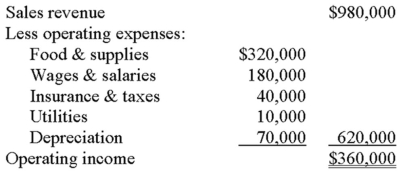 Disregard income taxes.
Required:
A. If management requires a payback period of four years or less, should the new site be opened? Why?
B. Compute the accounting rate of return on the initial investment.
C. What significant limitation of payback and the accounting rate of return is overcome by the net-present-value method?
Disregard income taxes.
Required:
A. If management requires a payback period of four years or less, should the new site be opened? Why?
B. Compute the accounting rate of return on the initial investment.
C. What significant limitation of payback and the accounting rate of return is overcome by the net-present-value method? (Essay)
4.7/5 (77)
(77) Puck Company received $18,000 cash from the sale of a machine that had a $13,000 book value. If the company is subject to a 30% income tax rate, the net cash flow to use in a discounted-cash-flow analysis would be:
(Multiple Choice)
4.9/5 (77)
(77) If a proposal's profitability index is greater than one then the net present value is positive.
(True/False)
4.8/5 (73)
(73) Jenkins plans to generate $650,000 of sales revenue if a capital project is implemented. Assuming a 30% tax rate, the sales revenue should be reflected in the analysis by a:
(Multiple Choice)
4.9/5 (77)
(77) San Remo has a $4,000,000 asset investment and is subject to a 30% income tax rate. Cash inflows are expected to average $600,000 before tax over the next few years; in contrast, average income before tax is anticipated to be $500,000. The company's after-tax accounting rate of return is:
(Multiple Choice)
4.9/5 (68)
(68) 
Filters
- Essay(0)
- Multiple Choice(0)
- Short Answer(0)
- True False(0)
- Matching(0)