



 Chat with AI
Exam 16: Capital Expenditure Decisions

Exam 1: The Changing Role of Managerial Accounting in a Dynamic Business Environment62 Questions
Exam 2: Basic Cost Management Concepts85 Questions
Exam 3: Product Costing and Cost Accumulation in a Batch Production Environment80 Questions
Exam 4: Process Costing and Hybrid Product-Costing Systems84 Questions
Exam 5: Activity-Based Costing and Management85 Questions
Exam 6: Activity Analysis, Cost Behavior, and Cost Estimation93 Questions
Exam 7: Cost-Volume-Profit Analysis89 Questions
Exam 8: Variable Costing and the Costs of Quality and Sustainability64 Questions
Exam 9: Financial Planning and Analysis: the Master Budget95 Questions
Exam 10: Standard Costing and Analysis of Direct Costs80 Questions
Exam 11: Flexible Budgeting and Analysis of Overhead Costs91 Questions
Exam 12: Responsibility Accounting, Operational Performance Measures, and the Balanced Scorecard72 Questions
Exam 13: Investment Centers and Transfer Pricing95 Questions
Exam 14: Decision Making: Relevant Costs and Benefits90 Questions
Exam 15: Target Costing and Cost Analysis for Pricing Decisions99 Questions
Exam 16: Capital Expenditure Decisions104 Questions
Exam 17: Allocation of Support Activity Costs and Joint Costs81 Questions
Exam 18: The Sarbanes-Oxley Act, Internal Controls, and Management Accounting14 Questions
Exam 19: Compound Interest and the Concept of Present Value24 Questions
Exam 20: Inventory Management14 Questions
Select questions type


Which of the following tools is sometimes used to rank investment proposals?

Free
(Multiple Choice)
5.0/5  (75)
(75) Correct Answer: Verified
A
Both net present value (NPV) and the internal rate of return (IRR) have a reinvestment assumption.
Required:
A. State the assumption for each method.
B. One of the advantages of the NPV method is that users can adjust for risk considerations. Explain how this is done.
Free
(Essay)
4.9/5 (76)
(76) Correct Answer:Verified
VerifiedA. In the NPV method, cash flows are assumed to be reinvested at the hurdle rate. With the IRR, cash flows are assumed to be reinvested at the same rate as the project's return.
B. In the NPV method, a higher hurdle rate can be used, either for the entire analysis or for the estimated cash inflows (savings) that occur late in the project's life.
Mad's Hatters Corporation will evaluate a potential investment in an advanced manufacturing system by use of the net-present-value (NPV) method. Which of the following system benefits is least likely to be omitted from the NPV analysis?
Free
(Multiple Choice)
4.9/5 (80)
(80) Correct Answer:Verified
VerifiedA
Consider the following statements about the accounting rate of return:
I. The accounting rate of return focuses on a project's income rather than its cash flows.
II. Companies can figure the accounting rate of return on either the initial investment figure or an average investment figure.
III. The accounting rate of return considers the time value of money.
Which of the above statements is (are) correct?
(Multiple Choice)
4.9/5 (89)
(89) Consider the following statements about taxes and after-tax cash flows:
I. Capital budgeting analyses should incorporate after-tax cash flows rather than before-tax cash flows.
II. Added company revenues will result in lower taxes for a firm.
III. Operating expenses may actually provide a tax benefit for an organization.
Which of the above statements is (are) correct?
(Multiple Choice)
4.9/5 (74)
(74) Hazeldine Company plans to incur $230,000 of additional cash operating expenses and produce $410,000 of additional sales revenue if a capital project is implemented. Assuming a 30% tax rate, these two items collectively should appear in a capital budgeting analysis as:
(Multiple Choice)
4.9/5 (91)
(91) Custom Plastics plans to purchase $4.5 million of equipment in the not-too-distant future. The equipment will be depreciated by the optional straight-line method over the MACRS life of 5 years. Custom is subject to a 30% income tax rate.
The company's accountant is about to perform a net-present-value analysis, assuming a 10% after-tax hurdle rate.
Required:
A. Determine the discounted cash flows that would be reflected in the analysis in year 0 and year 1.
B. Determine the discounted cash flow that would be reflected in the analysis in year 6, assuming that Custom sells the equipment for $450,000,
(Essay)
4.8/5 (86)
(86) Porschia is considering the acquisition of new machinery that will produce uniform benefits over the next eight years. The following information is available:
Annual savings in cash operating costs: $350,000
Annual depreciation expense: $250,000
If the company is subject to a 30% tax rate, what denominator should be used to compute the machinery's payback period?
(Multiple Choice)
4.7/5 (76)
(76) Hightower Company plans to incur $350,000 of salaries expense if a capital project is implemented. Assuming a 30% tax rate, the salaries should be reflected in the analysis by a:
(Multiple Choice)
4.8/5 (85)
(85) Wornell Industries is currently purchasing part no. 456 from an outside supplier for $90 per unit. Because of supplier reliability problems, the company is considering producing the part internally in a currently idle manufacturing plant. Annual volume over the next five years is expected to total 400,000 units at variable manufacturing costs of $88 per unit.
Wornell must acquire $200,000 of new equipment if it reopens the plant. The equipment has a five-year service life, a $20,000 salvage value, and will be depreciated by the straight-line method. Normal equipment maintenance is expected to total $12,000 in year 4, and the equipment will be sold at the end of its life for $20,000, which represents $20,000 gain.
Required:
Rounding to the nearest dollar, use the net-present-value method (total-cost approach) and a 12% after-tax hurdle rate to determine whether Wornell should make or buy part no. 456. The company is subject to a 30% income tax rate.
Wornell is better off to make part no. 456.
(Essay)
4.8/5 (90)
(90) The internal-rate-of-return method assumes that project funds are reinvested at the:
(Multiple Choice)
4.7/5 (85)
(85) On January 2, 20x1, Rebecca Brown purchased 800 shares of Bazooka Telecommunications common stock at $35 per share. The company paid a $1.50 dividend per share on December 28 of that year, and raised the amount by $0.50 per share for a distribution on December 28, 20x2. Rebecca sold her entire investment on December 30, 20x2, generating a $5,000 gain on the sale of stock.
Required:
A. Prepare a dated listing of the cash inflows and outflows related to Rebecca's stock investment. Ignore income taxes.
B. Assume that Rebecca has a 10% hurdle rate for all investments. Rounding to the nearest dollar, compute the net present value of her investment in Bazooka and determine whether she achieved her 10% goal.
(Essay)
4.9/5 (83)
(83) When making investment decisions that involve advanced manufacturing systems, the use of net present value:
(Multiple Choice)
4.9/5 (85)
(85) A company's hurdle rate is generally influenced by whether management uses the net-present-value method or the internal-rate-of-return method.
(True/False)
4.9/5 (82)
(82) In a net-present-value analysis, the discount rate is often called the:
(Multiple Choice)
4.7/5 (83)
(83) Perez Corporation recently purchased a $1,200,000 asset that has a three-year service life and no salvage value. The company is subject to a 30% income tax rate and employs a 12% after-tax hurdle rate in capital investment decisions.
Management is studying whether to depreciate the asset by using the straight-line method or the Modified Accelerated Cost Recovery System (MACRS). Assume that the following MACRS factors are in effect: year 1, 33%; year 2, 45%; year 3, 15%; and year 4, 7%
Required:
A. Calculate the total depreciation expense that Perez will record under each method.
B. Calculate the total tax savings that will occur with each method.
C. On the basis of your calculations in part "B," which of the two methods will management likely prefer? Explain your answer.
D. Compute the present value of the tax savings for each method, rounding to the nearest dollar.
(Essay)
4.7/5 (74)
(74) Which of the following choices correctly states how funds are assumed to be reinvested under the net-present-value method and the internal-rate-of-return method? 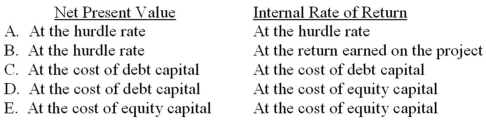
(Multiple Choice)
4.9/5 (83)
(83) 
Filters
- Essay(0)
- Multiple Choice(0)
- Short Answer(0)
- True False(0)
- Matching(0)