



 Chat with AI
Exam 41: The Child with an Infectious Disease

Exam 1: Foundations of Maternity, Women’s Health, and Child Health Nursing26 Questions
Exam 2: The Nurse’s Role in Maternity, Women’s Health, and Pediatric Nursing17 Questions
Exam 3: The Childbearing and Child-Rearing Family23 Questions
Exam 4: Communicating with Children and Families18 Questions
Exam 5: Health Promotion for the Developing Child20 Questions
Exam 6: Health Promotion for the Infant26 Questions
Exam 7: Health Promotion During Early Childhood26 Questions
Exam 8: Health Promotion for the School-Age Child27 Questions
Exam 9: Health Promotion for the Adolescent26 Questions
Exam 10: Hereditary and Environmental Influences on Development20 Questions
Exam 11: Reproductive Anatomy and Physiology15 Questions
Exam 12: Conception and Prenatal Development25 Questions
Exam 13: Adaptations to Pregnancy43 Questions
Exam 14: Nutrition for Childbearing30 Questions
Exam 15: Prenatal Diagnostic Tests21 Questions
Exam 16: Giving Birth41 Questions
Exam 17: Intrapartum Fetal Surveillance27 Questions
Exam 18: Pain Management for Childbirth35 Questions
Exam 19: Nursing Care during Obstetric Procedures28 Questions
Exam 20: Postpartum Adaptations41 Questions
Exam 21: The Normal Newborn: Adaptation and Assessment44 Questions
Exam 22: The Normal Newborn: Nursing Care21 Questions
Exam 23: Newborn Feeding37 Questions
Exam 24: The Childbearing Family with Special Needs23 Questions
Exam 25: Pregnancy-Related Complications35 Questions
Exam 26: Concurrent Disorders during Pregnancy30 Questions
Exam 27: The Woman with an Intrapartum Complication30 Questions
Exam 28: The Woman with a Postpartum Complication34 Questions
Exam 29: The High-Risk Newborn: Problems Related to Gestational Age and Development25 Questions
Exam 30: The High-Risk Newborn: Acquired and Congenital Conditions30 Questions
Exam 31: Management of Fertility and Infertility25 Questions
Exam 32: Women’s HealthCare37 Questions
Exam 33: Physical Assessment of Children37 Questions
Exam 34: Emergency Care of the Child30 Questions
Exam 35: The Ill Child in the Hospital and Other Care Settings28 Questions
Exam 36: The Child with a Chronic Condition or Terminal Illness35 Questions
Exam 37: Principles and Procedures for Nursing Care of Children25 Questions
Exam 38: Medication Administration and Safety for Infants and Children26 Questions
Exam 39: Pain Management for Children20 Questions
Exam 40: The Child with a Fluid and Electrolyte Alteration17 Questions
Exam 41: The Child with an Infectious Disease22 Questions
Exam 42: The Child with an Immunologic Alteration22 Questions
Exam 43: The Child with a Gastrointestinal Alteration55 Questions
Exam 44: The Child with a Genitourinary Alteration33 Questions
Exam 45: The Child with a Respiratory Alteration48 Questions
Exam 46: The Child with a Cardiovascular Alteration39 Questions
Exam 47: The Child with a Hematologic Alteration25 Questions
Exam 48: The Child with Cancer27 Questions
Exam 49: The Child with an Alteration in Tissue Integrity34 Questions
Exam 50: The Child with a Musculoskeletal Alteration37 Questions
Exam 51: The Child with an Endocrine or Metabolic Alteration31 Questions
Exam 52: The Child with a Neurologic Alteration41 Questions
Exam 53: Psychosocial Problems in Children and Families20 Questions
Exam 54: The Child With an Intellectual Disability or Developmental Disability25 Questions
Exam 55: The Child with a Sensory Alteration32 Questions
Select questions type


A parent brings a child to the emergency department and reports fever,foul smell coming from the throat,and a gray covering over the tonsils.What action by the nurse takes priority?

Free
(Multiple Choice)
4.9/5  (65)
(65) Correct Answer: Verified
C
What is the best response to a parent of a 2-month-old infant who asks when the infant should first receive the measles vaccine?
Free
(Multiple Choice)
4.8/5 (78)
(78) Correct Answer:Verified
VerifiedB
How should the nurse respond to a parent who asks,"How can I protect my baby from whooping cough?"
Free
(Multiple Choice)
4.9/5 (79)
(79) Correct Answer:Verified
VerifiedB
What should be included in health teaching to prevent Lyme disease?
(Multiple Choice)
4.8/5 (88)
(88) Which statement indicates that a father understands the treatment for his child who has scarlet fever?
(Multiple Choice)
4.9/5 (74)
(74) Which STD should the nurse suspect when an adolescent girl comes to the clinic because she has a vaginal discharge that is white with a fishy smell?
(Multiple Choice)
4.8/5 (75)
(75) The nurse in the pediatric clinic is caring for a child and assesses this skin rash.What action by the nurse is best?
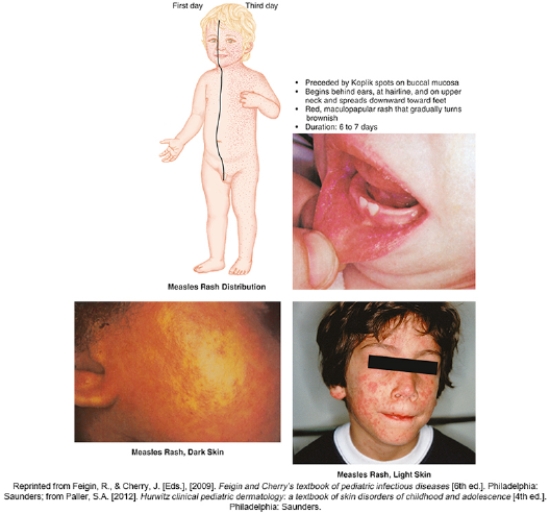
(Multiple Choice)
4.8/5 (77)
(77) Parents report their 3-year-old child appears restless at night and frequently scratches her anal area.What action by the nurse is best?
(Multiple Choice)
4.8/5 (79)
(79) The nurse should provide which information to parents about preventing parasitic infections? (Select all that apply.)
(Multiple Choice)
4.7/5 (77)
(77) Which statement made by a parent about intervention for a child's fever shows the need for further education?
(Multiple Choice)
4.8/5 (77)
(77) A nurse is conducting a health education class for a group of school-age children.Which statement made by the nurse is correct about the body's first line of defense against infection in the innate immune system?
(Multiple Choice)
4.9/5 (78)
(78) What should be included in the care for a neonate who was diagnosed with pertussis?
(Multiple Choice)
4.9/5 (93)
(93) A child taking oral corticosteroids for asthma is exposed to varicella.The child has not had the varicella vaccine and has never had the disease.What intervention should be taken to prevent varicella from developing?
(Multiple Choice)
4.7/5 (88)
(88) Which statement made by an adolescent girl indicates an understanding about the prevention of sexually transmitted diseases (STDs)?
(Multiple Choice)
4.8/5 (73)
(73) The mother of an infant with multiple anomalies tells the nurse that she had a viral infection in the beginning of her pregnancy.Which viral infection is associated with fetal anomalies?
(Multiple Choice)
4.9/5 (84)
(84) A hospitalized child has developed a methicillin-resistant Staphylococcus aureus (MRSA)infection.The nurse plans which interventions when caring for this child? (Select all that apply.)
(Multiple Choice)
4.7/5 (85)
(85) Which intervention is appropriate for a hospitalized child who has crops of lesions on the trunk that appear as a macular rash and vesicles?
(Multiple Choice)
4.7/5 (73)
(73) What should the nurse expect to observe in the prodromal phase of rubeola?
(Multiple Choice)
4.9/5 (78)
(78) A preschooler is diagnosed with helminths.The child's mother is very upset and wants to know how her child could have contracted this illness.After obtaining a detailed history,the nurse identifies all possible transmission modes.What do they include? (Select all that apply.)
(Multiple Choice)
4.8/5 (82)
(82) Which action is initiated when a child has been scratched by a potentially rabid animal?
(Multiple Choice)
4.9/5 (89)
(89) 
Filters
- Essay(0)
- Multiple Choice(0)
- Short Answer(0)
- True False(0)
- Matching(0)