



 Chat with AI
Exam 17: Intrapartum Fetal Surveillance

Exam 1: Foundations of Maternity, Women’s Health, and Child Health Nursing26 Questions
Exam 2: The Nurse’s Role in Maternity, Women’s Health, and Pediatric Nursing17 Questions
Exam 3: The Childbearing and Child-Rearing Family23 Questions
Exam 4: Communicating with Children and Families18 Questions
Exam 5: Health Promotion for the Developing Child20 Questions
Exam 6: Health Promotion for the Infant26 Questions
Exam 7: Health Promotion During Early Childhood26 Questions
Exam 8: Health Promotion for the School-Age Child27 Questions
Exam 9: Health Promotion for the Adolescent26 Questions
Exam 10: Hereditary and Environmental Influences on Development20 Questions
Exam 11: Reproductive Anatomy and Physiology15 Questions
Exam 12: Conception and Prenatal Development25 Questions
Exam 13: Adaptations to Pregnancy43 Questions
Exam 14: Nutrition for Childbearing30 Questions
Exam 15: Prenatal Diagnostic Tests21 Questions
Exam 16: Giving Birth41 Questions
Exam 17: Intrapartum Fetal Surveillance27 Questions
Exam 18: Pain Management for Childbirth35 Questions
Exam 19: Nursing Care during Obstetric Procedures28 Questions
Exam 20: Postpartum Adaptations41 Questions
Exam 21: The Normal Newborn: Adaptation and Assessment44 Questions
Exam 22: The Normal Newborn: Nursing Care21 Questions
Exam 23: Newborn Feeding37 Questions
Exam 24: The Childbearing Family with Special Needs23 Questions
Exam 25: Pregnancy-Related Complications35 Questions
Exam 26: Concurrent Disorders during Pregnancy30 Questions
Exam 27: The Woman with an Intrapartum Complication30 Questions
Exam 28: The Woman with a Postpartum Complication34 Questions
Exam 29: The High-Risk Newborn: Problems Related to Gestational Age and Development25 Questions
Exam 30: The High-Risk Newborn: Acquired and Congenital Conditions30 Questions
Exam 31: Management of Fertility and Infertility25 Questions
Exam 32: Women’s HealthCare37 Questions
Exam 33: Physical Assessment of Children37 Questions
Exam 34: Emergency Care of the Child30 Questions
Exam 35: The Ill Child in the Hospital and Other Care Settings28 Questions
Exam 36: The Child with a Chronic Condition or Terminal Illness35 Questions
Exam 37: Principles and Procedures for Nursing Care of Children25 Questions
Exam 38: Medication Administration and Safety for Infants and Children26 Questions
Exam 39: Pain Management for Children20 Questions
Exam 40: The Child with a Fluid and Electrolyte Alteration17 Questions
Exam 41: The Child with an Infectious Disease22 Questions
Exam 42: The Child with an Immunologic Alteration22 Questions
Exam 43: The Child with a Gastrointestinal Alteration55 Questions
Exam 44: The Child with a Genitourinary Alteration33 Questions
Exam 45: The Child with a Respiratory Alteration48 Questions
Exam 46: The Child with a Cardiovascular Alteration39 Questions
Exam 47: The Child with a Hematologic Alteration25 Questions
Exam 48: The Child with Cancer27 Questions
Exam 49: The Child with an Alteration in Tissue Integrity34 Questions
Exam 50: The Child with a Musculoskeletal Alteration37 Questions
Exam 51: The Child with an Endocrine or Metabolic Alteration31 Questions
Exam 52: The Child with a Neurologic Alteration41 Questions
Exam 53: Psychosocial Problems in Children and Families20 Questions
Exam 54: The Child With an Intellectual Disability or Developmental Disability25 Questions
Exam 55: The Child with a Sensory Alteration32 Questions
Select questions type


The nurse explains to the student that increasing the infusion rate of non-additive intravenous fluids can increase fetal oxygenation primarily by

Free
(Multiple Choice)
4.8/5  (83)
(83) Correct Answer: Verified
D
A woman has a history of hypertension during pregnancy.What method of intrapartum fetal monitoring does the nurse initiate?
Free
(Multiple Choice)
4.8/5 (73)
(73) Correct Answer:Verified
VerifiedB
A new nurse notes a fetal heart rate pattern of late deceleration with minimal variability in a laboring woman with vaginal bleeding.Which action by the new nurse warrants intervention by the charge nurse?
Free
(Multiple Choice)
4.7/5 (79)
(79) Correct Answer:Verified
VerifiedB
The precepting nurse explains to the newly hired nurse that when using IA for FHR which situation is unit protocol?
(Multiple Choice)
4.7/5 (94)
(94) The new nurse learns that which condition related to decreased variability is considered benign?
(Multiple Choice)
4.8/5 (78)
(78) The nurse assesses the fetal monitor and sees the following strip.What action by the nurse is most appropriate?
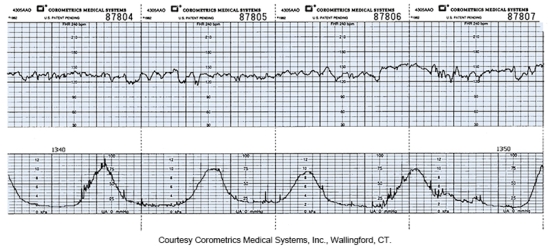
(Multiple Choice)
4.9/5 (80)
(80) The nursing student is planning to assess a fetal heart rate.The registered nurse reminds the student to get gel.Which method of assessing the fetal heart rate is the student planning on conducting?
(Multiple Choice)
4.8/5 (75)
(75) In the low-risk patient assessments for variability and periodic changes if using the fetal monitor should be done how often?
(Multiple Choice)
4.8/5 (76)
(76) A Labor and Delivery nurse knows that four of the five fetal factors that interact to regulate the heart rate are which of the following? (Select all that apply.)
(Multiple Choice)
4.7/5 (81)
(81) The labor nurse is evaluating the patient's most recent 10-minute segment on the monitor strip and notes a late deceleration.This is likely to be caused by which physiologic alterations? (Select all that apply.)
(Multiple Choice)
5.0/5 (71)
(71) Which statement correctly describes the nurse's responsibility related to electronic monitoring?
(Multiple Choice)
4.7/5 (75)
(75) The fetal heart rate baseline increases 15 beats per minute after vibroacoustic stimulation.What action by the nurse is most appropriate?
(Multiple Choice)
4.9/5 (78)
(78) In which situation is a baseline fetal heart rate of 160 to 170 beats per minute considered a normal finding?
(Multiple Choice)
4.7/5 (89)
(89) A student nurse is placing a tocotransducer on a woman for electronic fetal monitoring.What action by the student indicates to the registered nurse that the student understands the procedure?
(Multiple Choice)
5.0/5 (82)
(82) Which of the following factors place the intrapartum woman at risk for complications during labor and delivery? (Select all that apply.)
(Multiple Choice)
4.9/5 (84)
(84) A nurse manager plans staffing for the Labor and Delivery unit.How does the available staff influence the selection of either continuous electronic or intermittent auscultation as the fetal monitoring method?
(Multiple Choice)
4.8/5 (76)
(76) When the mother's membranes rupture during active labor,the fetal heart rate should be observed for the occurrence of which periodic pattern?
(Multiple Choice)
4.9/5 (85)
(85) A new nurse to Labor and Delivery learns about the three categories of fetal heart rate patterns.Which characteristics of the fetal heart belong in Category III? (Select all that apply.)
(Multiple Choice)
4.9/5 (86)
(86) The nurse notes a nonreassuring pattern of the fetal heart rate.The mother is already lying on her left side.What nursing action is indicated?
(Multiple Choice)
4.9/5 (81)
(81) 
Filters
- Essay(0)
- Multiple Choice(0)
- Short Answer(0)
- True False(0)
- Matching(0)