



 Chat with AI
Exam 14: Respiratory System

Exam 1: Cytoplasm24 Questions
Exam 2: Nucleus14 Questions
Exam 3: Extracellular Matrix14 Questions
Exam 4: Epithelium and Glands18 Questions
Exam 5: Connective Tissue12 Questions
Exam 6: Cartilage and Bone22 Questions
Exam 7: Muscle24 Questions
Exam 8: Nervous Tissue23 Questions
Exam 9: Blood and Hemopoiesis29 Questions
Exam 10: Circulatory System14 Questions
Exam 11: Lymphoid Immune System14 Questions
Exam 12: Endocrine System12 Questions
Exam 13: Integument14 Questions
Exam 14: Respiratory System14 Questions
Exam 15: Digestive System: Oral Cavity8 Questions
Exam 16: Digestive System: Alimentary Canal12 Questions
Exam 17: Digestive System: Glands10 Questions
Exam 18: Urinary System6 Questions
Exam 19: Female Reproductive System6 Questions
Exam 20: Male Reproductive System7 Questions
Exam 21: Special Senses2 Questions
Select questions type


A baby who was just born is suffering from respiratory distress of the newborn and is given glucocorticoids to stimulate

Free
(Multiple Choice)
4.9/5  (85)
(85) Correct Answer: Verified
D
The olfactory cells possess olfactory cilia whose terminal ends have
Free
(Multiple Choice)
4.7/5 (86)
(86) Correct Answer:Verified
VerifiedD
The region enclosed by the rectangle is a (an) 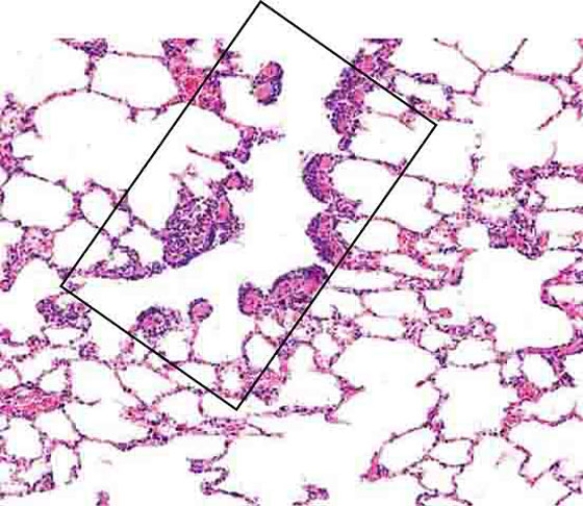
Free
(Multiple Choice)
4.7/5 (78)
(78) Correct Answer:Verified
VerifiedC
A patient is brought into the emergency department because she is bleeding from the Kiesselbach area. Blood is apparent on (in) the patient's
(Multiple Choice)
4.8/5 (73)
(73) Patients with emphysema have a reduced amount of 1-antitrypsin. This protein functions in
(Multiple Choice)
4.8/5 (75)
(75) A patient goes to his allergist for the symptoms of headache, pain below the eyes, toothache affecting the upper teeth, and general malaise. The allergist determines that the patient has an infection of the
(Multiple Choice)
4.9/5 (84)
(84) Oxygen and carbon dioxide crossing between blood and air in the lungs must pass through cells of the following types:
(Multiple Choice)
4.8/5 (72)
(72) 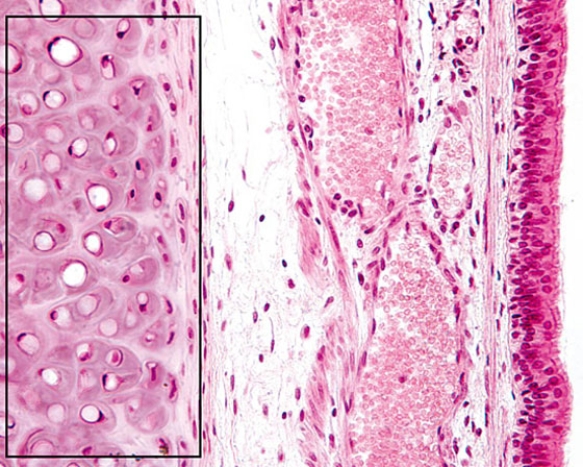
In which of the following structures is ciliated pseudostratified columnar epithelium not found?
(Multiple Choice)
4.9/5 (91)
(91) Pneumocytes II (type II pneumocytes) are responsible for which of the following?
(Multiple Choice)
4.9/5 (76)
(76) Which of following structures belongs to the respiratory (as opposed to the conducting) portion of the respiratory system?
(Multiple Choice)
4.9/5 (66)
(66) Patients who are in the last phase of poliomyelitis, myasthenia gravis, and Guillain-Barré syndrome usually die of respiratory failure because their
(Multiple Choice)
4.8/5 (75)
(75) 
Filters
- Essay(0)
- Multiple Choice(0)
- Short Answer(0)
- True False(0)
- Matching(0)