



 Chat with AI
Exam 16: Digestive System: Alimentary Canal

Exam 1: Cytoplasm24 Questions
Exam 2: Nucleus14 Questions
Exam 3: Extracellular Matrix14 Questions
Exam 4: Epithelium and Glands18 Questions
Exam 5: Connective Tissue12 Questions
Exam 6: Cartilage and Bone22 Questions
Exam 7: Muscle24 Questions
Exam 8: Nervous Tissue23 Questions
Exam 9: Blood and Hemopoiesis29 Questions
Exam 10: Circulatory System14 Questions
Exam 11: Lymphoid Immune System14 Questions
Exam 12: Endocrine System12 Questions
Exam 13: Integument14 Questions
Exam 14: Respiratory System14 Questions
Exam 15: Digestive System: Oral Cavity8 Questions
Exam 16: Digestive System: Alimentary Canal12 Questions
Exam 17: Digestive System: Glands10 Questions
Exam 18: Urinary System6 Questions
Exam 19: Female Reproductive System6 Questions
Exam 20: Male Reproductive System7 Questions
Exam 21: Special Senses2 Questions
Select questions type


A patient has Barrett syndrome. The physician should be examining his

Free
(Multiple Choice)
5.0/5  (70)
(70) Correct Answer: Verified
A
Which of the following cells is present in the mucosa of the stomach and manufactures visible mucus?
Free
(Multiple Choice)
4.9/5 (77)
(77) Correct Answer:Verified
VerifiedA
An old patient has a low-grade fever, copious, severe abdominal cramps, and a copious watery diarrhea. The physician believes his condition to be pseudomembranous colitis, an infection caused by bacteria of the genus
Free
(Multiple Choice)
4.8/5 (87)
(87) Correct Answer:Verified
VerifiedA
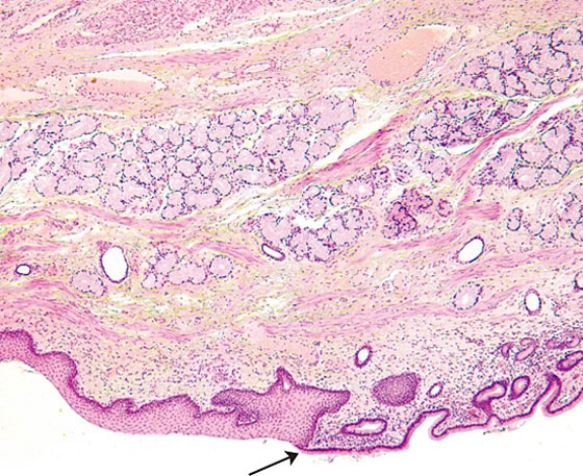
In Fig. Img_005a, a patient presents with an ulcer.This photomicrograph shows a healthy area of the ulcerated organ. Where is this patient's ulcer located? 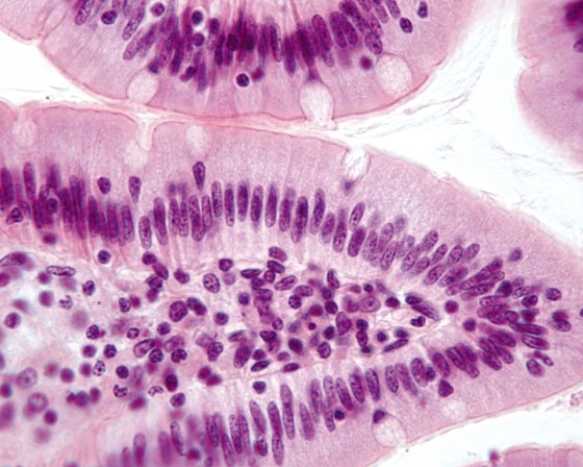
(Multiple Choice)
4.7/5 (75)
(75) 
A patient who has appendicitis does not have which one of the following symptoms?
(Multiple Choice)
4.8/5 (75)
(75) A patient with pernicious anemia has vitamin B12 deficiency. The reason for the deficiency is lack of gastric intrinsic factor (GIF). The cell that secretes GIF is
(Multiple Choice)
4.9/5 (85)
(85) 
Filters
- Essay(0)
- Multiple Choice(0)
- Short Answer(0)
- True False(0)
- Matching(0)