



 Chat with AI
Exam 10: Photosynthesis

Exam 1: Biology and the Tree of Life37 Questions
Exam 2: Water and Carbon: the Chemical Basis of Life59 Questions
Exam 3: Protein Structure and Function59 Questions
Exam 4: Nucleic Acids and the Rna World43 Questions
Exam 5: An Introduction to Carbohydrates44 Questions
Exam 53: Ecosystems and Global Ecology57 Questions
Exam 6: Lipids, Membranes, and the First Cells59 Questions
Exam 7: Inside the Cell60 Questions
Exam 8: Energy and Enzymes: an Introduction to Metabolism60 Questions
Exam 9: Cellular Respiration and Fermentation61 Questions
Exam 10: Photosynthesis58 Questions
Exam 11: Cellcell Interactions52 Questions
Exam 12: The Cell Cycle59 Questions
Exam 13: Meiosis63 Questions
Exam 14: Mendel and the Gene60 Questions
Exam 15: Dna and the Gene: Synthesis and Repair51 Questions
Exam 16: How Genes Work48 Questions
Exam 17: Transcription, Rna Processing, and Translation58 Questions
Exam 18: Control of Gene Expression in Bacteria29 Questions
Exam 19: Control of Gene Expression in Eukaryotes56 Questions
Exam 20: The Molecular Revolution: Biotechnology and Beyond70 Questions
Exam 21: Genes, Development, and Evolution38 Questions
Exam 22: Evolution by Natural Selection38 Questions
Exam 23: Evolutionary Processes37 Questions
Exam 24: Speciation56 Questions
Exam 25: Phylogenies and the History of Life63 Questions
Exam 26: Bacteria and Archaea38 Questions
Exam 27: Protists37 Questions
Exam 28: Green Algae and Land Plants59 Questions
Exam 29: Fungi47 Questions
Exam 30: An Introduction to Animals48 Questions
Exam 31: Protostome Animals54 Questions
Exam 32: Deuterostome Animals60 Questions
Exam 33: Viruses44 Questions
Exam 34: Plant Form and Function46 Questions
Exam 35: Water and Sugar Transport in Plants47 Questions
Exam 36: Plant Nutrition54 Questions
Exam 37: Plant Sensory Systems, Signals, and Responses48 Questions
Exam 38: Plant Reproduction and Development51 Questions
Exam 39: Animal Form and Function53 Questions
Exam 40: Water and Electrolyte Balance in Animals60 Questions
Exam 41: Animal Nutrition94 Questions
Exam 42: Gas Exchange and Circulation93 Questions
Exam 43: Animal Nervous Systems100 Questions
Exam 44: Animal Sensory Systems50 Questions
Exam 45: Animal Movement40 Questions
Exam 46: Chemical Signals in Animals59 Questions
Exam 47: Animal Reproduction and Development104 Questions
Exam 48: The Immune System in Animals77 Questions
Exam 49: An Introduction to Ecology40 Questions
Exam 50: Behavioral Ecology40 Questions
Exam 51: Population Ecology57 Questions
Exam 52: Community Ecology55 Questions
Exam 54: Biodiversity and Conservation Biology43 Questions
Select questions type


Which of the following statements best represents the relationships between the light reactions and the Calvin cycle?
(Multiple Choice)
5.0/5  (64)
(64) Carotenoids are often found in foods that are considered to have antioxidant properties in human nutrition. What related function do they have in plants?
(Multiple Choice)
4.7/5 (75)
(75) In autumn, the leaves of deciduous trees change colors. This is because chlorophyll is degraded and ________.
(Multiple Choice)
4.9/5 (95)
(95) The pH of the inner thylakoid space has been measured, as have the pH of the stroma and of the cytosol of a particular plant cell. Which, if any, relationship would you expect to find?
(Multiple Choice)
4.9/5 (84)
(84) In photosynthetic cells, synthesis of ATP by the chemiosmotic mechanism occurs during ________.
(Multiple Choice)
4.8/5 (68)
(68) The chemiosmotic process in chloroplasts involves the ________.
(Multiple Choice)
4.8/5 (78)
(78) The light-independent reactions of plants function to make organic molecules using carbon dioxide as a carbon source. What is the electron source that helps reduce carbon dioxide to sugars and other organic molecules?
(Multiple Choice)
4.7/5 (77)
(77) Why are there several structurally different pigments in the reaction centers of photosystems?
(Multiple Choice)
4.9/5 (87)
(87) P680+ is said to be the strongest biological oxidizing agent. Given its function, why is this necessary?
(Multiple Choice)
4.9/5 (80)
(80) What event accompanies energy absorption by chlorophyll (or other pigment molecules of the antenna complex)?
(Multiple Choice)
4.8/5 (83)
(83) Use the following information to answer the question(s) below.
A spaceship is designed to support animal life for a multiyear voyage to the outer planets of the solar system. Plants will be grown to provide oxygen and to recycle carbon dioxide. Since the spaceship will be too far from the Sun for photosynthesis, an artificial light source will be needed.
-What would be the expected effect on plants if the atmospheric CO2 concentration was doubled?
(Multiple Choice)
4.8/5 (83)
(83) Where do the enzymatic reactions of the Calvin cycle take place?
(Multiple Choice)
4.9/5 (86)
(86) Use the accompanying figure and the molecules labeled A, B, C, D, and E to answer the following questions. 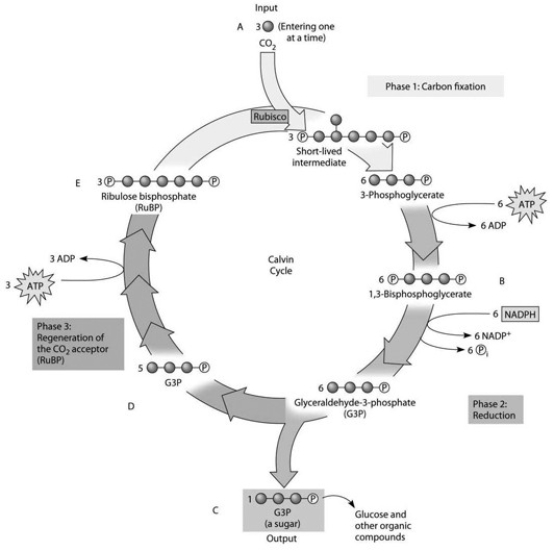 Refer to the figure. To identify the molecule that accepts CO2, Calvin and Benson manipulated the carbon-fixation cycle by either cutting off CO2 or cutting off light from cultures of photosynthetic algae. They then measured the concentrations of various metabolites immediately following the manipulation. How would these experiments help identify the CO2 acceptor?
 (Multiple Choice)
4.9/5 (80)
(80) Which of the events listed below occurs in the light reactions of photosynthesis?
(Multiple Choice)
4.9/5 (89)
(89) CAM plants keep stomata closed in the daytime, thus reducing loss of water. They can do this because they ________.
(Multiple Choice)
4.9/5 (72)
(72) As a research scientist, you measure the amount of ATP and NADPH consumed by the Calvin cycle in 1 hour. You find that 30,000 molecules of ATP were consumed, but only 20,000 molecules of NADPH were consumed. Where did the extra ATP molecules come from?
(Multiple Choice)
4.9/5 (76)
(76) 
Filters
- Essay(0)
- Multiple Choice(0)
- Short Answer(0)
- True False(0)
- Matching(0)