



 Chat with AI
Exam 10: Photosynthesis

Exam 1: Biology and the Tree of Life37 Questions
Exam 2: Water and Carbon: the Chemical Basis of Life59 Questions
Exam 3: Protein Structure and Function59 Questions
Exam 4: Nucleic Acids and the Rna World43 Questions
Exam 5: An Introduction to Carbohydrates44 Questions
Exam 53: Ecosystems and Global Ecology57 Questions
Exam 6: Lipids, Membranes, and the First Cells59 Questions
Exam 7: Inside the Cell60 Questions
Exam 8: Energy and Enzymes: an Introduction to Metabolism60 Questions
Exam 9: Cellular Respiration and Fermentation61 Questions
Exam 10: Photosynthesis58 Questions
Exam 11: Cellcell Interactions52 Questions
Exam 12: The Cell Cycle59 Questions
Exam 13: Meiosis63 Questions
Exam 14: Mendel and the Gene60 Questions
Exam 15: Dna and the Gene: Synthesis and Repair51 Questions
Exam 16: How Genes Work48 Questions
Exam 17: Transcription, Rna Processing, and Translation58 Questions
Exam 18: Control of Gene Expression in Bacteria29 Questions
Exam 19: Control of Gene Expression in Eukaryotes56 Questions
Exam 20: The Molecular Revolution: Biotechnology and Beyond70 Questions
Exam 21: Genes, Development, and Evolution38 Questions
Exam 22: Evolution by Natural Selection38 Questions
Exam 23: Evolutionary Processes37 Questions
Exam 24: Speciation56 Questions
Exam 25: Phylogenies and the History of Life63 Questions
Exam 26: Bacteria and Archaea38 Questions
Exam 27: Protists37 Questions
Exam 28: Green Algae and Land Plants59 Questions
Exam 29: Fungi47 Questions
Exam 30: An Introduction to Animals48 Questions
Exam 31: Protostome Animals54 Questions
Exam 32: Deuterostome Animals60 Questions
Exam 33: Viruses44 Questions
Exam 34: Plant Form and Function46 Questions
Exam 35: Water and Sugar Transport in Plants47 Questions
Exam 36: Plant Nutrition54 Questions
Exam 37: Plant Sensory Systems, Signals, and Responses48 Questions
Exam 38: Plant Reproduction and Development51 Questions
Exam 39: Animal Form and Function53 Questions
Exam 40: Water and Electrolyte Balance in Animals60 Questions
Exam 41: Animal Nutrition94 Questions
Exam 42: Gas Exchange and Circulation93 Questions
Exam 43: Animal Nervous Systems100 Questions
Exam 44: Animal Sensory Systems50 Questions
Exam 45: Animal Movement40 Questions
Exam 46: Chemical Signals in Animals59 Questions
Exam 47: Animal Reproduction and Development104 Questions
Exam 48: The Immune System in Animals77 Questions
Exam 49: An Introduction to Ecology40 Questions
Exam 50: Behavioral Ecology40 Questions
Exam 51: Population Ecology57 Questions
Exam 52: Community Ecology55 Questions
Exam 54: Biodiversity and Conservation Biology43 Questions
Select questions type


In mitochondria, chemiosmosis moves protons from the matrix into the intermembrane space, whereas in chloroplasts, chemiosmosis moves protons from the ________.
(Multiple Choice)
4.7/5  (79)
(79) How are the light-dependent and light-independent reactions of photosynthesis related?
(Multiple Choice)
4.8/5 (84)
(84) Which of the following statements best describes the relationship between photosynthesis and respiration?
(Multiple Choice)
4.9/5 (91)
(91) A flask containing photosynthetic green algae and a control flask containing water with no algae are both placed under a bank of lights, which are set to cycle between 12 hours of light and 12 hours of dark. The dissolved oxygen concentrations in both flasks are monitored. Predict what the relative dissolved oxygen concentrations will be in the flask with algae compared to the control flask. The dissolved oxygen in the flask with algae will ________.
(Multiple Choice)
4.9/5 (92)
(92) Plastoquinone (PQ), an electron carrier of small molecular weight, is found in the electron transport chain associated with photosystem II. If PQ is not directly anchored to other membrane or cytoplasmic structures, it is probably ________.
(Multiple Choice)
4.7/5 (93)
(93) Suppose a plant has a unique photosynthetic pigment and the leaves of this plant appear to be reddish yellow. What wavelengths of visible light are absorbed by this pigment?
(Multiple Choice)
4.9/5 (85)
(85) Which statement describes the functioning of photosystem II?
(Multiple Choice)
4.7/5 (83)
(83) The phylogenetic distribution of the enzyme rubisco is limited to ________.
(Multiple Choice)
5.0/5 (85)
(85) Use the accompanying figure to answer the question(s) below. 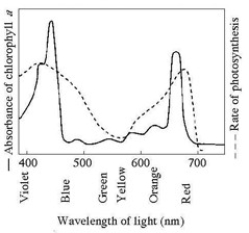 -The proteins of the electron transport chain active in the light-dependent reactions ________.
 (Multiple Choice)
4.8/5 (78)
(78) Use the accompanying figure to answer the question(s) below.
-What is the difference between NAD+ and NADP?
-What is the difference between NAD+ and NADP? (Multiple Choice)
4.8/5 (84)
(84) What is the main purpose of light-dependent reactions of photosynthesis?
(Multiple Choice)
4.9/5 (75)
(75) Assume a thylakoid is somehow punctured so that the interior of the thylakoid is no longer separated from the stroma. This damage will most directly affect the ________.
(Multiple Choice)
4.8/5 (82)
(82) Use the following information to answer the question(s) below.
A spaceship is designed to support animal life for a multiyear voyage to the outer planets of the solar system. Plants will be grown to provide oxygen and to recycle carbon dioxide. Since the spaceship will be too far from the Sun for photosynthesis, an artificial light source will be needed.
-If the power fails and the lights go dark, CO2 levels will ________.
(Multiple Choice)
4.8/5 (81)
(81) When oxygen is released as a result of photosynthesis, it is a direct by-product of ________.
(Multiple Choice)
4.9/5 (81)
(81) Use the accompanying figure and the molecules labeled A, B, C, D, and E to answer the following question. 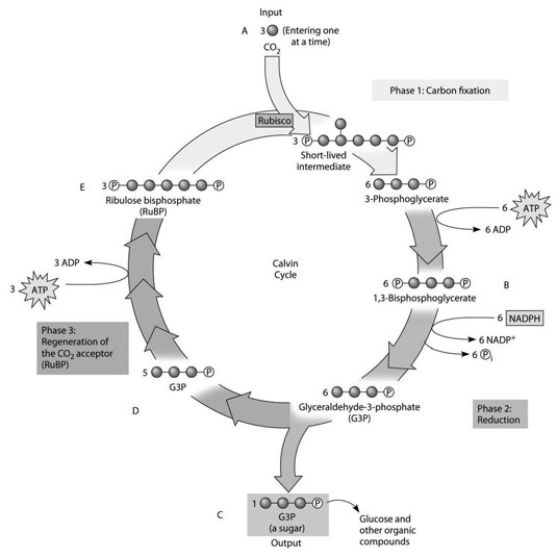 Refer to the figure. If the carbon atom of each of the incoming CO2 molecules is labeled with a radioactive isotope of carbon, which organic molecules will be radioactively labeled after one cycle?
 (Multiple Choice)
4.8/5 (79)
(79) Use the following information to answer the question below.
Theodor W. Engelmann illuminated a filament of algae with light that passed through a prism, thus exposing different segments of algae to different wavelengths of light. He added aerobic bacteria and then noted in which areas the bacteria congregated. He noted that the largest groups were found in the areas illuminated by the red and blue light.
If you ran the same experiment as Engelmann without passing light through a prism, what would you predict?
(Multiple Choice)
4.8/5 (83)
(83) Suppose the interior of the thylakoids of isolated chloroplasts were made acidic and then transferred in the dark to a pH 8 solution. What would most likely happen?
(Multiple Choice)
4.7/5 (84)
(84) The accumulation of free oxygen in Earth's atmosphere began with the origin of ________.
(Multiple Choice)
4.9/5 (84)
(84) If photosynthesizing green algae are provided with CO2 containing heavy oxygen (18O), later analysis will show that all of the following molecules produced by the algae contain 18O EXCEPT ________.
(Multiple Choice)
4.8/5 (79)
(79) 
Filters
- Essay(0)
- Multiple Choice(0)
- Short Answer(0)
- True False(0)
- Matching(0)