



 Chat with AI
Exam 12: The Cell Cycle

Exam 1: Biology and the Tree of Life37 Questions
Exam 2: Water and Carbon: the Chemical Basis of Life59 Questions
Exam 3: Protein Structure and Function59 Questions
Exam 4: Nucleic Acids and the Rna World43 Questions
Exam 5: An Introduction to Carbohydrates44 Questions
Exam 53: Ecosystems and Global Ecology57 Questions
Exam 6: Lipids, Membranes, and the First Cells59 Questions
Exam 7: Inside the Cell60 Questions
Exam 8: Energy and Enzymes: an Introduction to Metabolism60 Questions
Exam 9: Cellular Respiration and Fermentation61 Questions
Exam 10: Photosynthesis58 Questions
Exam 11: Cellcell Interactions52 Questions
Exam 12: The Cell Cycle59 Questions
Exam 13: Meiosis63 Questions
Exam 14: Mendel and the Gene60 Questions
Exam 15: Dna and the Gene: Synthesis and Repair51 Questions
Exam 16: How Genes Work48 Questions
Exam 17: Transcription, Rna Processing, and Translation58 Questions
Exam 18: Control of Gene Expression in Bacteria29 Questions
Exam 19: Control of Gene Expression in Eukaryotes56 Questions
Exam 20: The Molecular Revolution: Biotechnology and Beyond70 Questions
Exam 21: Genes, Development, and Evolution38 Questions
Exam 22: Evolution by Natural Selection38 Questions
Exam 23: Evolutionary Processes37 Questions
Exam 24: Speciation56 Questions
Exam 25: Phylogenies and the History of Life63 Questions
Exam 26: Bacteria and Archaea38 Questions
Exam 27: Protists37 Questions
Exam 28: Green Algae and Land Plants59 Questions
Exam 29: Fungi47 Questions
Exam 30: An Introduction to Animals48 Questions
Exam 31: Protostome Animals54 Questions
Exam 32: Deuterostome Animals60 Questions
Exam 33: Viruses44 Questions
Exam 34: Plant Form and Function46 Questions
Exam 35: Water and Sugar Transport in Plants47 Questions
Exam 36: Plant Nutrition54 Questions
Exam 37: Plant Sensory Systems, Signals, and Responses48 Questions
Exam 38: Plant Reproduction and Development51 Questions
Exam 39: Animal Form and Function53 Questions
Exam 40: Water and Electrolyte Balance in Animals60 Questions
Exam 41: Animal Nutrition94 Questions
Exam 42: Gas Exchange and Circulation93 Questions
Exam 43: Animal Nervous Systems100 Questions
Exam 44: Animal Sensory Systems50 Questions
Exam 45: Animal Movement40 Questions
Exam 46: Chemical Signals in Animals59 Questions
Exam 47: Animal Reproduction and Development104 Questions
Exam 48: The Immune System in Animals77 Questions
Exam 49: An Introduction to Ecology40 Questions
Exam 50: Behavioral Ecology40 Questions
Exam 51: Population Ecology57 Questions
Exam 52: Community Ecology55 Questions
Exam 54: Biodiversity and Conservation Biology43 Questions
Select questions type


Use the data in the accompanying table to answer the following question(s).
-The best conclusion concerning delta is that the cells ________.
(Multiple Choice)
4.8/5  (73)
(73) Which cytoskeletal proteins are important constituents of the contractile structures that form the cleavage furrows involved in animal cell cytokinesis?
(Multiple Choice)
4.9/5 (85)
(85) Through a microscope, you can see a cell plate beginning to develop across the middle of a cell and nuclei forming on either side of the cell plate. This cell is most likely ________.
(Multiple Choice)
4.9/5 (86)
(86) Kinetochore microtubules assist in the process of splitting centromeres by ________.
(Multiple Choice)
4.7/5 (72)
(72) Use the following information to answer the question(s) below.
Nucleotides can be radiolabeled before they are incorporated into newly forming DNA and, therefore, can be assayed to track their incorporation. In a set of experiments, a student-faculty research team used labeled T nucleotides and introduced these into the culture of dividing human cells at specific times.
-In eukaryotic cells, chromosomes are composed of ________.
(Multiple Choice)
4.9/5 (72)
(72) 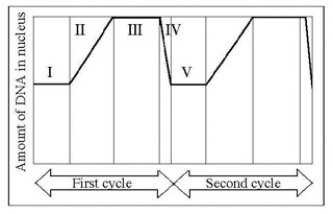 -In the accompanying figure, MPF reaches its highest concentration during this stage.
 (Multiple Choice)
4.9/5 (76)
(76) Movement of the chromosomes during anaphase would be most affected by a drug that prevents ________.
(Multiple Choice)
4.8/5 (67)
(67) If there are 20 chromatids in a cell, how many centromeres are there?
(Multiple Choice)
4.9/5 (78)
(78) Scientists isolate cells in various phases of the cell cycle. They find a group of cells that have  times more DNA than G1 phase cells. The cells of this group are ________.
 (Multiple Choice)
4.9/5 (76)
(76) Vinblastine is a standard chemotherapeutic drug used to treat cancer. Because it interferes with the assembly of microtubules, its effectiveness must be related to ________.
(Multiple Choice)
4.8/5 (79)
(79) Which of the following are primarily responsible for cytokinesis in plant cells but not in animal cells?
(Multiple Choice)
4.9/5 (87)
(87) Myosin is a motor protein involved in animal cell cytokinesis. It binds to ATP or ADP, causing the myosin to move with respect to actin. What is the effect of the interaction between myosin and actin?
(Multiple Choice)
4.8/5 (73)
(73) In human and many other eukaryotic species' cells, the nuclear membrane has to disappear to permit ________.
(Multiple Choice)
4.8/5 (86)
(86) The following question(s) are based on the accompanying figure. 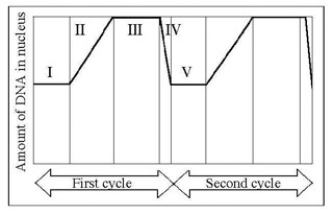 -In the figure, at which of the numbered regions would you expect to find cells at metaphase?
 (Multiple Choice)
4.9/5 (84)
(84) The following question(s) are based on the accompanying figure.
-In the figure, G1 is represented by which numbered part(s) of the cycle?
-In the figure, G1 is represented by which numbered part(s) of the cycle? (Multiple Choice)
4.9/5 (79)
(79) At which phase are centrioles beginning to move apart in animal cells?
(Multiple Choice)
4.9/5 (81)
(81) What happens if MPF (mitosis-promoting factor) is introduced into immature frog oocytes that are arrested in G2?
(Multiple Choice)
4.9/5 (69)
(69) Use the data in the accompanying table to answer the following question(s).
-Of the following, the best conclusion concerning the difference between the S phases for beta and gamma is that ________.
(Multiple Choice)
5.0/5 (90)
(90) 
Filters
- Essay(0)
- Multiple Choice(0)
- Short Answer(0)
- True False(0)
- Matching(0)