



 Chat with AI
Exam 12: The Cell Cycle

Exam 1: Biology and the Tree of Life37 Questions
Exam 2: Water and Carbon: the Chemical Basis of Life59 Questions
Exam 3: Protein Structure and Function59 Questions
Exam 4: Nucleic Acids and the Rna World43 Questions
Exam 5: An Introduction to Carbohydrates44 Questions
Exam 53: Ecosystems and Global Ecology57 Questions
Exam 6: Lipids, Membranes, and the First Cells59 Questions
Exam 7: Inside the Cell60 Questions
Exam 8: Energy and Enzymes: an Introduction to Metabolism60 Questions
Exam 9: Cellular Respiration and Fermentation61 Questions
Exam 10: Photosynthesis58 Questions
Exam 11: Cellcell Interactions52 Questions
Exam 12: The Cell Cycle59 Questions
Exam 13: Meiosis63 Questions
Exam 14: Mendel and the Gene60 Questions
Exam 15: Dna and the Gene: Synthesis and Repair51 Questions
Exam 16: How Genes Work48 Questions
Exam 17: Transcription, Rna Processing, and Translation58 Questions
Exam 18: Control of Gene Expression in Bacteria29 Questions
Exam 19: Control of Gene Expression in Eukaryotes56 Questions
Exam 20: The Molecular Revolution: Biotechnology and Beyond70 Questions
Exam 21: Genes, Development, and Evolution38 Questions
Exam 22: Evolution by Natural Selection38 Questions
Exam 23: Evolutionary Processes37 Questions
Exam 24: Speciation56 Questions
Exam 25: Phylogenies and the History of Life63 Questions
Exam 26: Bacteria and Archaea38 Questions
Exam 27: Protists37 Questions
Exam 28: Green Algae and Land Plants59 Questions
Exam 29: Fungi47 Questions
Exam 30: An Introduction to Animals48 Questions
Exam 31: Protostome Animals54 Questions
Exam 32: Deuterostome Animals60 Questions
Exam 33: Viruses44 Questions
Exam 34: Plant Form and Function46 Questions
Exam 35: Water and Sugar Transport in Plants47 Questions
Exam 36: Plant Nutrition54 Questions
Exam 37: Plant Sensory Systems, Signals, and Responses48 Questions
Exam 38: Plant Reproduction and Development51 Questions
Exam 39: Animal Form and Function53 Questions
Exam 40: Water and Electrolyte Balance in Animals60 Questions
Exam 41: Animal Nutrition94 Questions
Exam 42: Gas Exchange and Circulation93 Questions
Exam 43: Animal Nervous Systems100 Questions
Exam 44: Animal Sensory Systems50 Questions
Exam 45: Animal Movement40 Questions
Exam 46: Chemical Signals in Animals59 Questions
Exam 47: Animal Reproduction and Development104 Questions
Exam 48: The Immune System in Animals77 Questions
Exam 49: An Introduction to Ecology40 Questions
Exam 50: Behavioral Ecology40 Questions
Exam 51: Population Ecology57 Questions
Exam 52: Community Ecology55 Questions
Exam 54: Biodiversity and Conservation Biology43 Questions
Select questions type


Use the following information to answer the question(s) below.
Nucleotides can be radiolabeled before they are incorporated into newly forming DNA and, therefore, can be assayed to track their incorporation. In a set of experiments, a student-faculty research team used labeled T nucleotides and introduced these into the culture of dividing human cells at specific times.
-Which of the following questions might be answered by using the method described?
(Multiple Choice)
4.7/5  (83)
(83) The following question(s) are based on the accompanying figure. 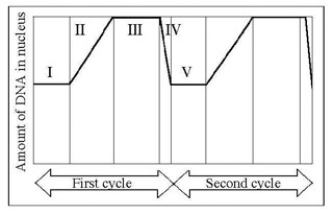 -In the figure, which number represents DNA synthesis?
 (Multiple Choice)
4.8/5 (86)
(86) Use the following information to answer the question(s) below.
Nucleotides can be radiolabeled before they are incorporated into newly forming DNA and, therefore, can be assayed to track their incorporation. In a set of experiments, a student-faculty research team used labeled T nucleotides and introduced these into the culture of dividing human cells at specific times.
-The research team used their experiments to study the incorporation of labeled nucleotides into a culture of lymphocytes and found that the lymphocytes incorporated the labeled nucleotide at a significantly higher level after a pathogen was introduced into the culture. They concluded that ________.
(Multiple Choice)
4.9/5 (79)
(79) Proteins that are involved in the regulation of the cell cycle and that show fluctuations in concentration during the cell cycle are called ________.
(Multiple Choice)
4.7/5 (81)
(81) Some cells have several nuclei per cell. How could such multinucleated cells be explained?
(Multiple Choice)
4.8/5 (68)
(68) The cancer-causing forms of the Ras protein are involved in which of the following processes?
(Multiple Choice)
4.8/5 (79)
(79) 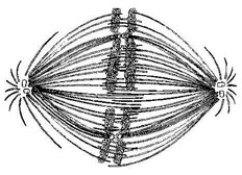 If the cell whose nuclear material is shown in the accompanying figure continues toward completion of mitosis, which of the following events would occur next?
 (Multiple Choice)
4.8/5 (89)
(89) Starting with a fertilized egg (zygote), a series of five cell divisions would produce an early embryo with how many cells?
(Multiple Choice)
5.0/5 (86)
(86) Regulatory proteins that prevent a cell from entering the S phase under conditions of DNA damage are also known as ________.
(Multiple Choice)
4.9/5 (92)
(92) Once a cell completes mitosis, molecular division triggers must be turned off. What happens to MPF during mitosis?
(Multiple Choice)
4.8/5 (86)
(86) If a cell has accumulated DNA damage, it is unlikely to ________.
(Multiple Choice)
4.8/5 (91)
(91) Taxol is an anticancer drug extracted from the Pacific yew tree. In animal cells, Taxol disrupts microtubule formation. Surprisingly, this stops mitosis. Specifically, Taxol must affect ________.
(Multiple Choice)
4.8/5 (81)
(81) In the cells of some organisms, mitosis occurs without cytokinesis. This results in ________.
(Multiple Choice)
4.7/5 (77)
(77) Researchers pulsed rapidly dividing cultured cells with radioactive thymidine for 30 minutes. The cells were then exposed to a solution containing non-radiolabeled thymidine. Cells were analyzed at 2-hour intervals. At the 2-hour time point, no cells appeared to be dividing. Only after 4 hours did some labeled cells appear to be in M phase. This result can be explained in the following way:
(Multiple Choice)
4.9/5 (80)
(80) The following question(s) are based on the accompanying figure.
-In the figure, which number represents the point in the cell cycle during which the chromosomes are replicated?
-In the figure, which number represents the point in the cell cycle during which the chromosomes are replicated? (Multiple Choice)
4.8/5 (63)
(63) The microtubule-organizing center found in animal cells is an identifiable structure present during all phases of the cell cycle. Specifically, it is known as the ________.
(Multiple Choice)
4.8/5 (62)
(62) Exposure of zebrafish nuclei to meiotic cytosol resulted in phosphorylation of NEP55 and L68 proteins by cyclin-dependent kinase 2. NEP55 is a protein of the inner nuclear membrane, and L68 is a protein of the nuclear lamina. What is the most likely role of phosphorylation of these proteins in the process of mitosis?
(Multiple Choice)
4.9/5 (84)
(84) 
Filters
- Essay(0)
- Multiple Choice(0)
- Short Answer(0)
- True False(0)
- Matching(0)