



 Chat with AI
Exam 14: Mendel and the Gene

Exam 1: Biology and the Tree of Life37 Questions
Exam 2: Water and Carbon: the Chemical Basis of Life59 Questions
Exam 3: Protein Structure and Function59 Questions
Exam 4: Nucleic Acids and the Rna World43 Questions
Exam 5: An Introduction to Carbohydrates44 Questions
Exam 53: Ecosystems and Global Ecology57 Questions
Exam 6: Lipids, Membranes, and the First Cells59 Questions
Exam 7: Inside the Cell60 Questions
Exam 8: Energy and Enzymes: an Introduction to Metabolism60 Questions
Exam 9: Cellular Respiration and Fermentation61 Questions
Exam 10: Photosynthesis58 Questions
Exam 11: Cellcell Interactions52 Questions
Exam 12: The Cell Cycle59 Questions
Exam 13: Meiosis63 Questions
Exam 14: Mendel and the Gene60 Questions
Exam 15: Dna and the Gene: Synthesis and Repair51 Questions
Exam 16: How Genes Work48 Questions
Exam 17: Transcription, Rna Processing, and Translation58 Questions
Exam 18: Control of Gene Expression in Bacteria29 Questions
Exam 19: Control of Gene Expression in Eukaryotes56 Questions
Exam 20: The Molecular Revolution: Biotechnology and Beyond70 Questions
Exam 21: Genes, Development, and Evolution38 Questions
Exam 22: Evolution by Natural Selection38 Questions
Exam 23: Evolutionary Processes37 Questions
Exam 24: Speciation56 Questions
Exam 25: Phylogenies and the History of Life63 Questions
Exam 26: Bacteria and Archaea38 Questions
Exam 27: Protists37 Questions
Exam 28: Green Algae and Land Plants59 Questions
Exam 29: Fungi47 Questions
Exam 30: An Introduction to Animals48 Questions
Exam 31: Protostome Animals54 Questions
Exam 32: Deuterostome Animals60 Questions
Exam 33: Viruses44 Questions
Exam 34: Plant Form and Function46 Questions
Exam 35: Water and Sugar Transport in Plants47 Questions
Exam 36: Plant Nutrition54 Questions
Exam 37: Plant Sensory Systems, Signals, and Responses48 Questions
Exam 38: Plant Reproduction and Development51 Questions
Exam 39: Animal Form and Function53 Questions
Exam 40: Water and Electrolyte Balance in Animals60 Questions
Exam 41: Animal Nutrition94 Questions
Exam 42: Gas Exchange and Circulation93 Questions
Exam 43: Animal Nervous Systems100 Questions
Exam 44: Animal Sensory Systems50 Questions
Exam 45: Animal Movement40 Questions
Exam 46: Chemical Signals in Animals59 Questions
Exam 47: Animal Reproduction and Development104 Questions
Exam 48: The Immune System in Animals77 Questions
Exam 49: An Introduction to Ecology40 Questions
Exam 50: Behavioral Ecology40 Questions
Exam 51: Population Ecology57 Questions
Exam 52: Community Ecology55 Questions
Exam 54: Biodiversity and Conservation Biology43 Questions
Select questions type


In rabbits, the homozygous CC is normal, Cc results in deformed legs, and cc results in very short legs. The genotype BB produces black fur, Bb brown fur, and bb white fur. If a cross is made between brown rabbits with deformed legs and white rabbits with deformed legs, what percentage of the offspring would be expected to have deformed legs and white fur?
(Multiple Choice)
4.8/5  (85)
(85) When Thomas Hunt Morgan crossed his red-eyed F1 generation flies to each other, the F2 generation included both red- and white-eyed flies. Remarkably, all the white-eyed flies were male. What was the explanation for this result?
(Multiple Choice)
4.8/5 (81)
(81) Which of the following describes the ability of a single allele to have multiple phenotypic effects?
(Multiple Choice)
4.9/5 (79)
(79) The accompanying figure shows the pedigree for a family. Dark-shaded symbols represent individuals with one of the two major types of colon cancer. Numbers under the symbols are the individual's age at the time of diagnosis. Males are represented by squares, females by circles. 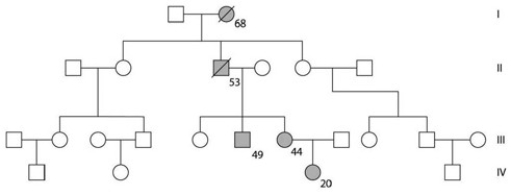 From this pedigree, this trait seems to be inherited ________.
 (Multiple Choice)
5.0/5 (77)
(77) When Mendel crossed yellow-seeded and green-seeded pea plants, all the offspring were yellow seeded. When he took these F1 yellow-seeded plants and crossed them to green-seeded plants, what genotypic ratio was expected?
(Multiple Choice)
4.8/5 (86)
(86) Two plants are crossed, resulting in offspring with a 3:1 ratio for a particular trait. This ratio suggests that ________.
(Multiple Choice)
4.8/5 (86)
(86) The individual with genotype AaBbCCDdEE can make many kinds of gametes. Which of the following is the major reason?
(Multiple Choice)
4.7/5 (78)
(78) Different ratios occur in crosses with single gene pairs or two gene pairs. What types of ratios are likely to occur in crosses dealing with a single gene pair?
(Multiple Choice)
4.9/5 (95)
(95) Gene S controls the sharpness of spines in a type of cactus. Cactuses with the dominant allele, S, have sharp spines, whereas homozygous recessive ss cactuses have dull spines. At the same time, a second gene, N, determines whether or not cactuses have spines. Homozygous recessive nn cactuses have no spines at all. If doubly heterozygous SsNn cactuses were allowed to self-pollinate, the F2 would segregate in which of the following ratios?
(Multiple Choice)
4.8/5 (74)
(74) Mendel's observation of the segregation of alleles in gamete formation has its basis in which of the following phases of cell division?
(Multiple Choice)
4.7/5 (75)
(75) Hydrangea plants of the same genotype are planted in a large flower garden. Some of the plants produce blue flowers and others pink flowers. This can be best explained by which of the following?
(Multiple Choice)
4.8/5 (78)
(78) In the cross AaBbCc × AaBbCc, what is the probability of producing the genotype AABBCC?
(Multiple Choice)
4.9/5 (93)
(93) When crossing an organism that is homozygous recessive for a single trait with a heterozygote, what is the chance of producing an offspring with the homozygous recessive phenotype?
(Multiple Choice)
4.9/5 (86)
(86) Radish flowers may be red, purple, or white. The part of the radish we eat may be oval or long. A cross between a red-flowered long radish plant and a white-flowered oval radish plant yields all-purple long radish offspring. Then the F1 are crossed. In the resulting F2 generation, which of the following phenotypic ratios would be expected?
(Multiple Choice)
4.9/5 (63)
(63) In cats, black fur color is caused by an X-linked allele; the other allele at this locus causes orange color. The heterozygote is tortoiseshell. What kinds of offspring would you expect from the cross of a black female and an orange male?
(Multiple Choice)
4.8/5 (82)
(82) In cattle, roan coat color (mixed red and white hairs) occurs in the heterozygous (Rr) offspring of red (RR) and white (rr) homozygotes. Which of the following crosses would produce offspring in the ratio of 1 red:2 roan:1 white?
(Multiple Choice)
4.9/5 (73)
(73) Gray seed color in peas is dominant to white. Assume that Mendel conducted a series of experiments where plants with gray seeds were crossed among themselves, and the following progeny were produced: 302 gray and 98 white.
(a) What is the most probable genotype of each parent?
(b) Based on your answer in (a) above, what genotypic and phenotypic ratios are expected in these progeny? (Assume the following symbols: G = gray and g = white.)
(Multiple Choice)
4.8/5 (85)
(85) Cinnabar eyes is a sex-linked, recessive characteristic in fruit flies. If a female having cinnabar eyes is crossed with a wild-type male, what percentage of the F1 males will have cinnabar eyes?
(Multiple Choice)
4.8/5 (74)
(74) What do we mean when we use the terms "monohybrid cross" and "dihybrid cross"?
(Multiple Choice)
4.9/5 (80)
(80) Gene S controls the sharpness of spines in a type of cactus. Cactuses with the dominant allele, S, have sharp spines, whereas homozygous recessive ss cactuses have dull spines. At the same time, a second gene, N, determines whether or not cactuses have spines. Homozygous recessive nn cactuses have no spines at all. A cross between a true-breeding sharp-spined cactus and a spineless cactus would produce ________.
(Multiple Choice)
4.8/5 (78)
(78) 
Filters
- Essay(0)
- Multiple Choice(0)
- Short Answer(0)
- True False(0)
- Matching(0)