



 Chat with AI
Exam 14: Mendel and the Gene

Exam 1: Biology and the Tree of Life37 Questions
Exam 2: Water and Carbon: the Chemical Basis of Life59 Questions
Exam 3: Protein Structure and Function59 Questions
Exam 4: Nucleic Acids and the Rna World43 Questions
Exam 5: An Introduction to Carbohydrates44 Questions
Exam 53: Ecosystems and Global Ecology57 Questions
Exam 6: Lipids, Membranes, and the First Cells59 Questions
Exam 7: Inside the Cell60 Questions
Exam 8: Energy and Enzymes: an Introduction to Metabolism60 Questions
Exam 9: Cellular Respiration and Fermentation61 Questions
Exam 10: Photosynthesis58 Questions
Exam 11: Cellcell Interactions52 Questions
Exam 12: The Cell Cycle59 Questions
Exam 13: Meiosis63 Questions
Exam 14: Mendel and the Gene60 Questions
Exam 15: Dna and the Gene: Synthesis and Repair51 Questions
Exam 16: How Genes Work48 Questions
Exam 17: Transcription, Rna Processing, and Translation58 Questions
Exam 18: Control of Gene Expression in Bacteria29 Questions
Exam 19: Control of Gene Expression in Eukaryotes56 Questions
Exam 20: The Molecular Revolution: Biotechnology and Beyond70 Questions
Exam 21: Genes, Development, and Evolution38 Questions
Exam 22: Evolution by Natural Selection38 Questions
Exam 23: Evolutionary Processes37 Questions
Exam 24: Speciation56 Questions
Exam 25: Phylogenies and the History of Life63 Questions
Exam 26: Bacteria and Archaea38 Questions
Exam 27: Protists37 Questions
Exam 28: Green Algae and Land Plants59 Questions
Exam 29: Fungi47 Questions
Exam 30: An Introduction to Animals48 Questions
Exam 31: Protostome Animals54 Questions
Exam 32: Deuterostome Animals60 Questions
Exam 33: Viruses44 Questions
Exam 34: Plant Form and Function46 Questions
Exam 35: Water and Sugar Transport in Plants47 Questions
Exam 36: Plant Nutrition54 Questions
Exam 37: Plant Sensory Systems, Signals, and Responses48 Questions
Exam 38: Plant Reproduction and Development51 Questions
Exam 39: Animal Form and Function53 Questions
Exam 40: Water and Electrolyte Balance in Animals60 Questions
Exam 41: Animal Nutrition94 Questions
Exam 42: Gas Exchange and Circulation93 Questions
Exam 43: Animal Nervous Systems100 Questions
Exam 44: Animal Sensory Systems50 Questions
Exam 45: Animal Movement40 Questions
Exam 46: Chemical Signals in Animals59 Questions
Exam 47: Animal Reproduction and Development104 Questions
Exam 48: The Immune System in Animals77 Questions
Exam 49: An Introduction to Ecology40 Questions
Exam 50: Behavioral Ecology40 Questions
Exam 51: Population Ecology57 Questions
Exam 52: Community Ecology55 Questions
Exam 54: Biodiversity and Conservation Biology43 Questions
Select questions type


Red-green color blindness is a sex-linked recessive trait in humans. Two people with normal color vision have a color-blind son. What are the genotypes of the parents?
(Multiple Choice)
4.9/5  (82)
(82) In humans, blue eyes are inherited as a recessive autosomal trait and color blindness is an X-linked recessive trait. A woman with blue eyes and normal color vision whose father was color-blind marries a man who also has normal color vision. He has brown eyes, but his mother had blue eyes. Which of the following would you expect to be TRUE for their sons?
(Multiple Choice)
4.9/5 (80)
(80) Which of the following is an example of polygenic inheritance?
(Multiple Choice)
4.9/5 (89)
(89) The following question(s) refer to the pedigree chart in the accompanying figure for a family, some of whose members exhibit the dominant trait, W. Affected individuals are indicated by a dark square or circle. 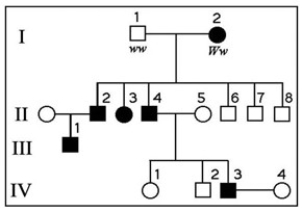 -What is the genotype of individual II-5?
 (Multiple Choice)
4.8/5 (73)
(73) The fact that all seven of the pea plant traits studied by Mendel obeyed the principle of independent assortment most probably indicates which of the following?
(Multiple Choice)
5.0/5 (87)
(87) Given the parents AABBCc × AabbCc, assume simple dominance for each trait and independent assortment. What proportion of the progeny will be expected to phenotypically resemble the first parent with genotype AABBCc?
(Multiple Choice)
4.9/5 (84)
(84) Two true-breeding stocks of pea plants are crossed. One parent has red, axial flowers and the other has white, terminal flowers; all F1 individuals have red, axial flowers. The genes for flower color and location assort independently. If 1000 F2 offspring resulted from a dihybrid cross, approximately how many of them would you expect to have red, terminal flowers?
(Multiple Choice)
4.8/5 (69)
(69) How many unique gametes could be produced through independent assortment by an individual with the genotype AaBbCCDdEE?
(Multiple Choice)
4.8/5 (89)
(89) Radish flowers may be red, purple, or white. A cross between a red-flowered plant and a white-flowered plant yields all-purple offspring. The part of the radish we eat may be oval or long, with long being the dominant trait. If true-breeding red long radishes are crossed with true-breeding white oval radishes, the F1 will be expected to be which of the following?
(Multiple Choice)
4.8/5 (67)
(67) A black guinea pig crossed with an albino guinea pig produced twelve black offspring. When the albino was crossed with a second black animal, six blacks and six albinos were obtained. What is the best explanation for this genetic situation?
(Multiple Choice)
4.8/5 (74)
(74) A man has extra digits (six fingers on each hand and six toes on each foot). His wife and their daughter have a normal number of digits. Having extra digits is a dominant trait. The couple's second child has extra digits. What is the probability that their next (third) child will have extra digits?
(Multiple Choice)
4.8/5 (75)
(75) In tigers, a recessive allele causes a white tiger (absence of fur pigmentation). If one phenotypically normal tiger that is heterozygous is mated to another that is phenotypically white, what percentage of their offspring is expected to be white?
(Multiple Choice)
4.9/5 (74)
(74) Mendel crossed yellow-seeded and green-seeded pea plants and then allowed the offspring to self-pollinate to produce an F2 generation. The results were as follows: 6022 yellow and 2001 green (8023 total). The allele for green seeds has what relationship to the allele for yellow seeds?
(Multiple Choice)
4.8/5 (77)
(77) A sexually reproducing animal has two unlinked genes, one for head shape (H) and one for tail length (T). Its genotype is HhTt. Which of the following genotypes is possible in a gamete from this organism?
(Multiple Choice)
4.9/5 (79)
(79) Suppose two AaBbCc individuals are mated. Assuming that the genes are NOT linked, what fraction of the offspring are expected to be homozygous recessive for the three traits?
(Multiple Choice)
4.8/5 (67)
(67) Feather color in budgies is determined by two different genes, Y and B, one for pigment on the outside and one for the inside of the feather. YYBB, YyBB, or YYBb is green; yyBB or yyBb is blue; YYbb or Yybb is yellow; and yybb is white. A blue budgie is crossed with a white budgie. Which of the following results is NOT possible?
(Multiple Choice)
4.7/5 (82)
(82) In humans, male-pattern baldness may be assumed to be controlled by an autosomal gene that occurs in two allelic forms. Allele B determines nonbaldness, and allele b determines pattern baldness. In males, because of the presence of testosterone, allele b is dominant over B. If a man and woman both with genotype Bb have a son, what is the chance that he will eventually be bald?
(Multiple Choice)
4.8/5 (78)
(78) Mendel studies seven different traits in the garden pea. What genetic term is used to describe an observable trait, such as those studied by Mendel?
(Multiple Choice)
4.8/5 (89)
(89) Why did the F1 offspring of Mendel's classic pea cross always look like one of the two parental varieties?
(Multiple Choice)
4.9/5 (83)
(83) Two true-breeding stocks of pea plants are crossed. One parent has red, axial flowers and the other has white, terminal flowers; all F1 individuals have red, axial flowers. The genes for flower color and location assort independently. Among the F2 offspring of a dihybrid cross, what is the probability of plants with white axial flowers?
(Multiple Choice)
4.8/5 (78)
(78) 
Filters
- Essay(0)
- Multiple Choice(0)
- Short Answer(0)
- True False(0)
- Matching(0)