



 Chat with AI
Exam 2: Water and Carbon: the Chemical Basis of Life

Exam 1: Biology and the Tree of Life37 Questions
Exam 2: Water and Carbon: the Chemical Basis of Life59 Questions
Exam 3: Protein Structure and Function59 Questions
Exam 4: Nucleic Acids and the Rna World43 Questions
Exam 5: An Introduction to Carbohydrates44 Questions
Exam 53: Ecosystems and Global Ecology57 Questions
Exam 6: Lipids, Membranes, and the First Cells59 Questions
Exam 7: Inside the Cell60 Questions
Exam 8: Energy and Enzymes: an Introduction to Metabolism60 Questions
Exam 9: Cellular Respiration and Fermentation61 Questions
Exam 10: Photosynthesis58 Questions
Exam 11: Cellcell Interactions52 Questions
Exam 12: The Cell Cycle59 Questions
Exam 13: Meiosis63 Questions
Exam 14: Mendel and the Gene60 Questions
Exam 15: Dna and the Gene: Synthesis and Repair51 Questions
Exam 16: How Genes Work48 Questions
Exam 17: Transcription, Rna Processing, and Translation58 Questions
Exam 18: Control of Gene Expression in Bacteria29 Questions
Exam 19: Control of Gene Expression in Eukaryotes56 Questions
Exam 20: The Molecular Revolution: Biotechnology and Beyond70 Questions
Exam 21: Genes, Development, and Evolution38 Questions
Exam 22: Evolution by Natural Selection38 Questions
Exam 23: Evolutionary Processes37 Questions
Exam 24: Speciation56 Questions
Exam 25: Phylogenies and the History of Life63 Questions
Exam 26: Bacteria and Archaea38 Questions
Exam 27: Protists37 Questions
Exam 28: Green Algae and Land Plants59 Questions
Exam 29: Fungi47 Questions
Exam 30: An Introduction to Animals48 Questions
Exam 31: Protostome Animals54 Questions
Exam 32: Deuterostome Animals60 Questions
Exam 33: Viruses44 Questions
Exam 34: Plant Form and Function46 Questions
Exam 35: Water and Sugar Transport in Plants47 Questions
Exam 36: Plant Nutrition54 Questions
Exam 37: Plant Sensory Systems, Signals, and Responses48 Questions
Exam 38: Plant Reproduction and Development51 Questions
Exam 39: Animal Form and Function53 Questions
Exam 40: Water and Electrolyte Balance in Animals60 Questions
Exam 41: Animal Nutrition94 Questions
Exam 42: Gas Exchange and Circulation93 Questions
Exam 43: Animal Nervous Systems100 Questions
Exam 44: Animal Sensory Systems50 Questions
Exam 45: Animal Movement40 Questions
Exam 46: Chemical Signals in Animals59 Questions
Exam 47: Animal Reproduction and Development104 Questions
Exam 48: The Immune System in Animals77 Questions
Exam 49: An Introduction to Ecology40 Questions
Exam 50: Behavioral Ecology40 Questions
Exam 51: Population Ecology57 Questions
Exam 52: Community Ecology55 Questions
Exam 54: Biodiversity and Conservation Biology43 Questions
Select questions type


An atom has four electrons in its valence shell. What types of covalent bonds is it capable of forming?
(Multiple Choice)
4.8/5  (82)
(82) You need to write down information about a molecule, but need to indicate only the type and number of atoms it contains. Which representation would work best?
(Multiple Choice)
4.7/5 (80)
(80) 
One of the buffers that contribute to pH stability in human blood is carbonic acid (H2CO3). Carbonic acid is a weak acid that, when placed in an aqueous solution, dissociates into a bicarbonate ion (HCO3−) and a hydrogen ion (H+), as noted below.  If the pH of blood increases, one would expect ________.
 (Multiple Choice)
4.9/5 (78)
(78) Which of the following takes place as an ice cube cools a drink?
(Multiple Choice)
4.8/5 (77)
(77) Which of the following correctly describes all chemical equilibrium?
(Multiple Choice)
4.9/5 (86)
(86) To act as an effective coolant in a car's radiator, a substance has to have the capacity to absorb a great deal of heat. You have a reference book with tables listing the physical properties of many liquids. In choosing a coolant for your car, which table would you check first?
(Multiple Choice)
4.8/5 (90)
(90) From its atomic number of 15, it is possible to predict that the phosphorus atom has ________.
(Multiple Choice)
4.8/5 (89)
(89)  The illustration above shows a representation of formic acid. A formic acid molecule ________.
 (Multiple Choice)
4.8/5 (83)
(83) The partial negative charge at one end of a water molecule is attracted to the partial positive charge of another water molecule. What is this attraction called?
(Multiple Choice)
4.9/5 (74)
(74) Which of the functional groups below acts most like an acid in water?
(Multiple Choice)
4.8/5 (77)
(77) 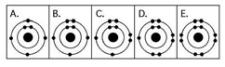 -Which drawing in the figure above depicts the electron configuration of an element with chemical properties most similar to helium (2He)?
 (Multiple Choice)
4.8/5 (74)
(74) ________ atoms give organic molecules their overall shape; ________ atoms determine the overall chemical behavior of organic molecules.
(Multiple Choice)
4.9/5 (79)
(79) In a single molecule of water, two hydrogen atoms are bonded to a single oxygen atom by ________.
(Multiple Choice)
4.9/5 (68)
(68) Bonds between two atoms that are equally electronegative are ________.
(Multiple Choice)
4.9/5 (78)
(78) Which of the following always tends to make chemical reactions spontaneous?
(Multiple Choice)
4.8/5 (72)
(72) Elements found on the left side of the periodic table contain outer shells that are ________; these elements tend to form ________ in solution.
(Multiple Choice)
4.9/5 (76)
(76) Consider the following reaction at equilibrium:  What would be the effect of adding additional H2CO3?
 (Multiple Choice)
4.8/5 (84)
(84) 
Filters
- Essay(0)
- Multiple Choice(0)
- Short Answer(0)
- True False(0)
- Matching(0)