



 Chat with AI
Exam 22: Evolution by Natural Selection

Exam 1: Biology and the Tree of Life37 Questions
Exam 2: Water and Carbon: the Chemical Basis of Life59 Questions
Exam 3: Protein Structure and Function59 Questions
Exam 4: Nucleic Acids and the Rna World43 Questions
Exam 5: An Introduction to Carbohydrates44 Questions
Exam 53: Ecosystems and Global Ecology57 Questions
Exam 6: Lipids, Membranes, and the First Cells59 Questions
Exam 7: Inside the Cell60 Questions
Exam 8: Energy and Enzymes: an Introduction to Metabolism60 Questions
Exam 9: Cellular Respiration and Fermentation61 Questions
Exam 10: Photosynthesis58 Questions
Exam 11: Cellcell Interactions52 Questions
Exam 12: The Cell Cycle59 Questions
Exam 13: Meiosis63 Questions
Exam 14: Mendel and the Gene60 Questions
Exam 15: Dna and the Gene: Synthesis and Repair51 Questions
Exam 16: How Genes Work48 Questions
Exam 17: Transcription, Rna Processing, and Translation58 Questions
Exam 18: Control of Gene Expression in Bacteria29 Questions
Exam 19: Control of Gene Expression in Eukaryotes56 Questions
Exam 20: The Molecular Revolution: Biotechnology and Beyond70 Questions
Exam 21: Genes, Development, and Evolution38 Questions
Exam 22: Evolution by Natural Selection38 Questions
Exam 23: Evolutionary Processes37 Questions
Exam 24: Speciation56 Questions
Exam 25: Phylogenies and the History of Life63 Questions
Exam 26: Bacteria and Archaea38 Questions
Exam 27: Protists37 Questions
Exam 28: Green Algae and Land Plants59 Questions
Exam 29: Fungi47 Questions
Exam 30: An Introduction to Animals48 Questions
Exam 31: Protostome Animals54 Questions
Exam 32: Deuterostome Animals60 Questions
Exam 33: Viruses44 Questions
Exam 34: Plant Form and Function46 Questions
Exam 35: Water and Sugar Transport in Plants47 Questions
Exam 36: Plant Nutrition54 Questions
Exam 37: Plant Sensory Systems, Signals, and Responses48 Questions
Exam 38: Plant Reproduction and Development51 Questions
Exam 39: Animal Form and Function53 Questions
Exam 40: Water and Electrolyte Balance in Animals60 Questions
Exam 41: Animal Nutrition94 Questions
Exam 42: Gas Exchange and Circulation93 Questions
Exam 43: Animal Nervous Systems100 Questions
Exam 44: Animal Sensory Systems50 Questions
Exam 45: Animal Movement40 Questions
Exam 46: Chemical Signals in Animals59 Questions
Exam 47: Animal Reproduction and Development104 Questions
Exam 48: The Immune System in Animals77 Questions
Exam 49: An Introduction to Ecology40 Questions
Exam 50: Behavioral Ecology40 Questions
Exam 51: Population Ecology57 Questions
Exam 52: Community Ecology55 Questions
Exam 54: Biodiversity and Conservation Biology43 Questions
Select questions type


Which statement about the beak size of finches on the island of Daphne Major during prolonged drought is TRUE?
(Multiple Choice)
4.7/5  (73)
(73) Which of the following is the best modern definition of evolution?
(Multiple Choice)
4.9/5 (84)
(84) Given a population that contains genetic variation, what is the correct sequence of the following events under the influence of natural selection?
1) Well-adapted individuals leave more offspring than do poorly-adapted individuals.
2) A change occurs in the environment.
3) Genetic frequencies within the population change.
4) Poorly-adapted individuals have decreased survivorship.
(Multiple Choice)
4.8/5 (71)
(71) Use the following information and figure to answer the question(s) below.
Traditionally, whales and hippopotamuses have been classified in different orders, the Cetacea and the Artiodactyla, respectively. Recent molecular evidence, however, indicates that the whales' closest living relatives are the hippos. This has caused some zoologists to lump the two orders together into a single clade, the Cetartiodactyla. There is no consensus on whether the Cetartiodactyla should be accorded order status or superorder status. This is because it remains unclear whether the whale lineage diverged from the lineage leading to the hippos before or after the other members of the order Artiodactyla (pigs, camels, etc.) diverged (see the accompanying figure). 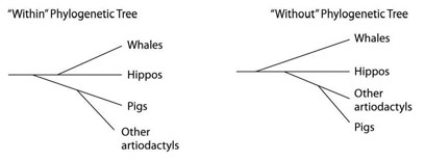 The figure contrasts the "Within the artiodactyls" origin of the whale lineage with the "Without the artiodactyls" origin of the whale lineage.
-One morphological feature of some modern cetaceans is a vestigial pelvic girdle. If it is determined that the cetacean lineage diverged from the artiodactyls' lineage after the divergence of pigs and other artiodactyla, then the vestigial pelvic girdle of cetaceans should be considered a shared ________.
The figure contrasts the "Within the artiodactyls" origin of the whale lineage with the "Without the artiodactyls" origin of the whale lineage.
-One morphological feature of some modern cetaceans is a vestigial pelvic girdle. If it is determined that the cetacean lineage diverged from the artiodactyls' lineage after the divergence of pigs and other artiodactyla, then the vestigial pelvic girdle of cetaceans should be considered a shared ________. (Multiple Choice)
4.9/5 (73)
(73) Fossils of Thrinaxodon, a species that lived during the Triassic period, have been found in both South Africa and Antarctica. Thrinaxodon had a reptile-like skeleton and laid eggs, but small depressions on the front of its skull suggest it had whiskers and, therefore, fur. Thrinaxodon may have been warm-blooded. The fossils of Thrinaxodon are consistent with the hypothesis that ________.
(Multiple Choice)
4.9/5 (85)
(85) Cotton-topped tamarins are small primates with tufts of long white hair on their heads. While studying these creatures, you notice that males with longer hair get more opportunities to mate and father more offspring. To test the hypothesis that having longer hair is adaptive in these males, you should ________.
(Multiple Choice)
4.8/5 (82)
(82) After the drought of 1977, researchers on the island of Daphne Major hypothesized that medium ground finches that had large, deep beaks survived better than those with smaller beaks because they could more easily crack and eat the tough Tribulus cistoides fruits. If this hypothesis is correct, what would you expect to observe if a population of these medium ground finches colonizes a nearby island where T. cistoides is the most abundant food for the next 1000 years? Assume that (1) even the survivors of the 1977 drought sometimes had difficulty cracking the tough T. cistoides fruits and would eat other seeds when offered a choice; and (2) food availability is the primary limit on finch fitness on this new island.
(Multiple Choice)
4.8/5 (86)
(86) The following question(s) are based on information in Hopi E. Hoekstra, Kristen E. Drumm, and Michael W. Nachman, "Ecological Genetics of Adaptive Color Polymorphism in Pocket Mice: Geographic Variation in Selected and Neutral Genes," Evolution 58(6), 2004: 1329-41. 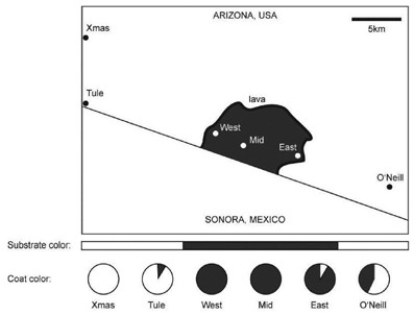 -The accompanying figure shows the distribution of pocket-mouse coat colors in several Arizona populations found either on light-colored granite substrate or on dark volcanic rock (dark substrate). The Melanocortin-1 receptor (Mc1r) alleles, D and d, differ by four amino acids. Mice with DD and Dd genotypes have dark coats, whereas mice with the dd genotype are light colored. What sort of genotype frequencies might you expect to find in the Xmas, Mid, and O'Neill populations?
 (Multiple Choice)
4.9/5 (85)
(85) Many crustaceans (for example, lobsters, shrimp, and crayfish) use their tails to swim, but crabs have reduced tails that curl under their shells and are not used in swimming. This is an example of ________.
(Multiple Choice)
4.9/5 (62)
(62) Which of the following, if discovered, could refute our current understanding of the pattern of evolution?
(Multiple Choice)
4.9/5 (84)
(84) If the bacterium Staphylococcus aureus experiences a cost for maintaining one or more antibiotic-resistance genes, what would happen in environments that lack antibiotics?
(Multiple Choice)
4.9/5 (76)
(76) Researchers discovered that a new strain of bacteria that cause tuberculosis (M. tuberculosis) taken from a dead patient has a point mutation in the rpoB gene that codes for part of the RNA polymerase enzyme. This mutant form of RNA polymerase does not function as well as the more common form of RNA polymerase. A commonly used antibiotic called rifampin does not affect the mutant rpoB bacteria.
A researcher mixes M. tuberculosis with and without the rpoB mutation and adds the bacteria to cell cultures. Half the cell cultures contain only standard nutrients, while the other half of the cell cultures contain rifampin and the standard nutrients. After many cell generations, the researcher finds that ________.
(Multiple Choice)
4.9/5 (74)
(74) Logically, which of these should cast the most doubt on the relationships depicted by an evolutionary tree?
(Multiple Choice)
4.8/5 (80)
(80) There is a population of beetles that typically have black wings. A scientist studying these beetles knows that their eggs hatch in early spring, the young insects grow through the late spring and summer, they lay eggs in the early fall, and they die in the early winter. Recently some beetles have been born with white wings. Early in life, the black- and white-winged beetles seem to be very similar in number of mating events, eggs laid, and survival rates, but shortly after laying their eggs, the white beetles die and there are only black-winged beetles during the late fall. Which of the following is a TRUE statement about the beetles?
(Multiple Choice)
4.8/5 (76)
(76) The giant sloth described by Georges Cuvier suggests that ________.
(Multiple Choice)
4.9/5 (75)
(75) Darwin and Wallace's theory of evolution by natural selection was revolutionary because it ________.
(Multiple Choice)
4.7/5 (94)
(94) 
Filters
- Essay(0)
- Multiple Choice(0)
- Short Answer(0)
- True False(0)
- Matching(0)