Multiple Choice
The following question(s) are based on information in Hopi E. Hoekstra, Kristen E. Drumm, and Michael W. Nachman, "Ecological Genetics of Adaptive Color Polymorphism in Pocket Mice: Geographic Variation in Selected and Neutral Genes," Evolution 58(6) , 2004: 1329-41. 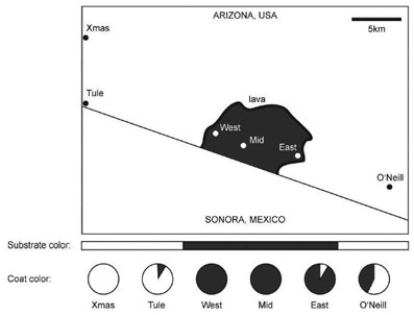
-The accompanying figure shows the distribution of pocket-mouse coat colors in several Arizona populations found either on light-colored granite substrate or on dark volcanic rock (dark substrate) . The Melanocortin-1 receptor (Mc1r) alleles, D and d, differ by four amino acids. Mice with DD and Dd genotypes have dark coats, whereas mice with the dd genotype are light colored. What sort of genotype frequencies might you expect to find in the Xmas, Mid, and O'Neill populations?
A) Xmas-high DD frequency; Mid-high Dd frequency, O'Neill-high dd frequency
B) Xmas-high Dd frequency; Mid-high DD frequency, O'Neill-high dd frequency
C) Xmas-high Dd frequency; Mid-high dd frequency, O'Neill-high DD frequency
D) Xmas-high dd frequency; Mid-high Dd frequency, O'Neill-high DD frequency
E) Xmas-high dd frequency; Mid-high DD frequency, O'Neill-high Dd frequency
Correct Answer:

Verified
Correct Answer:
Verified
Q3: Many crustaceans (for example, lobsters, shrimp, and
Q12: If the bacterium Staphylococcus aureus experiences a
Q19: Cotton-topped tamarins are small primates with tufts
Q25: Use the following information and figure to
Q28: After the drought of 1977, researchers on
Q30: Fossils of Thrinaxodon, a species that lived
Q30: What must be TRUE of any organ
Q32: Which of the following, if discovered, could
Q34: Researchers discovered that a new strain of
Q44: Given a population that contains genetic variation,