



 Chat with AI
Exam 29: Fungi

Exam 1: Biology and the Tree of Life37 Questions
Exam 2: Water and Carbon: the Chemical Basis of Life59 Questions
Exam 3: Protein Structure and Function59 Questions
Exam 4: Nucleic Acids and the Rna World43 Questions
Exam 5: An Introduction to Carbohydrates44 Questions
Exam 53: Ecosystems and Global Ecology57 Questions
Exam 6: Lipids, Membranes, and the First Cells59 Questions
Exam 7: Inside the Cell60 Questions
Exam 8: Energy and Enzymes: an Introduction to Metabolism60 Questions
Exam 9: Cellular Respiration and Fermentation61 Questions
Exam 10: Photosynthesis58 Questions
Exam 11: Cellcell Interactions52 Questions
Exam 12: The Cell Cycle59 Questions
Exam 13: Meiosis63 Questions
Exam 14: Mendel and the Gene60 Questions
Exam 15: Dna and the Gene: Synthesis and Repair51 Questions
Exam 16: How Genes Work48 Questions
Exam 17: Transcription, Rna Processing, and Translation58 Questions
Exam 18: Control of Gene Expression in Bacteria29 Questions
Exam 19: Control of Gene Expression in Eukaryotes56 Questions
Exam 20: The Molecular Revolution: Biotechnology and Beyond70 Questions
Exam 21: Genes, Development, and Evolution38 Questions
Exam 22: Evolution by Natural Selection38 Questions
Exam 23: Evolutionary Processes37 Questions
Exam 24: Speciation56 Questions
Exam 25: Phylogenies and the History of Life63 Questions
Exam 26: Bacteria and Archaea38 Questions
Exam 27: Protists37 Questions
Exam 28: Green Algae and Land Plants59 Questions
Exam 29: Fungi47 Questions
Exam 30: An Introduction to Animals48 Questions
Exam 31: Protostome Animals54 Questions
Exam 32: Deuterostome Animals60 Questions
Exam 33: Viruses44 Questions
Exam 34: Plant Form and Function46 Questions
Exam 35: Water and Sugar Transport in Plants47 Questions
Exam 36: Plant Nutrition54 Questions
Exam 37: Plant Sensory Systems, Signals, and Responses48 Questions
Exam 38: Plant Reproduction and Development51 Questions
Exam 39: Animal Form and Function53 Questions
Exam 40: Water and Electrolyte Balance in Animals60 Questions
Exam 41: Animal Nutrition94 Questions
Exam 42: Gas Exchange and Circulation93 Questions
Exam 43: Animal Nervous Systems100 Questions
Exam 44: Animal Sensory Systems50 Questions
Exam 45: Animal Movement40 Questions
Exam 46: Chemical Signals in Animals59 Questions
Exam 47: Animal Reproduction and Development104 Questions
Exam 48: The Immune System in Animals77 Questions
Exam 49: An Introduction to Ecology40 Questions
Exam 50: Behavioral Ecology40 Questions
Exam 51: Population Ecology57 Questions
Exam 52: Community Ecology55 Questions
Exam 54: Biodiversity and Conservation Biology43 Questions
Select questions type


Use the following information to answer the question(s) below.
For several decades now, amphibian species worldwide have been in decline. A significant proportion of the decline seems to be due to the spread of the chytrid fungus, Batrachochytrium dendrobatidis (Bd). Chytrid sporangia reside within the epidermal cells of infected animals, animals that consequently show areas of sloughed skin. They can also be lethargic, which is expressed through failure to hide and failure to flee. The infection cycle typically takes 4 to 5 days, at the end of which zoospores are released from sporangia into the environment. In some amphibian species, mortality rates approach 100 percent; other species seem able to survive the infection.
-It has been hypothesized that fungi and plants have a mutualistic relationship because fungi provide critical nitrogen for the plants' use. How do we know this happens? In experiments using radioactively labeled ________.
(Multiple Choice)
4.8/5  (74)
(74) You are a forester charged with increasing productivity in a South American forest newly planted with pines from Oregon. You believe that the southern forest lacks the fungal diversity needed by the North American pines and that this lack of fungi is affecting the pines' productivity, but you have no evidence to support your ideas. To count how many fungal species were present in the Oregon forest, which methodology would you choose?
(Multiple Choice)
4.8/5 (83)
(83) Which of the following characteristics is unique to chytrids compared to other groups of fungi?
(Multiple Choice)
4.9/5 (79)
(79) Why does total biomass (graph e in the accompanying figure) not vary with AMF diversity?
(Multiple Choice)
4.9/5 (87)
(87) Why is it more difficult to treat fungal infections than bacterial infections in humans?
(Multiple Choice)
4.9/5 (86)
(86) Use the following information to answer the question(s) below.
Canadian and Swiss researchers wanted to know if the diversity of arbuscular mycorrhizal fungi (AMF) was important to the productivity of grasslands (M.G.A. van der Heijden, J. N. Klironomos, M. Ursic, P. Moutoglis, R. Streitwolf-Engel, T. Boler, A. Wiemken, and I. R. Sanders. 1998. Mycorrhizal fungal diversity determines plant biodiversity, ecosystem variability and productivity. Nature 396:69-72). Specifically, they wanted to know if it mattered which specific AMF species were present, or just that some type of AMF was present. They grew various plants in combination with one of four AMF species (A, B, C, and D), no AMF species (O), or all four AMF species together (A + B + C + D); and they measured plant growth under each set of conditions. All plant species were grown in each plot, so they always competed with each other with the only difference being which AMF species were present.
On the graphs below, the x-axis labels indicate the number and identity of AMF species (bar 0 = no fungi; bars A-D = individual AMF species; bar A + B + C + D = all AMF species together). The y-axis indicates the amount (grams) of plant biomass for the species shown in italics above each graph. Graph (e) is the total biomass (grams) of all 11 plant species combined; graph (f) is the biomass of Bromus erectus plants only, separated from the total. 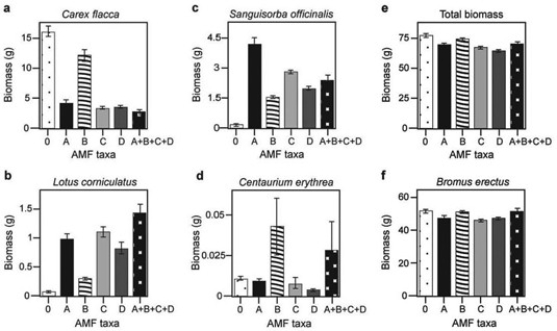 -Based on graphs in the accompanying figure, which of the following is the best description of the data supporting the idea that a plant species did not form mycorrhizae with a fungus? Its biomass is greatest when ________.
 (Multiple Choice)
4.9/5 (76)
(76) 
Filters
- Essay(0)
- Multiple Choice(0)
- Short Answer(0)
- True False(0)
- Matching(0)