



 Chat with AI
Exam 31: Protostome Animals

Exam 1: Biology and the Tree of Life37 Questions
Exam 2: Water and Carbon: the Chemical Basis of Life59 Questions
Exam 3: Protein Structure and Function59 Questions
Exam 4: Nucleic Acids and the Rna World43 Questions
Exam 5: An Introduction to Carbohydrates44 Questions
Exam 53: Ecosystems and Global Ecology57 Questions
Exam 6: Lipids, Membranes, and the First Cells59 Questions
Exam 7: Inside the Cell60 Questions
Exam 8: Energy and Enzymes: an Introduction to Metabolism60 Questions
Exam 9: Cellular Respiration and Fermentation61 Questions
Exam 10: Photosynthesis58 Questions
Exam 11: Cellcell Interactions52 Questions
Exam 12: The Cell Cycle59 Questions
Exam 13: Meiosis63 Questions
Exam 14: Mendel and the Gene60 Questions
Exam 15: Dna and the Gene: Synthesis and Repair51 Questions
Exam 16: How Genes Work48 Questions
Exam 17: Transcription, Rna Processing, and Translation58 Questions
Exam 18: Control of Gene Expression in Bacteria29 Questions
Exam 19: Control of Gene Expression in Eukaryotes56 Questions
Exam 20: The Molecular Revolution: Biotechnology and Beyond70 Questions
Exam 21: Genes, Development, and Evolution38 Questions
Exam 22: Evolution by Natural Selection38 Questions
Exam 23: Evolutionary Processes37 Questions
Exam 24: Speciation56 Questions
Exam 25: Phylogenies and the History of Life63 Questions
Exam 26: Bacteria and Archaea38 Questions
Exam 27: Protists37 Questions
Exam 28: Green Algae and Land Plants59 Questions
Exam 29: Fungi47 Questions
Exam 30: An Introduction to Animals48 Questions
Exam 31: Protostome Animals54 Questions
Exam 32: Deuterostome Animals60 Questions
Exam 33: Viruses44 Questions
Exam 34: Plant Form and Function46 Questions
Exam 35: Water and Sugar Transport in Plants47 Questions
Exam 36: Plant Nutrition54 Questions
Exam 37: Plant Sensory Systems, Signals, and Responses48 Questions
Exam 38: Plant Reproduction and Development51 Questions
Exam 39: Animal Form and Function53 Questions
Exam 40: Water and Electrolyte Balance in Animals60 Questions
Exam 41: Animal Nutrition94 Questions
Exam 42: Gas Exchange and Circulation93 Questions
Exam 43: Animal Nervous Systems100 Questions
Exam 44: Animal Sensory Systems50 Questions
Exam 45: Animal Movement40 Questions
Exam 46: Chemical Signals in Animals59 Questions
Exam 47: Animal Reproduction and Development104 Questions
Exam 48: The Immune System in Animals77 Questions
Exam 49: An Introduction to Ecology40 Questions
Exam 50: Behavioral Ecology40 Questions
Exam 51: Population Ecology57 Questions
Exam 52: Community Ecology55 Questions
Exam 54: Biodiversity and Conservation Biology43 Questions
Select questions type


When considering the wormlike phyla within the protostomes, which feature is most useful in distinguishing groups?
(Multiple Choice)
4.9/5  (90)
(90) Adaptations to terrestrial environments evolved independently in arthropods, mollusks, nematodes, and annelids. What logical conclusion would you make from this statement?
(Multiple Choice)
4.8/5 (81)
(81) You find a wormlike animal while scuba diving and want to determine whether it is a nudibranch, a polychaete, or a flatworm. Finding which of the following traits would best help you classify the mystery animal?
(Multiple Choice)
4.8/5 (72)
(72) Which one of these mollusk groups can be classified as suspension feeders?
(Multiple Choice)
4.9/5 (90)
(90) Use the following information to answer the question(s) below.
Many terrestrial arthropods exchange gases with their environments by using tracheae, tubes that lead from openings (called spiracles) in the animal's exoskeleton or cuticle directly to the animal's tissues. Some arthropods can control whether their spiracles are open or closed; opening the spiracles allows carbon dioxide produced in the tissues to travel down the tracheae and be released outside the animal. Klok et al. measured the carbon dioxide emitted over time (represented by VCO2) by several species of centipedes. The figure below presents graphs of their results for two species, Cormocephalus morsitans and Scutigerina weberi. (C. J. Klok, R. D. Mercer, and S. L. Chown. 2002. Discontinuous gas-exchange in centipedes and its convergent evolution in tracheated arthropods. Journal of Experimental Biology 205:1019-29.) Copyright 2002 The Company of Biologists and the Journal of Experimental Biology. 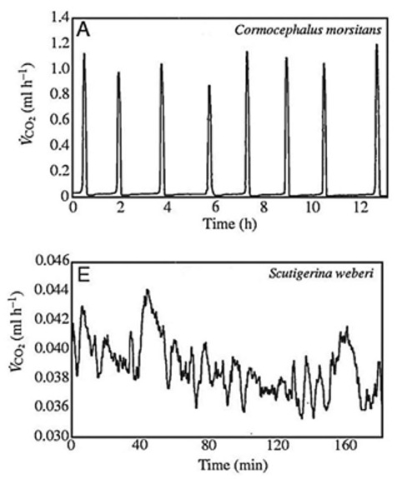 -Compare the graphs in the accompanying figure of carbon dioxide (CO2) emission for Cormocephalus morsitans and Scutigerina weberi. What hypothesis can you make about each centipede's habitat?
 (Multiple Choice)
5.0/5 (81)
(81) A student observes a wormlike organism crawling about on dead organic matter. Later, the organism sheds its outer covering. One possibility is that the organism is a larval insect (like a maggot). However, it might be a member of the phylum ________, and one way to distinguish between the two possibilities is by looking for the presence or absence of ________.
(Multiple Choice)
4.8/5 (70)
(70) Which of the following organisms would you expect to have the largest surface-area-to-volume ratio? Assume that all of the following are the same total length.
(Multiple Choice)
4.9/5 (79)
(79) Which mollusk clade includes members that undergo embryonic torsion?
(Multiple Choice)
4.8/5 (77)
(77) Use the following information to answer the question(s) below.
A farm pond, usually dry during winter, has plenty of water and aquatic pond life during the summer. One summer, Sarah returns to the family farm from college. Observing the pond, she is fascinated by some six-legged organisms that can crawl about on submerged surfaces or, when disturbed, seemingly "jet" through the water. Watching further, she is able to conclude that the "mystery organisms" are ambush predators, and their prey includes everything from insects to small fish and tadpoles.
-If the pond organisms are larvae, rather than adults, Sarah should expect them to have all of the following structures, EXCEPT ________.
(Multiple Choice)
4.9/5 (86)
(86) The protostome developmental sequence arose just once in evolutionary history, resulting in two main subgroups-Lophotrochozoa and Ecdysozoa. What does this finding suggest?
(Multiple Choice)
5.0/5 (87)
(87) Use the following information to answer the question(s) below.
Many terrestrial arthropods exchange gases with their environments by using tracheae, tubes that lead from openings (called spiracles) in the animal's exoskeleton or cuticle directly to the animal's tissues. Some arthropods can control whether their spiracles are open or closed; opening the spiracles allows carbon dioxide produced in the tissues to travel down the tracheae and be released outside the animal. Klok et al. measured the carbon dioxide emitted over time (represented by VCO2) by several species of centipedes. The figure below presents graphs of their results for two species, Cormocephalus morsitans and Scutigerina weberi. (C. J. Klok, R. D. Mercer, and S. L. Chown. 2002. Discontinuous gas-exchange in centipedes and its convergent evolution in tracheated arthropods. Journal of Experimental Biology 205:1019-29.) Copyright 2002 The Company of Biologists and the Journal of Experimental Biology.
-On which body segment are arthropod wings attached?
-On which body segment are arthropod wings attached? (Multiple Choice)
4.9/5 (86)
(86) The possession of two pairs of antennae is a characteristic of ________.
(Multiple Choice)
4.7/5 (79)
(79) All arthropods ________.
1) undergo complete metamorphosis
2) have jointed appendages
3) molt
4) have segmented bodies
5) have an exoskeleton or cuticle
(Multiple Choice)
4.9/5 (78)
(78) Nematode worms and annelid worms share which of the following features?
(Multiple Choice)
4.8/5 (86)
(86) 
Filters
- Essay(0)
- Multiple Choice(0)
- Short Answer(0)
- True False(0)
- Matching(0)