



 Chat with AI
Exam 31: Protostome Animals

Exam 1: Biology and the Tree of Life37 Questions
Exam 2: Water and Carbon: the Chemical Basis of Life59 Questions
Exam 3: Protein Structure and Function59 Questions
Exam 4: Nucleic Acids and the Rna World43 Questions
Exam 5: An Introduction to Carbohydrates44 Questions
Exam 53: Ecosystems and Global Ecology57 Questions
Exam 6: Lipids, Membranes, and the First Cells59 Questions
Exam 7: Inside the Cell60 Questions
Exam 8: Energy and Enzymes: an Introduction to Metabolism60 Questions
Exam 9: Cellular Respiration and Fermentation61 Questions
Exam 10: Photosynthesis58 Questions
Exam 11: Cellcell Interactions52 Questions
Exam 12: The Cell Cycle59 Questions
Exam 13: Meiosis63 Questions
Exam 14: Mendel and the Gene60 Questions
Exam 15: Dna and the Gene: Synthesis and Repair51 Questions
Exam 16: How Genes Work48 Questions
Exam 17: Transcription, Rna Processing, and Translation58 Questions
Exam 18: Control of Gene Expression in Bacteria29 Questions
Exam 19: Control of Gene Expression in Eukaryotes56 Questions
Exam 20: The Molecular Revolution: Biotechnology and Beyond70 Questions
Exam 21: Genes, Development, and Evolution38 Questions
Exam 22: Evolution by Natural Selection38 Questions
Exam 23: Evolutionary Processes37 Questions
Exam 24: Speciation56 Questions
Exam 25: Phylogenies and the History of Life63 Questions
Exam 26: Bacteria and Archaea38 Questions
Exam 27: Protists37 Questions
Exam 28: Green Algae and Land Plants59 Questions
Exam 29: Fungi47 Questions
Exam 30: An Introduction to Animals48 Questions
Exam 31: Protostome Animals54 Questions
Exam 32: Deuterostome Animals60 Questions
Exam 33: Viruses44 Questions
Exam 34: Plant Form and Function46 Questions
Exam 35: Water and Sugar Transport in Plants47 Questions
Exam 36: Plant Nutrition54 Questions
Exam 37: Plant Sensory Systems, Signals, and Responses48 Questions
Exam 38: Plant Reproduction and Development51 Questions
Exam 39: Animal Form and Function53 Questions
Exam 40: Water and Electrolyte Balance in Animals60 Questions
Exam 41: Animal Nutrition94 Questions
Exam 42: Gas Exchange and Circulation93 Questions
Exam 43: Animal Nervous Systems100 Questions
Exam 44: Animal Sensory Systems50 Questions
Exam 45: Animal Movement40 Questions
Exam 46: Chemical Signals in Animals59 Questions
Exam 47: Animal Reproduction and Development104 Questions
Exam 48: The Immune System in Animals77 Questions
Exam 49: An Introduction to Ecology40 Questions
Exam 50: Behavioral Ecology40 Questions
Exam 51: Population Ecology57 Questions
Exam 52: Community Ecology55 Questions
Exam 54: Biodiversity and Conservation Biology43 Questions
Select questions type


The common ancestor of the protostomes had a coelom. What does this suggest?
(Multiple Choice)
4.9/5  (67)
(67) A shared derived characteristic for members of the arthropod subgroup that includes spiders would be the presence of ________.
(Multiple Choice)
4.8/5 (71)
(71) Use the following information to answer the question(s) below.
A farm pond, usually dry during winter, has plenty of water and aquatic pond life during the summer. One summer, Sarah returns to the family farm from college. Observing the pond, she is fascinated by some six-legged organisms that can crawl about on submerged surfaces or, when disturbed, seemingly "jet" through the water. Watching further, she is able to conclude that the "mystery organisms" are ambush predators, and their prey includes everything from insects to small fish and tadpoles.
-In adult arthropods, the hemocoel ________.
(Multiple Choice)
4.8/5 (79)
(79) A terrestrial animal species is discovered with the following larval characteristics: exoskeleton, system of tubes for gas exchange, and modified segmentation. A knowledgeable zoologist should predict that the adults of this species would also feature ________.
(Multiple Choice)
4.7/5 (88)
(88) Use the following information to answer the question(s) below.
Nudibranchs, a type of predatory sea slug, can have various protuberances (that is, extensions) on their dorsal surfaces. Rhinophores are paired structures, located close to the head, which bear many chemoreceptors. Dorsal plummules, usually located posteriorly, perform respiratory gas exchange. Cerata usually cover much of the dorsal surface and contain nematocysts at their tips.
-The stingers of honeybees have a function most similar to that of ________.
(Multiple Choice)
4.8/5 (80)
(80) Use the following information to answer the question(s) below.
Many terrestrial arthropods exchange gases with their environments by using tracheae, tubes that lead from openings (called spiracles) in the animal's exoskeleton or cuticle directly to the animal's tissues. Some arthropods can control whether their spiracles are open or closed; opening the spiracles allows carbon dioxide produced in the tissues to travel down the tracheae and be released outside the animal. Klok et al. measured the carbon dioxide emitted over time (represented by VCO2) by several species of centipedes. The figure below presents graphs of their results for two species, Cormocephalus morsitans and Scutigerina weberi. (C. J. Klok, R. D. Mercer, and S. L. Chown. 2002. Discontinuous gas-exchange in centipedes and its convergent evolution in tracheated arthropods. Journal of Experimental Biology 205:1019-29.) Copyright 2002 The Company of Biologists and the Journal of Experimental Biology. 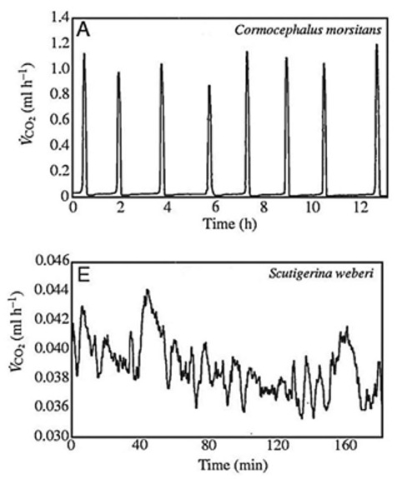 -Look at the graph for Scutigerina weberi (note the scale of the y-axis) in the accompanying figure. What is the best interpretation of these results?
 (Multiple Choice)
4.8/5 (66)
(66) Among the invertebrate phyla, phylum Arthropoda is unique in possessing members that have ________.
(Multiple Choice)
4.9/5 (79)
(79) What is the only group of Mollusca that does NOT have a radula?
(Multiple Choice)
4.8/5 (80)
(80) Upon close inspection of movement in annelids and nematodes, you would notice an obvious difference. Nematodes tend to wriggle back and forth, while annelids tend to contract along their length as their girth swells and then thin out as they stretch. What anatomical feature explains this type of movement?
(Multiple Choice)
4.8/5 (81)
(81) In a tide pool, a student encounters an organism with a hard outer covering that contains much calcium carbonate, an open circulatory system, and gills. The organism could potentially be a crab, a shrimp, a barnacle, or a bivalve. The presence of which of the following structures would allow for the most certain identification of the organism?
(Multiple Choice)
4.7/5 (77)
(77) You find a small animal with eight legs crawling up your bedroom wall. Closer examination will probably reveal that this animal also has ________.
(Multiple Choice)
4.8/5 (88)
(88) Use the following information to answer the question(s) below.
A farm pond, usually dry during winter, has plenty of water and aquatic pond life during the summer. One summer, Sarah returns to the family farm from college. Observing the pond, she is fascinated by some six-legged organisms that can crawl about on submerged surfaces or, when disturbed, seemingly "jet" through the water. Watching further, she is able to conclude that the "mystery organisms" are ambush predators, and their prey includes everything from insects to small fish and tadpoles.
-Arthropods invaded land about 100 million years before vertebrates did so. This most clearly implies that ________.
(Multiple Choice)
4.7/5 (81)
(81) Use the following information to answer the question(s) below.
A farm pond, usually dry during winter, has plenty of water and aquatic pond life during the summer. One summer, Sarah returns to the family farm from college. Observing the pond, she is fascinated by some six-legged organisms that can crawl about on submerged surfaces or, when disturbed, seemingly "jet" through the water. Watching further, she is able to conclude that the "mystery organisms" are ambush predators, and their prey includes everything from insects to small fish and tadpoles.
-A land snail, a clam, and an octopus all have ________.
(Multiple Choice)
4.8/5 (88)
(88) Use the following information to answer the question(s) below.
Many terrestrial arthropods exchange gases with their environments by using tracheae, tubes that lead from openings (called spiracles) in the animal's exoskeleton or cuticle directly to the animal's tissues. Some arthropods can control whether their spiracles are open or closed; opening the spiracles allows carbon dioxide produced in the tissues to travel down the tracheae and be released outside the animal. Klok et al. measured the carbon dioxide emitted over time (represented by VCO2) by several species of centipedes. The figure below presents graphs of their results for two species, Cormocephalus morsitans and Scutigerina weberi. (C. J. Klok, R. D. Mercer, and S. L. Chown. 2002. Discontinuous gas-exchange in centipedes and its convergent evolution in tracheated arthropods. Journal of Experimental Biology 205:1019-29.) Copyright 2002 The Company of Biologists and the Journal of Experimental Biology.
-Look at the graph for Cormocephalus morsitans in the accompanying figure. What is the best interpretation of these results?
-Look at the graph for Cormocephalus morsitans in the accompanying figure. What is the best interpretation of these results? (Multiple Choice)
4.9/5 (90)
(90) In your laboratory, you examine a vial of freshwater from a local pond. You notice several unfamiliar small (less than 1 millimeter in length) animals and decide to study them. You observe that the animals have a coelom, eat microscopic food particles, reproduce by parthenogenesis, and have offspring that do not undergo any larval stages. What else would you expect to observe about this organism?
(Multiple Choice)
4.8/5 (76)
(76) You find what you believe is a new species of animal. Which of the following characteristics would enable you to argue that it is more closely related to a flatworm than it is to a roundworm?
(Multiple Choice)
4.8/5 (85)
(85) Use the following information to answer the question(s) below.
Many terrestrial arthropods exchange gases with their environments by using tracheae, tubes that lead from openings (called spiracles) in the animal's exoskeleton or cuticle directly to the animal's tissues. Some arthropods can control whether their spiracles are open or closed; opening the spiracles allows carbon dioxide produced in the tissues to travel down the tracheae and be released outside the animal. Klok et al. measured the carbon dioxide emitted over time (represented by VCO2) by several species of centipedes. The figure below presents graphs of their results for two species, Cormocephalus morsitans and Scutigerina weberi. (C. J. Klok, R. D. Mercer, and S. L. Chown. 2002. Discontinuous gas-exchange in centipedes and its convergent evolution in tracheated arthropods. Journal of Experimental Biology 205:1019-29.) Copyright 2002 The Company of Biologists and the Journal of Experimental Biology.
-How would a terrestrial centipede most likely benefit from the ability to close its spiracles? Closing spiracles would ________.
-How would a terrestrial centipede most likely benefit from the ability to close its spiracles? Closing spiracles would ________. (Multiple Choice)
4.9/5 (71)
(71) Use the following information to answer the question(s) below.
A farm pond, usually dry during winter, has plenty of water and aquatic pond life during the summer. One summer, Sarah returns to the family farm from college. Observing the pond, she is fascinated by some six-legged organisms that can crawl about on submerged surfaces or, when disturbed, seemingly "jet" through the water. Watching further, she is able to conclude that the "mystery organisms" are ambush predators, and their prey includes everything from insects to small fish and tadpoles.
-Sarah observed that the mystery pond organisms never come up to the pond's surface. If she catches one of these organisms and observes closely, perhaps dissecting the organism, she should find ________.
(Multiple Choice)
4.8/5 (66)
(66) If a lung were to be found in a mollusk, where would it be located?
(Multiple Choice)
4.9/5 (82)
(82) 
Filters
- Essay(0)
- Multiple Choice(0)
- Short Answer(0)
- True False(0)
- Matching(0)