



 Chat with AI
Exam 32: Deuterostome Animals

Exam 1: Biology and the Tree of Life37 Questions
Exam 2: Water and Carbon: the Chemical Basis of Life59 Questions
Exam 3: Protein Structure and Function59 Questions
Exam 4: Nucleic Acids and the Rna World43 Questions
Exam 5: An Introduction to Carbohydrates44 Questions
Exam 53: Ecosystems and Global Ecology57 Questions
Exam 6: Lipids, Membranes, and the First Cells59 Questions
Exam 7: Inside the Cell60 Questions
Exam 8: Energy and Enzymes: an Introduction to Metabolism60 Questions
Exam 9: Cellular Respiration and Fermentation61 Questions
Exam 10: Photosynthesis58 Questions
Exam 11: Cellcell Interactions52 Questions
Exam 12: The Cell Cycle59 Questions
Exam 13: Meiosis63 Questions
Exam 14: Mendel and the Gene60 Questions
Exam 15: Dna and the Gene: Synthesis and Repair51 Questions
Exam 16: How Genes Work48 Questions
Exam 17: Transcription, Rna Processing, and Translation58 Questions
Exam 18: Control of Gene Expression in Bacteria29 Questions
Exam 19: Control of Gene Expression in Eukaryotes56 Questions
Exam 20: The Molecular Revolution: Biotechnology and Beyond70 Questions
Exam 21: Genes, Development, and Evolution38 Questions
Exam 22: Evolution by Natural Selection38 Questions
Exam 23: Evolutionary Processes37 Questions
Exam 24: Speciation56 Questions
Exam 25: Phylogenies and the History of Life63 Questions
Exam 26: Bacteria and Archaea38 Questions
Exam 27: Protists37 Questions
Exam 28: Green Algae and Land Plants59 Questions
Exam 29: Fungi47 Questions
Exam 30: An Introduction to Animals48 Questions
Exam 31: Protostome Animals54 Questions
Exam 32: Deuterostome Animals60 Questions
Exam 33: Viruses44 Questions
Exam 34: Plant Form and Function46 Questions
Exam 35: Water and Sugar Transport in Plants47 Questions
Exam 36: Plant Nutrition54 Questions
Exam 37: Plant Sensory Systems, Signals, and Responses48 Questions
Exam 38: Plant Reproduction and Development51 Questions
Exam 39: Animal Form and Function53 Questions
Exam 40: Water and Electrolyte Balance in Animals60 Questions
Exam 41: Animal Nutrition94 Questions
Exam 42: Gas Exchange and Circulation93 Questions
Exam 43: Animal Nervous Systems100 Questions
Exam 44: Animal Sensory Systems50 Questions
Exam 45: Animal Movement40 Questions
Exam 46: Chemical Signals in Animals59 Questions
Exam 47: Animal Reproduction and Development104 Questions
Exam 48: The Immune System in Animals77 Questions
Exam 49: An Introduction to Ecology40 Questions
Exam 50: Behavioral Ecology40 Questions
Exam 51: Population Ecology57 Questions
Exam 52: Community Ecology55 Questions
Exam 54: Biodiversity and Conservation Biology43 Questions
Select questions type


What unique characteristic do all deuterostomes have in common?
(Multiple Choice)
5.0/5  (73)
(73) If a tunicate's pharyngeal gill slits were suddenly blocked, the animal would have trouble ________.
(Multiple Choice)
4.8/5 (83)
(83) As hominins diverged from other primates, which of the following appeared first?
(Multiple Choice)
4.7/5 (73)
(73) Primate evolution and behavior, such as hunting skills, have been directed in part by the development of depth perception. What anatomical change made depth perception possible?
(Multiple Choice)
4.7/5 (78)
(78) What is the single unique characteristic that distinguishes extant birds from other extant vertebrates?
(Multiple Choice)
4.8/5 (76)
(76) Which structure of the amniotic egg most closely surrounds the embryo?
(Multiple Choice)
4.9/5 (84)
(84) Use the accompanying figure and information to answer the question(s) below. 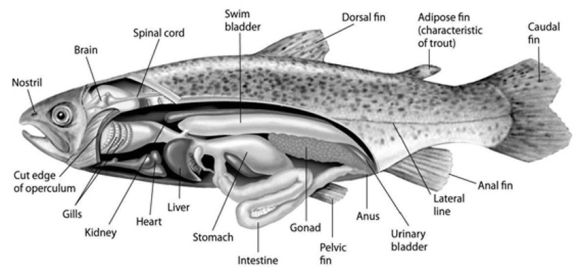 -When a shark stops swimming, it ________.
1) sinks
2) quickly dies
3) oxygenates its blood less effectively
-When a shark stops swimming, it ________.
1) sinks
2) quickly dies
3) oxygenates its blood less effectively (Multiple Choice)
4.8/5 (81)
(81) Adult tunicates (urochordates) lack notochords, however, larval urochordates have them and use them to ________.
(Multiple Choice)
4.9/5 (87)
(87) Which of the following is a characteristic of larval echinoderms?
(Multiple Choice)
4.8/5 (91)
(91) Internal fertilization, a leathery amniotic egg, and skin that resists drying are characteristics of ________.
(Multiple Choice)
5.0/5 (77)
(77) Which of the following is found in many tetrapods but not in fish?
(Multiple Choice)
4.8/5 (76)
(76) If the midbrain of a fish became damaged it would harm its ability to ________.
(Multiple Choice)
4.9/5 (69)
(69) The oldest fossil remains of Homo sapiens found so far date from about ________.
(Multiple Choice)
4.7/5 (85)
(85) Which evolutionary innovation was most significant in helping tetrapods move to dry terrestrial environments?
(Multiple Choice)
4.8/5 (70)
(70) What is believed to be the most significant result of the evolution of the amniotic egg?
(Multiple Choice)
4.9/5 (77)
(77) A team of researchers developed a poison effective against lamprey larvae in freshwater cultures. The poison is ingested and causes paralysis by detaching segmental muscles from the skeletal elements. The team wants to test the poison's effectiveness in streams feeding Lake Michigan, but one critic worries about potential effects on lancelets, which are similar to lampreys in many ways. Why is this concern misplaced?
(Multiple Choice)
4.8/5 (60)
(60) Use the following information to answer the question(s) below.
Terry catches a ray-finned fish from the ocean and notices that attached to its side is an equally long, snakelike organism. The attached organism has no external segmentation, no scales, a round mouth surrounded by a sucker, and two small eyes. Terry thinks it might be a marine leech, a hagfish, or a lamprey.
-Terry takes the body of the snakelike organism and slices it open along its dorsal side. If it is a hagfish, what should Terry see?
(Multiple Choice)
4.9/5 (88)
(88) How does a swim bladder help the ray-finned fishes maintain buoyancy?
(Multiple Choice)
4.7/5 (73)
(73) Which of these statements about human evolution is correct?
(Multiple Choice)
4.8/5 (73)
(73) 
Filters
- Essay(0)
- Multiple Choice(0)
- Short Answer(0)
- True False(0)
- Matching(0)