



 Chat with AI
Exam 36: Plant Nutrition

Exam 1: Biology and the Tree of Life37 Questions
Exam 2: Water and Carbon: the Chemical Basis of Life59 Questions
Exam 3: Protein Structure and Function59 Questions
Exam 4: Nucleic Acids and the Rna World43 Questions
Exam 5: An Introduction to Carbohydrates44 Questions
Exam 53: Ecosystems and Global Ecology57 Questions
Exam 6: Lipids, Membranes, and the First Cells59 Questions
Exam 7: Inside the Cell60 Questions
Exam 8: Energy and Enzymes: an Introduction to Metabolism60 Questions
Exam 9: Cellular Respiration and Fermentation61 Questions
Exam 10: Photosynthesis58 Questions
Exam 11: Cellcell Interactions52 Questions
Exam 12: The Cell Cycle59 Questions
Exam 13: Meiosis63 Questions
Exam 14: Mendel and the Gene60 Questions
Exam 15: Dna and the Gene: Synthesis and Repair51 Questions
Exam 16: How Genes Work48 Questions
Exam 17: Transcription, Rna Processing, and Translation58 Questions
Exam 18: Control of Gene Expression in Bacteria29 Questions
Exam 19: Control of Gene Expression in Eukaryotes56 Questions
Exam 20: The Molecular Revolution: Biotechnology and Beyond70 Questions
Exam 21: Genes, Development, and Evolution38 Questions
Exam 22: Evolution by Natural Selection38 Questions
Exam 23: Evolutionary Processes37 Questions
Exam 24: Speciation56 Questions
Exam 25: Phylogenies and the History of Life63 Questions
Exam 26: Bacteria and Archaea38 Questions
Exam 27: Protists37 Questions
Exam 28: Green Algae and Land Plants59 Questions
Exam 29: Fungi47 Questions
Exam 30: An Introduction to Animals48 Questions
Exam 31: Protostome Animals54 Questions
Exam 32: Deuterostome Animals60 Questions
Exam 33: Viruses44 Questions
Exam 34: Plant Form and Function46 Questions
Exam 35: Water and Sugar Transport in Plants47 Questions
Exam 36: Plant Nutrition54 Questions
Exam 37: Plant Sensory Systems, Signals, and Responses48 Questions
Exam 38: Plant Reproduction and Development51 Questions
Exam 39: Animal Form and Function53 Questions
Exam 40: Water and Electrolyte Balance in Animals60 Questions
Exam 41: Animal Nutrition94 Questions
Exam 42: Gas Exchange and Circulation93 Questions
Exam 43: Animal Nervous Systems100 Questions
Exam 44: Animal Sensory Systems50 Questions
Exam 45: Animal Movement40 Questions
Exam 46: Chemical Signals in Animals59 Questions
Exam 47: Animal Reproduction and Development104 Questions
Exam 48: The Immune System in Animals77 Questions
Exam 49: An Introduction to Ecology40 Questions
Exam 50: Behavioral Ecology40 Questions
Exam 51: Population Ecology57 Questions
Exam 52: Community Ecology55 Questions
Exam 54: Biodiversity and Conservation Biology43 Questions
Select questions type


Clay in soils represents a trade-off in nutrient availability, such that ________.
(Multiple Choice)
4.8/5  (93)
(93) Which criteria allow biologists to divide chemicals into macronutrients and micronutrients?
(Multiple Choice)
4.9/5 (76)
(76) Which of the following would inhibit the growth of most plants?
(Multiple Choice)
4.9/5 (85)
(85) What kind of climate is most often associated with epiphytic plants?
(Multiple Choice)
4.9/5 (75)
(75) A young farmer purchases some land in a relatively arid area and is interested in earning a reasonable profit for many years. Which of the following strategies would best allow the farmer to achieve such a goal in a sustainable way?
(Multiple Choice)
4.8/5 (89)
(89) Which of the following statements about essential nutrients are TRUE? Essential nutrients ________.
I. are necessary for plant growth and reproduction
II. are required for a specific structure or metabolic function
III. cannot be synthesized by a plant
IV. are produced by symbiotic bacteria
(Multiple Choice)
4.8/5 (79)
(79) Which of the following elements correctly pairs an essential element in plants with its function?
(Multiple Choice)
4.8/5 (90)
(90) Which of the following experiments is the best way to determine if an element is essential for plant growth?
(Multiple Choice)
4.8/5 (81)
(81) The most efficient way to increase essential amino acids in crop plants for human consumption would be to ________.
(Multiple Choice)
4.8/5 (98)
(98) In what way do nitrogen compounds differ from other minerals needed by plants? Only nitrogen ________.
(Multiple Choice)
4.8/5 (88)
(88) To understand the role of zinc in plant growth and development, you grow a tomato plant using hydroponics. Which plant organs do you expect to have developmental defects if you provide the plant with a solution devoid of zinc?
(Multiple Choice)
5.0/5 (94)
(94) 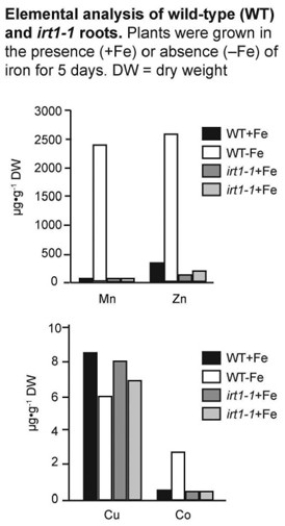 The irt1 gene is responsible for most of the iron uptake activity in roots (Vert et al., Plant Cell 14 [2002]: 1223-33). To determine the specificity of the irt1 transporter in Arabidopsis plants, researchers measured the concentration of manganese, zinc, copper, and cobalt contained in wild-type and irt1-1 mutant plants. What conclusions about irt1 specificity can you draw from the data in the accompanying figure?
 (Multiple Choice)
4.8/5 (72)
(72) The highest amount of oxygen will be found in soils containing large amounts of ________.
(Multiple Choice)
4.8/5 (77)
(77) Stunted growth and leaf necrosis, especially in young plants, is a typical symptom of deficiency of which element?
(Multiple Choice)
4.7/5 (71)
(71) Pine seedlings grown in sterile potting soil grow much slower than seedlings grown in soil from the area where the seeds were collected. This is most likely because ________.
(Multiple Choice)
4.8/5 (74)
(74) Why are anionic nutrients generally mobile in soils, and thus easily leached, while cationic nutrients are relatively immobile?
(Multiple Choice)
4.8/5 (75)
(75) Carnivorous plants have evolved mechanisms that trap and digest small animals. The products of this digestion are used to supplement the plant's supply of ________.
(Multiple Choice)
5.0/5 (93)
(93) If an African violet has chlorosis, which of the following elements might be a useful addition to the soil?
(Multiple Choice)
4.8/5 (79)
(79) 
Filters
- Essay(0)
- Multiple Choice(0)
- Short Answer(0)
- True False(0)
- Matching(0)