



 Chat with AI
Exam 39: Animal Form and Function

Exam 1: Biology and the Tree of Life37 Questions
Exam 2: Water and Carbon: the Chemical Basis of Life59 Questions
Exam 3: Protein Structure and Function59 Questions
Exam 4: Nucleic Acids and the Rna World43 Questions
Exam 5: An Introduction to Carbohydrates44 Questions
Exam 53: Ecosystems and Global Ecology57 Questions
Exam 6: Lipids, Membranes, and the First Cells59 Questions
Exam 7: Inside the Cell60 Questions
Exam 8: Energy and Enzymes: an Introduction to Metabolism60 Questions
Exam 9: Cellular Respiration and Fermentation61 Questions
Exam 10: Photosynthesis58 Questions
Exam 11: Cellcell Interactions52 Questions
Exam 12: The Cell Cycle59 Questions
Exam 13: Meiosis63 Questions
Exam 14: Mendel and the Gene60 Questions
Exam 15: Dna and the Gene: Synthesis and Repair51 Questions
Exam 16: How Genes Work48 Questions
Exam 17: Transcription, Rna Processing, and Translation58 Questions
Exam 18: Control of Gene Expression in Bacteria29 Questions
Exam 19: Control of Gene Expression in Eukaryotes56 Questions
Exam 20: The Molecular Revolution: Biotechnology and Beyond70 Questions
Exam 21: Genes, Development, and Evolution38 Questions
Exam 22: Evolution by Natural Selection38 Questions
Exam 23: Evolutionary Processes37 Questions
Exam 24: Speciation56 Questions
Exam 25: Phylogenies and the History of Life63 Questions
Exam 26: Bacteria and Archaea38 Questions
Exam 27: Protists37 Questions
Exam 28: Green Algae and Land Plants59 Questions
Exam 29: Fungi47 Questions
Exam 30: An Introduction to Animals48 Questions
Exam 31: Protostome Animals54 Questions
Exam 32: Deuterostome Animals60 Questions
Exam 33: Viruses44 Questions
Exam 34: Plant Form and Function46 Questions
Exam 35: Water and Sugar Transport in Plants47 Questions
Exam 36: Plant Nutrition54 Questions
Exam 37: Plant Sensory Systems, Signals, and Responses48 Questions
Exam 38: Plant Reproduction and Development51 Questions
Exam 39: Animal Form and Function53 Questions
Exam 40: Water and Electrolyte Balance in Animals60 Questions
Exam 41: Animal Nutrition94 Questions
Exam 42: Gas Exchange and Circulation93 Questions
Exam 43: Animal Nervous Systems100 Questions
Exam 44: Animal Sensory Systems50 Questions
Exam 45: Animal Movement40 Questions
Exam 46: Chemical Signals in Animals59 Questions
Exam 47: Animal Reproduction and Development104 Questions
Exam 48: The Immune System in Animals77 Questions
Exam 49: An Introduction to Ecology40 Questions
Exam 50: Behavioral Ecology40 Questions
Exam 51: Population Ecology57 Questions
Exam 52: Community Ecology55 Questions
Exam 54: Biodiversity and Conservation Biology43 Questions
Select questions type


Which of the following would increase the rate of heat exchange between an animal and its environment?
(Multiple Choice)
4.8/5  (84)
(84) 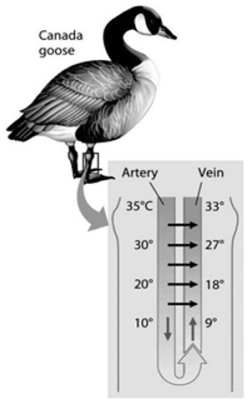 -Countercurrent heat exchangers are more useful for ________.
 (Multiple Choice)
4.7/5 (81)
(81) In a typical nerve cell, the nucleus is found in the ________.
(Multiple Choice)
4.9/5 (75)
(75) Which principle of heat exchange is the most important explanation for why birds look larger in colder weather because they fluff their feathers?
(Multiple Choice)
4.8/5 (71)
(71) Which of the following would be an example of an animal employing torpor to survive very cold weather?
(Multiple Choice)
4.9/5 (79)
(79) Which of the following is an example of a connective tissue?
(Multiple Choice)
4.9/5 (81)
(81) Compared to ectotherms, endothermic animals are likely to be at the greatest disadvantage in ________.
(Multiple Choice)
4.7/5 (94)
(94) The large surface area in the small intestine directly facilitates ________.
(Multiple Choice)
4.8/5 (61)
(61) You observe a lizard sitting on a log on a sunny day. If the lizard is attempting to raise its body temperature by basking in the sun, what mechanism of heat transfer is being employed?
(Multiple Choice)
5.0/5 (59)
(59) Blood is a type of connective tissue because blood ________.
(Multiple Choice)
5.0/5 (88)
(88) Chum salmon (Oncorhynchus ketA) are born in freshwater environments and then migrate to the sea. Near the end of their lives, they return to the freshwater stream where they were born to spawn. In freshwater, water constantly diffuses into the body and ions are lost from the body. In salt water, body water diffuses out of the body and excess ions are gained from the water. A salmon's gills have special cells to pump salt in or out of the body to maintain homeostasis. In response to the salmon's moves between freshwater and salt water, some cells in the gills are produced and others are destroyed. These changes made in the cells of the gills during the lifetime of an individual salmon are an example of which of the following?
(Multiple Choice)
5.0/5 (82)
(82) 
Filters
- Essay(0)
- Multiple Choice(0)
- Short Answer(0)
- True False(0)
- Matching(0)