



 Chat with AI
Exam 39: Animal Form and Function

Exam 1: Biology and the Tree of Life37 Questions
Exam 2: Water and Carbon: the Chemical Basis of Life59 Questions
Exam 3: Protein Structure and Function59 Questions
Exam 4: Nucleic Acids and the Rna World43 Questions
Exam 5: An Introduction to Carbohydrates44 Questions
Exam 53: Ecosystems and Global Ecology57 Questions
Exam 6: Lipids, Membranes, and the First Cells59 Questions
Exam 7: Inside the Cell60 Questions
Exam 8: Energy and Enzymes: an Introduction to Metabolism60 Questions
Exam 9: Cellular Respiration and Fermentation61 Questions
Exam 10: Photosynthesis58 Questions
Exam 11: Cellcell Interactions52 Questions
Exam 12: The Cell Cycle59 Questions
Exam 13: Meiosis63 Questions
Exam 14: Mendel and the Gene60 Questions
Exam 15: Dna and the Gene: Synthesis and Repair51 Questions
Exam 16: How Genes Work48 Questions
Exam 17: Transcription, Rna Processing, and Translation58 Questions
Exam 18: Control of Gene Expression in Bacteria29 Questions
Exam 19: Control of Gene Expression in Eukaryotes56 Questions
Exam 20: The Molecular Revolution: Biotechnology and Beyond70 Questions
Exam 21: Genes, Development, and Evolution38 Questions
Exam 22: Evolution by Natural Selection38 Questions
Exam 23: Evolutionary Processes37 Questions
Exam 24: Speciation56 Questions
Exam 25: Phylogenies and the History of Life63 Questions
Exam 26: Bacteria and Archaea38 Questions
Exam 27: Protists37 Questions
Exam 28: Green Algae and Land Plants59 Questions
Exam 29: Fungi47 Questions
Exam 30: An Introduction to Animals48 Questions
Exam 31: Protostome Animals54 Questions
Exam 32: Deuterostome Animals60 Questions
Exam 33: Viruses44 Questions
Exam 34: Plant Form and Function46 Questions
Exam 35: Water and Sugar Transport in Plants47 Questions
Exam 36: Plant Nutrition54 Questions
Exam 37: Plant Sensory Systems, Signals, and Responses48 Questions
Exam 38: Plant Reproduction and Development51 Questions
Exam 39: Animal Form and Function53 Questions
Exam 40: Water and Electrolyte Balance in Animals60 Questions
Exam 41: Animal Nutrition94 Questions
Exam 42: Gas Exchange and Circulation93 Questions
Exam 43: Animal Nervous Systems100 Questions
Exam 44: Animal Sensory Systems50 Questions
Exam 45: Animal Movement40 Questions
Exam 46: Chemical Signals in Animals59 Questions
Exam 47: Animal Reproduction and Development104 Questions
Exam 48: The Immune System in Animals77 Questions
Exam 49: An Introduction to Ecology40 Questions
Exam 50: Behavioral Ecology40 Questions
Exam 51: Population Ecology57 Questions
Exam 52: Community Ecology55 Questions
Exam 54: Biodiversity and Conservation Biology43 Questions
Select questions type


A moth preparing for flight on a cold morning may warm its flight muscles via ________.
(Multiple Choice)
5.0/5  (74)
(74)  -The thin horizontal arrows in the accompanying figure show that the ________.
 (Multiple Choice)
4.7/5 (71)
(71) The crucian carp (Carassius carassius) is a Northern European freshwater fish often inhabiting ponds that become hypoxic (have reduced oxygen levels) and even anoxic (have no oxygen) when the surface freezes during the winter. Surprisingly, when oxygen levels are normal, these fish lack the lamellae that provide a large surface area for gas exchange between water and blood: their gills are smooth. Yet when the level of oxygen in the water falls, the gill morphology undergoes a change: packing cells stop dividing and programmed cell death is induced, exposing gill lamellae that were buried in other tissue. With lamellae exposed, the gills have increased surface area for gas exchange. These changes in gill lamellar profile are reversible: investigators observed that the gills return to their normal structure within seven days after returning the fish to well-oxygenated water. (Jørund Sollid, Paula De Angelis, Kristian Gundersen, and Göran E. Nilsson. 2003. Hypoxia induces adaptive and reversible gross morphological changes in crucian carp gills. Journal of Experimental Biology 206:3667-73.)
Refer to the paragraph on crucian carp. Gills serve multiple functions in fish in addition to gas exchange. Given the large surface area of gills with lamellae, what is the most likely explanation for why crucian carp cover protruding lamellae in their gills when levels of oxygen are normal?
(Multiple Choice)
4.8/5 (80)
(80) Which of the following statements comparing endotherms and ectotherms is correct?
(Multiple Choice)
4.8/5 (80)
(80) A behavioral physiologist is studying the homeostatic control of blood pH. In a trial, a lizard runs on a treadmill for a set amount of time and the blood pH is measured. The blood pH drops as carbon dioxide is released into the bloodstream. Which component of the homeostatic feedback system is responsible for determining if the blood pH is far enough from normal that a response is necessary?
(Multiple Choice)
4.8/5 (82)
(82)
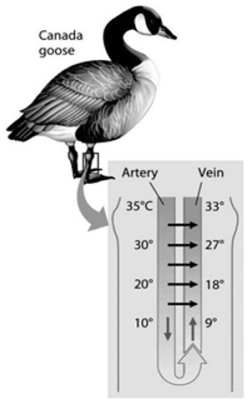
-Examine the accompanying figure. Near a goose's abdomen, the countercurrent arrangement of the arterial and venous blood vessels causes the ________.
-Examine the accompanying figure. Near a goose's abdomen, the countercurrent arrangement of the arterial and venous blood vessels causes the ________. (Multiple Choice)
4.7/5 (76)
(76) The composition of connective tissue determines its physical properties. If you gently bend your ear, and then let go, the shape of your ear will return. This can best be explained by the presence of what tissue type in your ear?
(Multiple Choice)
4.8/5 (62)
(62) Most mammals are strict homeotherms. Elephants allow their body temperature to vary during the hottest parts of the day, meaning they are ________.
(Multiple Choice)
4.8/5 (67)
(67) You are looking through a microscope at a slide of animal tissue and see a single layer of flat, closely packed cells that cover a surface. This specific tissue is most likely ________.
(Multiple Choice)
4.9/5 (81)
(81) You discover a new species of bacteria that grows in aquatic environments with high salt levels. While studying these bacteria, you note that their internal environment is similar to the salt concentrations in their surroundings. You also discover that the internal salt concentrations of the bacteria change as the salt concentration in their environment changes. The new species can tolerate small changes in this way but dies from large changes because it has no mechanism for altering its own internal salt levels. What type of homeostatic mechanism is this species using to regulate its internal salt levels?
(Multiple Choice)
4.9/5 (79)
(79) An elephant and a mouse are running in full sunlight, and both overheat by the same amount above their normal body temperatures. When they move into the shade and rest, which animal will cool down faster?
(Multiple Choice)
4.8/5 (78)
(78) In house sparrows (Passer domesticus) it is generally found that both males and females care for the eggs and young. However, some male house sparrows do not provide parental care. In addition, it is known that young that receive parental care from both the male and female are more likely to survive to fledging (leaving the nest). Which of the following activities by males that do not provide parental care would represent the most beneficial trade-off for the reduced survival of their offspring?
(Multiple Choice)
4.9/5 (81)
(81) Compared with a smaller cell, a larger cell of the same shape has ________.
(Multiple Choice)
4.9/5 (72)
(72) You are studying a large tropical reptile that has a high and relatively stable body temperature. How would you determine whether this animal is an endotherm or an ectotherm?
(Multiple Choice)
4.8/5 (67)
(67) A researcher is setting up an experiment to measure basal metabolic rate in prairie voles (Microtus ochrogaster-a small rodent). Which of the following would be the best set of conditions for the voles immediately before and during the measurement?
(Multiple Choice)
4.8/5 (82)
(82) Which of the following structural features of epithelial tissues are related to the function of these cells? Epithelial cells ________.
(Multiple Choice)
4.7/5 (78)
(78) If you were to view a sample of animal tissue under a light microscope and notice an extensive extracellular matrix surrounding a tissue, which tissue type would you most suspect?
(Multiple Choice)
4.8/5 (79)
(79) The body tissue that consists largely of material located outside of cells is ________.
(Multiple Choice)
4.7/5 (80)
(80) 
Filters
- Essay(0)
- Multiple Choice(0)
- Short Answer(0)
- True False(0)
- Matching(0)