



 Chat with AI
Exam 40: Water and Electrolyte Balance in Animals

Exam 1: Biology and the Tree of Life37 Questions
Exam 2: Water and Carbon: the Chemical Basis of Life59 Questions
Exam 3: Protein Structure and Function59 Questions
Exam 4: Nucleic Acids and the Rna World43 Questions
Exam 5: An Introduction to Carbohydrates44 Questions
Exam 53: Ecosystems and Global Ecology57 Questions
Exam 6: Lipids, Membranes, and the First Cells59 Questions
Exam 7: Inside the Cell60 Questions
Exam 8: Energy and Enzymes: an Introduction to Metabolism60 Questions
Exam 9: Cellular Respiration and Fermentation61 Questions
Exam 10: Photosynthesis58 Questions
Exam 11: Cellcell Interactions52 Questions
Exam 12: The Cell Cycle59 Questions
Exam 13: Meiosis63 Questions
Exam 14: Mendel and the Gene60 Questions
Exam 15: Dna and the Gene: Synthesis and Repair51 Questions
Exam 16: How Genes Work48 Questions
Exam 17: Transcription, Rna Processing, and Translation58 Questions
Exam 18: Control of Gene Expression in Bacteria29 Questions
Exam 19: Control of Gene Expression in Eukaryotes56 Questions
Exam 20: The Molecular Revolution: Biotechnology and Beyond70 Questions
Exam 21: Genes, Development, and Evolution38 Questions
Exam 22: Evolution by Natural Selection38 Questions
Exam 23: Evolutionary Processes37 Questions
Exam 24: Speciation56 Questions
Exam 25: Phylogenies and the History of Life63 Questions
Exam 26: Bacteria and Archaea38 Questions
Exam 27: Protists37 Questions
Exam 28: Green Algae and Land Plants59 Questions
Exam 29: Fungi47 Questions
Exam 30: An Introduction to Animals48 Questions
Exam 31: Protostome Animals54 Questions
Exam 32: Deuterostome Animals60 Questions
Exam 33: Viruses44 Questions
Exam 34: Plant Form and Function46 Questions
Exam 35: Water and Sugar Transport in Plants47 Questions
Exam 36: Plant Nutrition54 Questions
Exam 37: Plant Sensory Systems, Signals, and Responses48 Questions
Exam 38: Plant Reproduction and Development51 Questions
Exam 39: Animal Form and Function53 Questions
Exam 40: Water and Electrolyte Balance in Animals60 Questions
Exam 41: Animal Nutrition94 Questions
Exam 42: Gas Exchange and Circulation93 Questions
Exam 43: Animal Nervous Systems100 Questions
Exam 44: Animal Sensory Systems50 Questions
Exam 45: Animal Movement40 Questions
Exam 46: Chemical Signals in Animals59 Questions
Exam 47: Animal Reproduction and Development104 Questions
Exam 48: The Immune System in Animals77 Questions
Exam 49: An Introduction to Ecology40 Questions
Exam 50: Behavioral Ecology40 Questions
Exam 51: Population Ecology57 Questions
Exam 52: Community Ecology55 Questions
Exam 54: Biodiversity and Conservation Biology43 Questions
Select questions type


What is the function of the osmotic gradient found in the kidney? The osmotic gradient allows for ________.
(Multiple Choice)
4.8/5  (68)
(68) Which of the following most accurately describes selective permeability?
(Multiple Choice)
4.9/5 (74)
(74) In animals, nitrogenous wastes are produced mostly from the catabolism of ________.
(Multiple Choice)
4.8/5 (81)
(81) Salmon eggs hatch in freshwater. The fish then migrate to the ocean (a hypertonic solution) and, after several years of feeding and growing, return to freshwater to breed. How can these organisms make the transition from freshwater to ocean water and back to freshwater?
(Multiple Choice)
4.9/5 (73)
(73) If you are hiking through the desert for several days, which of the following should you drink to ensure proper hydration?
(Multiple Choice)
4.8/5 (79)
(79) A necropsy (postmortem analysis) of a marine sea star that died after it was mistakenly placed in freshwater would likely show that it died because ________.
(Multiple Choice)
4.9/5 (72)
(72) Osmoregulation in the Shark
-Refer to the accompanying table. Because the shark rectal gland functions only when ATP molecules are present, what can you infer about the movement of Na+, K+, and Cl−?
(Multiple Choice)
4.8/5 (86)
(86) Through studies of insect Malpighian tubules, researchers found that K+ accumulated on the inner face of the tubule, against its concentration gradient. What can you infer about the mechanism of transport?
(Multiple Choice)
4.9/5 (91)
(91) 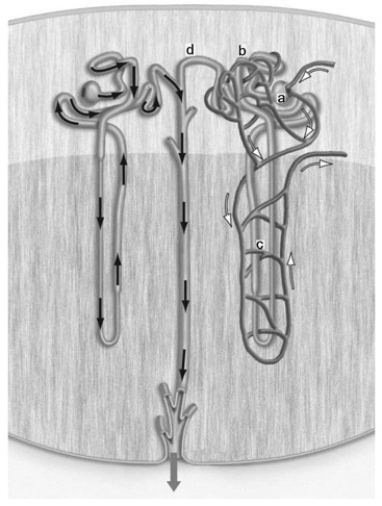 The accompanying figure shows a nephron. Filtration takes place in the structure labeled ________.
 (Multiple Choice)
4.8/5 (84)
(84) The Na+/Cl−/K+ cotransporter in the epithelial cells of the gills of bony fishes is found ________.
(Multiple Choice)
4.9/5 (81)
(81) Water loss from a terrestrial insect's surface is minimal due to which of the following structures?
(Multiple Choice)
4.7/5 (68)
(68) The filtrate formed in the renal corpuscle is analogous to the ________ formed in Malpighian tubules.
(Multiple Choice)
4.7/5 (84)
(84) Materials are returned to the blood from the filtrate by which of the following processes?
(Multiple Choice)
4.8/5 (77)
(77) Tissues of sharks are isotonic to seawater, but their concentrations of sodium ions, potassium ions, and chloride ions in cells and extracellular fluids are similar to those of freshwater fishes. What can you infer about the movement of sodium and chloride in these animals?
(Multiple Choice)
5.0/5 (93)
(93) Excretory organs known as Malpighian tubules are present in ________.
(Multiple Choice)
4.8/5 (74)
(74) Reabsorption of water in the hindgut of insects is controlled by which of the following?
(Multiple Choice)
4.7/5 (72)
(72) Which of the following pairs of organisms excrete nitrogenous wastes in the form of uric acid?
(Multiple Choice)
4.9/5 (74)
(74) 
Filters
- Essay(0)
- Multiple Choice(0)
- Short Answer(0)
- True False(0)
- Matching(0)