



 Chat with AI
Exam 42: Gas Exchange and Circulation

Exam 1: Biology and the Tree of Life37 Questions
Exam 2: Water and Carbon: the Chemical Basis of Life59 Questions
Exam 3: Protein Structure and Function59 Questions
Exam 4: Nucleic Acids and the Rna World43 Questions
Exam 5: An Introduction to Carbohydrates44 Questions
Exam 53: Ecosystems and Global Ecology57 Questions
Exam 6: Lipids, Membranes, and the First Cells59 Questions
Exam 7: Inside the Cell60 Questions
Exam 8: Energy and Enzymes: an Introduction to Metabolism60 Questions
Exam 9: Cellular Respiration and Fermentation61 Questions
Exam 10: Photosynthesis58 Questions
Exam 11: Cellcell Interactions52 Questions
Exam 12: The Cell Cycle59 Questions
Exam 13: Meiosis63 Questions
Exam 14: Mendel and the Gene60 Questions
Exam 15: Dna and the Gene: Synthesis and Repair51 Questions
Exam 16: How Genes Work48 Questions
Exam 17: Transcription, Rna Processing, and Translation58 Questions
Exam 18: Control of Gene Expression in Bacteria29 Questions
Exam 19: Control of Gene Expression in Eukaryotes56 Questions
Exam 20: The Molecular Revolution: Biotechnology and Beyond70 Questions
Exam 21: Genes, Development, and Evolution38 Questions
Exam 22: Evolution by Natural Selection38 Questions
Exam 23: Evolutionary Processes37 Questions
Exam 24: Speciation56 Questions
Exam 25: Phylogenies and the History of Life63 Questions
Exam 26: Bacteria and Archaea38 Questions
Exam 27: Protists37 Questions
Exam 28: Green Algae and Land Plants59 Questions
Exam 29: Fungi47 Questions
Exam 30: An Introduction to Animals48 Questions
Exam 31: Protostome Animals54 Questions
Exam 32: Deuterostome Animals60 Questions
Exam 33: Viruses44 Questions
Exam 34: Plant Form and Function46 Questions
Exam 35: Water and Sugar Transport in Plants47 Questions
Exam 36: Plant Nutrition54 Questions
Exam 37: Plant Sensory Systems, Signals, and Responses48 Questions
Exam 38: Plant Reproduction and Development51 Questions
Exam 39: Animal Form and Function53 Questions
Exam 40: Water and Electrolyte Balance in Animals60 Questions
Exam 41: Animal Nutrition94 Questions
Exam 42: Gas Exchange and Circulation93 Questions
Exam 43: Animal Nervous Systems100 Questions
Exam 44: Animal Sensory Systems50 Questions
Exam 45: Animal Movement40 Questions
Exam 46: Chemical Signals in Animals59 Questions
Exam 47: Animal Reproduction and Development104 Questions
Exam 48: The Immune System in Animals77 Questions
Exam 49: An Introduction to Ecology40 Questions
Exam 50: Behavioral Ecology40 Questions
Exam 51: Population Ecology57 Questions
Exam 52: Community Ecology55 Questions
Exam 54: Biodiversity and Conservation Biology43 Questions
Select questions type


A large increase in albumin concentration in the plasma of a dog would result in which of the following?
(Multiple Choice)
4.9/5  (87)
(87) What would be the consequences if we were to reverse the direction of water flow over the gills of a fish, moving water inward past the operculum, past the gills, then out of the mouth? This reversal of water flow would ________.
(Multiple Choice)
4.8/5 (91)
(91) To become bound to hemoglobin for transport in a mammal, atmospheric molecules of oxygen must cross ________.
(Multiple Choice)
5.0/5 (72)
(72) To increase the output of the heart, what adjustments are made in the circulatory system?
1) an increase in heart rate
2) an increase in stroke volume of the heart
3) a reduced blood flow to the brain
(Multiple Choice)
4.9/5 (78)
(78) Which component of blood is responsible for the formation of blood clots?
(Multiple Choice)
4.9/5 (66)
(66) Which of the following develops the greatest pressure on the blood in the mammalian aorta?
(Multiple Choice)
4.7/5 (67)
(67) Which of the following respiratory systems is NOT closely associated with the blood supply?
(Multiple Choice)
4.8/5 (80)
(80) When you hold your breath, which of the following blood gas changes first leads to the urge to breathe?
(Multiple Choice)
4.8/5 (71)
(71) A rabbit taken from a meadow near sea level and moved to a meadow high on a mountainside would have some trouble breathing. Why?
(Multiple Choice)
4.7/5 (69)
(69) Altitude sickness occurs when a hiker ascends to altitudes where the density of oxygen is low. Carbonic anhydrase inhibitors cause less movement of carbonic acid toward carbon dioxide production and are used as a prophylactic treatment of altitude sickness. How does this treatment decrease the symptoms of high altitude sickness?
(Multiple Choice)
4.9/5 (76)
(76) 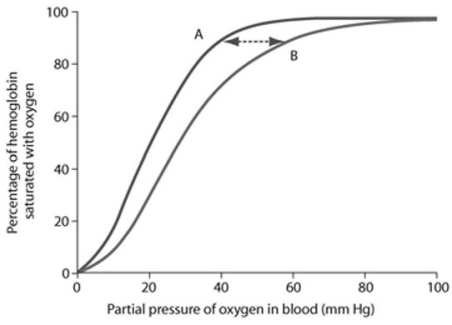 Based on the accompanying figure, showing fetal (A) and adult (B) oxygen-hemoglobin saturation curves, which of the following conclusions is TRUE?
 (Multiple Choice)
4.8/5 (70)
(70) Blockage of vessels supplying blood to the heart itself is ________.
(Multiple Choice)
4.9/5 (81)
(81) The movement of air along parabronchi is most similar to the movement of ________.
(Multiple Choice)
4.9/5 (72)
(72) If the inner lining of the air sacs is neither thin nor highly vascularized, then what can be inferred about the air sacs?
(Multiple Choice)
4.8/5 (71)
(71) You are a physician, and you are seeing a patient who complains of abnormal fatigue during exercise. You find that the immediate problem is a buildup of carbon dioxide in the tissues. What is the most likely cause?
(Multiple Choice)
5.0/5 (81)
(81) In what way does hemoglobin act as a buffer against changes in blood pH?
(Multiple Choice)
4.8/5 (90)
(90) In which of the following organisms does blood flow from the lungs to the heart before circulating through the rest of the body?
(Multiple Choice)
4.8/5 (69)
(69) Organisms with a circulating body fluid that is distinct from the fluid that directly surrounds the body's cells are likely to have ________.
(Multiple Choice)
4.9/5 (73)
(73) If other factors are equal, which of the following environments would have the highest level of dissolved oxygen?
(Multiple Choice)
4.8/5 (86)
(86) A species that has a normal resting systolic blood pressure of greater than 260 mm Hg is likely to be ________.
(Multiple Choice)
4.8/5 (83)
(83) 
Filters
- Essay(0)
- Multiple Choice(0)
- Short Answer(0)
- True False(0)
- Matching(0)