



 Chat with AI
Exam 44: Animal Sensory Systems

Exam 1: Biology and the Tree of Life37 Questions
Exam 2: Water and Carbon: the Chemical Basis of Life59 Questions
Exam 3: Protein Structure and Function59 Questions
Exam 4: Nucleic Acids and the Rna World43 Questions
Exam 5: An Introduction to Carbohydrates44 Questions
Exam 53: Ecosystems and Global Ecology57 Questions
Exam 6: Lipids, Membranes, and the First Cells59 Questions
Exam 7: Inside the Cell60 Questions
Exam 8: Energy and Enzymes: an Introduction to Metabolism60 Questions
Exam 9: Cellular Respiration and Fermentation61 Questions
Exam 10: Photosynthesis58 Questions
Exam 11: Cellcell Interactions52 Questions
Exam 12: The Cell Cycle59 Questions
Exam 13: Meiosis63 Questions
Exam 14: Mendel and the Gene60 Questions
Exam 15: Dna and the Gene: Synthesis and Repair51 Questions
Exam 16: How Genes Work48 Questions
Exam 17: Transcription, Rna Processing, and Translation58 Questions
Exam 18: Control of Gene Expression in Bacteria29 Questions
Exam 19: Control of Gene Expression in Eukaryotes56 Questions
Exam 20: The Molecular Revolution: Biotechnology and Beyond70 Questions
Exam 21: Genes, Development, and Evolution38 Questions
Exam 22: Evolution by Natural Selection38 Questions
Exam 23: Evolutionary Processes37 Questions
Exam 24: Speciation56 Questions
Exam 25: Phylogenies and the History of Life63 Questions
Exam 26: Bacteria and Archaea38 Questions
Exam 27: Protists37 Questions
Exam 28: Green Algae and Land Plants59 Questions
Exam 29: Fungi47 Questions
Exam 30: An Introduction to Animals48 Questions
Exam 31: Protostome Animals54 Questions
Exam 32: Deuterostome Animals60 Questions
Exam 33: Viruses44 Questions
Exam 34: Plant Form and Function46 Questions
Exam 35: Water and Sugar Transport in Plants47 Questions
Exam 36: Plant Nutrition54 Questions
Exam 37: Plant Sensory Systems, Signals, and Responses48 Questions
Exam 38: Plant Reproduction and Development51 Questions
Exam 39: Animal Form and Function53 Questions
Exam 40: Water and Electrolyte Balance in Animals60 Questions
Exam 41: Animal Nutrition94 Questions
Exam 42: Gas Exchange and Circulation93 Questions
Exam 43: Animal Nervous Systems100 Questions
Exam 44: Animal Sensory Systems50 Questions
Exam 45: Animal Movement40 Questions
Exam 46: Chemical Signals in Animals59 Questions
Exam 47: Animal Reproduction and Development104 Questions
Exam 48: The Immune System in Animals77 Questions
Exam 49: An Introduction to Ecology40 Questions
Exam 50: Behavioral Ecology40 Questions
Exam 51: Population Ecology57 Questions
Exam 52: Community Ecology55 Questions
Exam 54: Biodiversity and Conservation Biology43 Questions
Select questions type


Mechanoreceptors that react to changes in pressure are part of the ________.
(Multiple Choice)
4.8/5  (66)
(66) Sensory transduction of light in the vertebrate retina is accomplished by ________.
(Multiple Choice)
4.7/5 (94)
(94) A salmon follows a scent trail upstream to find its way back to the stream where it hatched. What type of sensory receptor cell would it use?
(Multiple Choice)
4.7/5 (81)
(81) Which type of receptor would you expect to be most abundant in the antennae of a moth?
(Multiple Choice)
5.0/5 (83)
(83) Refer to the accompanying diagram of the ear to answer the question(s) below. 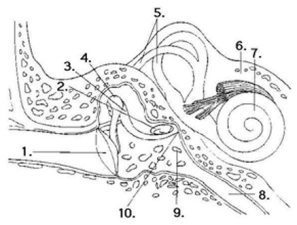 -Vibrations from the tympanic membrane to the oval window are transmitted by the structures at which numbers?
 (Multiple Choice)
4.9/5 (82)
(82) How would the vision of a fly be affected if several of the axons extending from the ommatidia of its compound eye were damaged?
(Multiple Choice)
4.9/5 (86)
(86) Refer to the accompanying diagram of the ear to answer the question(s) below.
-The cochlea is represented by which number?
-The cochlea is represented by which number? (Multiple Choice)
4.8/5 (70)
(70) The cochlea is an organ of auditory transduction that contains ________.
(Multiple Choice)
4.8/5 (87)
(87) Tastes and smells are distinct kinds of environmental information in that ________.
(Multiple Choice)
5.0/5 (67)
(67) 
Filters
- Essay(0)
- Multiple Choice(0)
- Short Answer(0)
- True False(0)
- Matching(0)