



 Chat with AI
Exam 44: Animal Sensory Systems

Exam 1: Biology and the Tree of Life37 Questions
Exam 2: Water and Carbon: the Chemical Basis of Life59 Questions
Exam 3: Protein Structure and Function59 Questions
Exam 4: Nucleic Acids and the Rna World43 Questions
Exam 5: An Introduction to Carbohydrates44 Questions
Exam 53: Ecosystems and Global Ecology57 Questions
Exam 6: Lipids, Membranes, and the First Cells59 Questions
Exam 7: Inside the Cell60 Questions
Exam 8: Energy and Enzymes: an Introduction to Metabolism60 Questions
Exam 9: Cellular Respiration and Fermentation61 Questions
Exam 10: Photosynthesis58 Questions
Exam 11: Cellcell Interactions52 Questions
Exam 12: The Cell Cycle59 Questions
Exam 13: Meiosis63 Questions
Exam 14: Mendel and the Gene60 Questions
Exam 15: Dna and the Gene: Synthesis and Repair51 Questions
Exam 16: How Genes Work48 Questions
Exam 17: Transcription, Rna Processing, and Translation58 Questions
Exam 18: Control of Gene Expression in Bacteria29 Questions
Exam 19: Control of Gene Expression in Eukaryotes56 Questions
Exam 20: The Molecular Revolution: Biotechnology and Beyond70 Questions
Exam 21: Genes, Development, and Evolution38 Questions
Exam 22: Evolution by Natural Selection38 Questions
Exam 23: Evolutionary Processes37 Questions
Exam 24: Speciation56 Questions
Exam 25: Phylogenies and the History of Life63 Questions
Exam 26: Bacteria and Archaea38 Questions
Exam 27: Protists37 Questions
Exam 28: Green Algae and Land Plants59 Questions
Exam 29: Fungi47 Questions
Exam 30: An Introduction to Animals48 Questions
Exam 31: Protostome Animals54 Questions
Exam 32: Deuterostome Animals60 Questions
Exam 33: Viruses44 Questions
Exam 34: Plant Form and Function46 Questions
Exam 35: Water and Sugar Transport in Plants47 Questions
Exam 36: Plant Nutrition54 Questions
Exam 37: Plant Sensory Systems, Signals, and Responses48 Questions
Exam 38: Plant Reproduction and Development51 Questions
Exam 39: Animal Form and Function53 Questions
Exam 40: Water and Electrolyte Balance in Animals60 Questions
Exam 41: Animal Nutrition94 Questions
Exam 42: Gas Exchange and Circulation93 Questions
Exam 43: Animal Nervous Systems100 Questions
Exam 44: Animal Sensory Systems50 Questions
Exam 45: Animal Movement40 Questions
Exam 46: Chemical Signals in Animals59 Questions
Exam 47: Animal Reproduction and Development104 Questions
Exam 48: The Immune System in Animals77 Questions
Exam 49: An Introduction to Ecology40 Questions
Exam 50: Behavioral Ecology40 Questions
Exam 51: Population Ecology57 Questions
Exam 52: Community Ecology55 Questions
Exam 54: Biodiversity and Conservation Biology43 Questions
Select questions type


Animals that can detect ultraviolet (UV) light differ from humans by having ________.
(Multiple Choice)
4.7/5  (86)
(86) Which of the following would explain why a person was able to hear only high-frequency sounds?
(Multiple Choice)
4.7/5 (76)
(76) Hair cells in the vertebrate ear are responsible for transducing sound pressure waves. Ion channels in the hair cell membrane open when ________.
(Multiple Choice)
5.0/5 (80)
(80) The cochlea ________.
I. amplifies sound vibrations
II. collects sound pressure waves
III. detects the frequency of sounds
(Multiple Choice)
4.8/5 (83)
(83) Bat echolocation (sonar) is most closely related to which human sensory system?
(Multiple Choice)
4.9/5 (71)
(71) Partial or complete loss of hearing (deafness) can be caused by damage to the ________.
I. axons of the neurons associated with each hair cell that carry information to the brain
II. hair cells (the sensory receptors) in the cochlea
III. tympanic membrane, or eardrum
(Multiple Choice)
4.9/5 (71)
(71) What would happen if an enzyme inhibitor for the enzyme phosphodiesterase (PDE) was applied to a vertebrate eye?
(Multiple Choice)
4.9/5 (74)
(74) Refer to this diagram of the ear to answer the question(s) below. 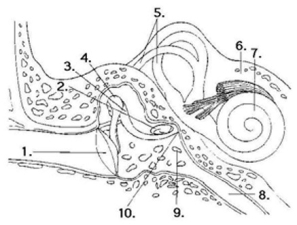 -Hair cells are found in structures represented by which numbers?
 (Multiple Choice)
4.8/5 (83)
(83) Two students studying physiology taste a known "bitter" substance. Student A reports sensing both a bitter taste and a salty taste, but student B reports only a salty taste. What is the most logical explanation?
(Multiple Choice)
4.8/5 (82)
(82) Deafness caused by loud sounds often results from damage to which receptor cells?
(Multiple Choice)
4.8/5 (81)
(81) Refer to the accompanying diagram of the ear to answer the question(s) below. 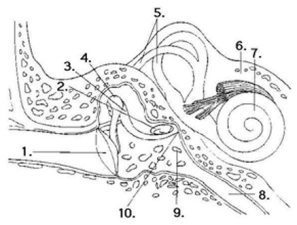 -The structure involved in equalizing the pressure between the ear and the atmosphere is represented by which number?
 (Multiple Choice)
4.9/5 (76)
(76) It can be very difficult to select an angle for sneaking up to a grasshopper to catch it because grasshoppers have ________.
(Multiple Choice)
4.9/5 (96)
(96) Most mammals have 1000 or more genes that encode receptor proteins on the surface of odor-receptor neurons, so why do some mammals have a better sense of smell than others?
(Multiple Choice)
4.7/5 (78)
(78) What structures would neurobiologists look for if they are interested in determining if an animal can see in color?
(Multiple Choice)
4.7/5 (81)
(81) External chemical signals that coordinate potential reproductive partners are called ________.
(Multiple Choice)
4.7/5 (81)
(81) How would an abnormally large oval window in a mouse affect that animal's hearing?
(Multiple Choice)
4.7/5 (97)
(97) The transduction of sound waves into action potentials by the human ear takes place ________.
(Multiple Choice)
4.8/5 (83)
(83) 
Filters
- Essay(0)
- Multiple Choice(0)
- Short Answer(0)
- True False(0)
- Matching(0)