



 Chat with AI
Exam 52: Community Ecology

Exam 1: Biology and the Tree of Life37 Questions
Exam 2: Water and Carbon: the Chemical Basis of Life59 Questions
Exam 3: Protein Structure and Function59 Questions
Exam 4: Nucleic Acids and the Rna World43 Questions
Exam 5: An Introduction to Carbohydrates44 Questions
Exam 53: Ecosystems and Global Ecology57 Questions
Exam 6: Lipids, Membranes, and the First Cells59 Questions
Exam 7: Inside the Cell60 Questions
Exam 8: Energy and Enzymes: an Introduction to Metabolism60 Questions
Exam 9: Cellular Respiration and Fermentation61 Questions
Exam 10: Photosynthesis58 Questions
Exam 11: Cellcell Interactions52 Questions
Exam 12: The Cell Cycle59 Questions
Exam 13: Meiosis63 Questions
Exam 14: Mendel and the Gene60 Questions
Exam 15: Dna and the Gene: Synthesis and Repair51 Questions
Exam 16: How Genes Work48 Questions
Exam 17: Transcription, Rna Processing, and Translation58 Questions
Exam 18: Control of Gene Expression in Bacteria29 Questions
Exam 19: Control of Gene Expression in Eukaryotes56 Questions
Exam 20: The Molecular Revolution: Biotechnology and Beyond70 Questions
Exam 21: Genes, Development, and Evolution38 Questions
Exam 22: Evolution by Natural Selection38 Questions
Exam 23: Evolutionary Processes37 Questions
Exam 24: Speciation56 Questions
Exam 25: Phylogenies and the History of Life63 Questions
Exam 26: Bacteria and Archaea38 Questions
Exam 27: Protists37 Questions
Exam 28: Green Algae and Land Plants59 Questions
Exam 29: Fungi47 Questions
Exam 30: An Introduction to Animals48 Questions
Exam 31: Protostome Animals54 Questions
Exam 32: Deuterostome Animals60 Questions
Exam 33: Viruses44 Questions
Exam 34: Plant Form and Function46 Questions
Exam 35: Water and Sugar Transport in Plants47 Questions
Exam 36: Plant Nutrition54 Questions
Exam 37: Plant Sensory Systems, Signals, and Responses48 Questions
Exam 38: Plant Reproduction and Development51 Questions
Exam 39: Animal Form and Function53 Questions
Exam 40: Water and Electrolyte Balance in Animals60 Questions
Exam 41: Animal Nutrition94 Questions
Exam 42: Gas Exchange and Circulation93 Questions
Exam 43: Animal Nervous Systems100 Questions
Exam 44: Animal Sensory Systems50 Questions
Exam 45: Animal Movement40 Questions
Exam 46: Chemical Signals in Animals59 Questions
Exam 47: Animal Reproduction and Development104 Questions
Exam 48: The Immune System in Animals77 Questions
Exam 49: An Introduction to Ecology40 Questions
Exam 50: Behavioral Ecology40 Questions
Exam 51: Population Ecology57 Questions
Exam 52: Community Ecology55 Questions
Exam 54: Biodiversity and Conservation Biology43 Questions
Select questions type


Refer to the accompanying art to answer the question below. 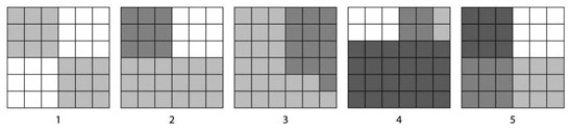 According to the Shannon Diversity Index, which of the five blocks shown, with each containing 36 squares, would show the greatest diversity?
 (Multiple Choice)
4.8/5  (73)
(73) 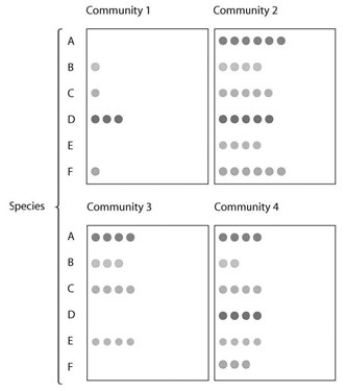 -In the accompanying figure, where do we find the highest species richness?
 (Multiple Choice)
5.0/5 (94)
(94) Use the accompanying diagram to answer the question(s) below. 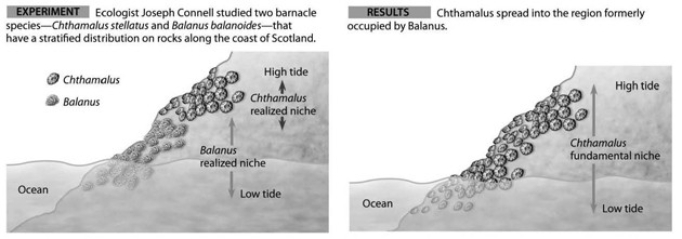 -Which of the following statements is a valid conclusion of this experiment?
 (Multiple Choice)
4.8/5 (92)
(92) 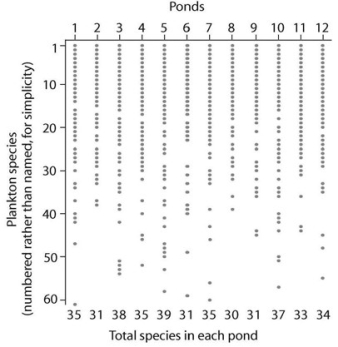 Looking at the results in the accompanying figure, which hypothesis (by Clements or Gleason) is supported by the data?
I. Clements
II. Gleason
Looking at the results in the accompanying figure, which hypothesis (by Clements or Gleason) is supported by the data?
I. Clements
II. Gleason (Multiple Choice)
4.8/5 (83)
(83) Which species interaction depends on prey density and effectiveness of prey defenses to determine the impact on the prey population?
(Multiple Choice)
4.7/5 (88)
(88) Use the accompanying diagram of five islands formed at around the same time near a particular mainland, as well as MacArthur and Wilson's island biogeography principles, to answer the question(s) below. 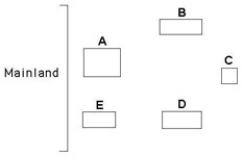 -Which island would likely have the lowest extinction rate?
 (Multiple Choice)
5.0/5 (84)
(84) Which one of the following animals would most likely be defined as a keystone species?
(Multiple Choice)
4.8/5 (77)
(77) 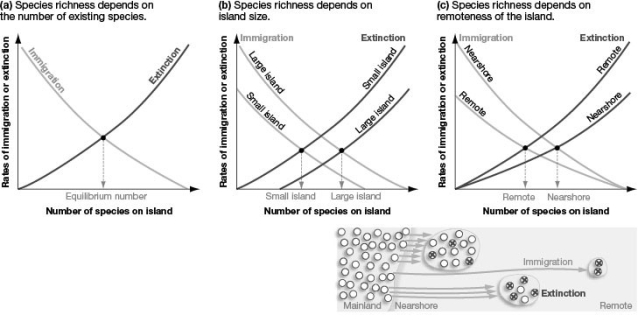 -Which of the following statements regarding the figure shown is TRUE?
 (Multiple Choice)
4.8/5 (92)
(92) The symbols +, −, and 0 are to be used to show the results of interactions between individuals and groups of individuals in the examples that follow. The symbol + denotes a positive interaction, − denotes a negative interaction, and 0 denotes where individuals are not affected by interacting. The first symbol refers to the first organism mentioned.
-What interactions exist between a lion pride and a hyena pack?
(Multiple Choice)
4.7/5 (89)
(89) Use the accompanying diagram of five islands formed at around the same time near a particular mainland, as well as MacArthur and Wilson's island biogeography principles, to answer the question(s) below.
-Which island would likely have the greatest species diversity?
-Which island would likely have the greatest species diversity? (Multiple Choice)
4.7/5 (77)
(77) During a one-year study, researchers found no difference in treehopper populations in any of their control and experimental groups. What could they measure during the second year to gain information about why this might have occurred?
(Multiple Choice)
4.7/5 (77)
(77) Which of the following are responsible for generating successional pathways?
I. species interactions
II. historical and environmental context
III. species traits
(Multiple Choice)
5.0/5 (92)
(92) 
Filters
- Essay(0)
- Multiple Choice(0)
- Short Answer(0)
- True False(0)
- Matching(0)