



 Chat with AI
Exam 52: Community Ecology

Exam 1: Biology and the Tree of Life37 Questions
Exam 2: Water and Carbon: the Chemical Basis of Life59 Questions
Exam 3: Protein Structure and Function59 Questions
Exam 4: Nucleic Acids and the Rna World43 Questions
Exam 5: An Introduction to Carbohydrates44 Questions
Exam 53: Ecosystems and Global Ecology57 Questions
Exam 6: Lipids, Membranes, and the First Cells59 Questions
Exam 7: Inside the Cell60 Questions
Exam 8: Energy and Enzymes: an Introduction to Metabolism60 Questions
Exam 9: Cellular Respiration and Fermentation61 Questions
Exam 10: Photosynthesis58 Questions
Exam 11: Cellcell Interactions52 Questions
Exam 12: The Cell Cycle59 Questions
Exam 13: Meiosis63 Questions
Exam 14: Mendel and the Gene60 Questions
Exam 15: Dna and the Gene: Synthesis and Repair51 Questions
Exam 16: How Genes Work48 Questions
Exam 17: Transcription, Rna Processing, and Translation58 Questions
Exam 18: Control of Gene Expression in Bacteria29 Questions
Exam 19: Control of Gene Expression in Eukaryotes56 Questions
Exam 20: The Molecular Revolution: Biotechnology and Beyond70 Questions
Exam 21: Genes, Development, and Evolution38 Questions
Exam 22: Evolution by Natural Selection38 Questions
Exam 23: Evolutionary Processes37 Questions
Exam 24: Speciation56 Questions
Exam 25: Phylogenies and the History of Life63 Questions
Exam 26: Bacteria and Archaea38 Questions
Exam 27: Protists37 Questions
Exam 28: Green Algae and Land Plants59 Questions
Exam 29: Fungi47 Questions
Exam 30: An Introduction to Animals48 Questions
Exam 31: Protostome Animals54 Questions
Exam 32: Deuterostome Animals60 Questions
Exam 33: Viruses44 Questions
Exam 34: Plant Form and Function46 Questions
Exam 35: Water and Sugar Transport in Plants47 Questions
Exam 36: Plant Nutrition54 Questions
Exam 37: Plant Sensory Systems, Signals, and Responses48 Questions
Exam 38: Plant Reproduction and Development51 Questions
Exam 39: Animal Form and Function53 Questions
Exam 40: Water and Electrolyte Balance in Animals60 Questions
Exam 41: Animal Nutrition94 Questions
Exam 42: Gas Exchange and Circulation93 Questions
Exam 43: Animal Nervous Systems100 Questions
Exam 44: Animal Sensory Systems50 Questions
Exam 45: Animal Movement40 Questions
Exam 46: Chemical Signals in Animals59 Questions
Exam 47: Animal Reproduction and Development104 Questions
Exam 48: The Immune System in Animals77 Questions
Exam 49: An Introduction to Ecology40 Questions
Exam 50: Behavioral Ecology40 Questions
Exam 51: Population Ecology57 Questions
Exam 52: Community Ecology55 Questions
Exam 54: Biodiversity and Conservation Biology43 Questions
Select questions type


What is the main advantage of controlled burnings of forested areas? Controlled burnings ________.
(Multiple Choice)
4.8/5  (84)
(84) Use the accompanying diagram of five islands formed at around the same time near a particular mainland, as well as MacArthur and Wilson's island biogeography principles, to answer the question(s) below. 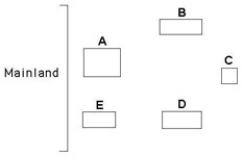 -Which island would likely exhibit the most impoverished species diversity?
 (Multiple Choice)
4.8/5 (77)
(77) 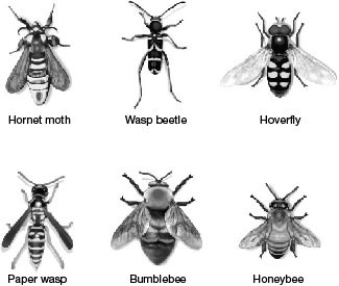 -In the accompanying figure, which of the following statements is TRUE?
 (Multiple Choice)
4.8/5 (90)
(90) Which statement best describes the evolutionary significance of mutualism?
(Multiple Choice)
4.8/5 (76)
(76) Elephants are not the most dominant species in African grasslands, yet they influence community structure. The grasslands contain scattered woody plants, but they are kept in check by the uprooting activities of the elephants. Take away the elephants, and the grasslands convert to forests or to shrublands. The newly growing forests support fewer species than the previous grasslands. Which of the following describes why elephants are the keystone species in this scenario?
(Multiple Choice)
4.9/5 (80)
(80) While traveling in Texas, you stumble across a snake with red, yellow, and black bands. You somehow remember that this could be a poisonous coral snake or a harmless milk snake, but you forget how to differentiate them because they both have similar colors and banding patterns. You wisely decide not to pick up the snake. What defense of the snake was successful in preventing you from grabbing the snake?
(Multiple Choice)
4.7/5 (88)
(88) Which of the following statements is consistent with the principle of competitive exclusion?
(Multiple Choice)
4.8/5 (71)
(71) What is the main difference between a disturbance and a disturbance regime?
(Multiple Choice)
4.9/5 (80)
(80) In a tide pool, 15 species of invertebrates were reduced to 8 after one species was removed. The species removed was likely a(n) ________.
(Multiple Choice)
4.9/5 (75)
(75) 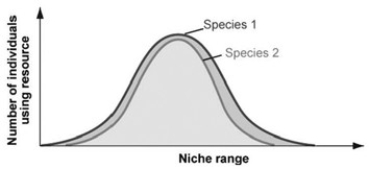 In the accompanying figure, which species is the stronger competitor?
 (Multiple Choice)
5.0/5 (87)
(87) In the hypothesis that C. stellatus (a species of barnacle) is competitively excluded from the lower intertidal zone by B. balanoides (another species of barnacle), what could be concluded about the two species?
(Multiple Choice)
4.8/5 (72)
(72) According to the figure shown, a species has the highest chance of extinction when ________.
(Multiple Choice)
4.7/5 (88)
(88) Some birds follow moving swarms of army ants in the tropics. As the ants march along the forest floor hunting insects and small vertebrates, birds follow and pick off any insects or small vertebrates that fly or jump out of the way of the ants. This situation is an example of what kind of species interaction between the birds and the ants?
(Multiple Choice)
4.8/5 (75)
(75) Some birds follow moving swarms of army ants in the tropics. As the ants march along the forest floor hunting insects and small vertebrates, birds follow and pick off any insects or small vertebrates that fly or jump out of the way of the ants. What is the result of the association between birds and ants?
(Multiple Choice)
4.9/5 (87)
(87) The symbols +, −, and 0 are to be used to show the results of interactions between individuals and groups of individuals in the examples that follow. The symbol + denotes a positive interaction, − denotes a negative interaction, and 0 denotes where individuals are not affected by interacting. The first symbol refers to the first organism mentioned.
-Recall that Clements's view of biological communities is that of a highly predictable and interrelated structure, while Gleason's view of biological communities is that individual species operate independently. If we set up many identical sterilized ponds in the same area and allowed them to be colonized, what should we predict if we wished to test Gleason's hypothesis?
(Multiple Choice)
4.9/5 (76)
(76) According to bottom-up and top-down control models of community organization, which of the following expressions would imply that an increase in the size of a carnivore (C) population would negatively impact its prey (P) population, but not vice versa?
(Multiple Choice)
4.9/5 (69)
(69) 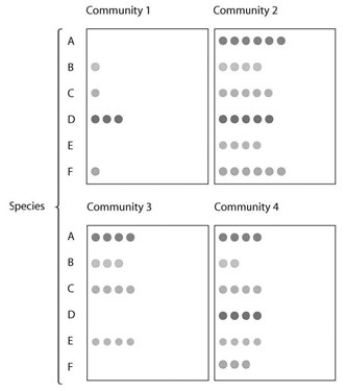 -In the figure shown, which community has the highest species diversity?
 (Multiple Choice)
4.9/5 (68)
(68) People with at least one copy of the HLA-B53 gene are better able to beat back malarial infections before the infection progresses. If this is a coevolutionary arms race between Plasmodium and humans, what would the next step in this race be?
(Multiple Choice)
4.9/5 (81)
(81) Why do moderate levels of disturbance result in an increase in community diversity?
(Multiple Choice)
4.7/5 (61)
(61) 
Filters
- Essay(0)
- Multiple Choice(0)
- Short Answer(0)
- True False(0)
- Matching(0)