



 Chat with AI
Exam 11: Derivatives Continued

Exam 1: Linear Equations and Functions245 Questions
Exam 2: Quadratic and Other Special Functions120 Questions
Exam 3: Matrices230 Questions
Exam 4: Inequalities and Linear Programming119 Questions
Exam 5: Exponential and Logarithmic Functions109 Questions
Exam 6: Mathematics of Finance131 Questions
Exam 7: Introduction to Probability180 Questions
Exam 8: Further Topics in Probability and Data Description114 Questions
Exam 9: Derivatives249 Questions
Exam 10: Derivatives172 Questions
Exam 11: Derivatives Continued139 Questions
Exam 12: Indefinite Integrals120 Questions
Exam 13: Definite Integrals - Techniques370 Questions
Exam 13: A: Definite Integrals - Techniques370 Questions
Exam 14: Functions of Two or More Variables122 Questions
Exam 15: Algebraic Concepts 240 Questions
Exam 15: Algebraic Concepts 374 Questions
Exam 15: Algebraic Concepts 496 Questions
Exam 15: Algebraic Concepts 599 Questions
Select questions type


 .
 if

 , find
 .

Suppose the weekly demand function for a product is 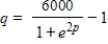 where p is the price in thousands of dollars and q is the number of units demanded. What is the elasticity of demand when the price is $1,000 and the quantity demanded is 714? Round your answer to two decimal places.
 (Multiple Choice)
4.7/5  (78)
(78) The loudness of sound (L, measured in decibels) perceived by the human ear depends on intensity levels (I) according to  , where
 is the standard threshold of audibility. If
 then using the change-of-base formula, we get
 . At what rate is the loudness changing with respect to x when the intensity is 1,000 times the standard threshold of audibility (that is, when x = 1,000)?
, where is the standard threshold of audibility. If then using the change-of-base formula, we get . At what rate is the loudness changing with respect to x when the intensity is 1,000 times the standard threshold of audibility (that is, when x = 1,000)? (Multiple Choice)
4.7/5 (90)
(90) p is in dollars and q is the number of units. Find the elasticity of the demand function  at
 . Round your answer to two decimal places.
at . Round your answer to two decimal places. (Multiple Choice)
4.8/5 (81)
(81) For the given equation, find the slope of the tangent to the curve at the point  . Round your answer to two decimal places.

. Round your answer to two decimal places. (Multiple Choice)
4.9/5 (80)
(80) At what y-value does the curve defined by 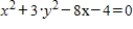 have a vertical tangent?
 (Multiple Choice)
4.8/5 (69)
(69) Which of the following functions has the same derivative as the function below? 
(Multiple Choice)
4.8/5 (89)
(89) 

 implicitly for

Find any relative maxima and minima. Use a graphing utility to check your results. 
(Multiple Choice)
4.9/5 (83)
(83) Assume that s, r, and h are differentiable functions of t. If  , find
 when
 ,
 ,
 , and
 . Round your answer to two decimal places.
, find when , , , and . Round your answer to two decimal places. (Multiple Choice)
4.8/5 (92)
(92) Find any relative maxima and minima. Use a graphing utility to check your results. 
(Multiple Choice)
4.9/5 (73)
(73) Find the relative maxima, and use a graphing utility to check your results. Round your answer to two decimal places. 
(Multiple Choice)
4.9/5 (81)
(81) 
The sales decay for a product is given by  , where S is the daily sales in dollars and t is the number of days since the end of a promotional campaign. Find the rate of change of sales decay.
 (Multiple Choice)
4.9/5 (74)
(74) Write the equation of the line tangent to the graph of  at
 .
at . (Multiple Choice)
4.9/5 (75)
(75) Assume that x and y are differentiable functions of t. A point is moving along the graph of the equation  At what rate is y changing when
 and is changing at a rate of 4 units/sec?
At what rate is y changing when and is changing at a rate of 4 units/sec? (Multiple Choice)
4.9/5 (86)
(86) 
Filters
- Essay(0)
- Multiple Choice(0)
- Short Answer(0)
- True False(0)
- Matching(0)