



 Chat with AI
Exam 11: Derivatives Continued

Exam 1: Linear Equations and Functions245 Questions
Exam 2: Quadratic and Other Special Functions120 Questions
Exam 3: Matrices230 Questions
Exam 4: Inequalities and Linear Programming119 Questions
Exam 5: Exponential and Logarithmic Functions109 Questions
Exam 6: Mathematics of Finance131 Questions
Exam 7: Introduction to Probability180 Questions
Exam 8: Further Topics in Probability and Data Description114 Questions
Exam 9: Derivatives249 Questions
Exam 10: Derivatives172 Questions
Exam 11: Derivatives Continued139 Questions
Exam 12: Indefinite Integrals120 Questions
Exam 13: Definite Integrals - Techniques370 Questions
Exam 13: A: Definite Integrals - Techniques370 Questions
Exam 14: Functions of Two or More Variables122 Questions
Exam 15: Algebraic Concepts 240 Questions
Exam 15: Algebraic Concepts 374 Questions
Exam 15: Algebraic Concepts 496 Questions
Exam 15: Algebraic Concepts 599 Questions
Select questions type


The demand functions for specialty steel products are given, where p is in dollars and q is the number of units demanded. Find the interval in which the demand is elastic. Round your answer to two decimal places. 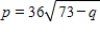
(Multiple Choice)
4.9/5  (83)
(83) 
The area of a circle is changing at a rate of 6 in2/sec At what rate is its radius changing when the radius is 5 in?
(Multiple Choice)
4.7/5 (74)
(74)  .

Suppose that the total cost (in dollars) for a product is given by  , where x is the number of units produced. Find the marginal cost function.
 (Multiple Choice)
4.8/5 (78)
(78) For the given equation, find the slope of the tangent to the curve at the point  . Round your answer to two decimal places.

. Round your answer to two decimal places. (Multiple Choice)
5.0/5 (86)
(86)  .

 , find
 .
 .
Total personal income in the U.S. (in billions of dollars) for selected years from 1960 to 2002 is given in the following table.

These data can be modeled by
 , where x is the number of years past 1960. Use the data to find the average rate of change from 2000 to 2002, which can be used to approximate the rate of change in 2002. Round your answer to the nearest ten million dollar.
These data can be modeled by , where x is the number of years past 1960. Use the data to find the average rate of change from 2000 to 2002, which can be used to approximate the rate of change in 2002. Round your answer to the nearest ten million dollar.
(Multiple Choice)
4.8/5 (78)
(78) p is in dollars and q is the number of units. Find the elasticity of the demand function  at
 and use it to determine how a price increase will affect total revenue.
at and use it to determine how a price increase will affect total revenue. (Multiple Choice)
4.7/5 (76)
(76) At what x-value does the curve defined by 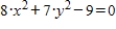 have a horizontal tangent?
 (Multiple Choice)
4.9/5 (81)
(81) The demand function for specialty steel products are given, where p is in dollars and q is the number of units demanded. Find the point at which the demand is of unitary elasticity. Round your answer to two decimal places. 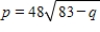
(Multiple Choice)
4.9/5 (78)
(78) 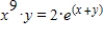 , find
 .
Which of the following functions has the same derivative as the function below? 
(Multiple Choice)
4.8/5 (74)
(74)  , find
 .
Suppose that the demand for a product is given by  . Find the elasticity when
 and also determine how would revenue be affected by a price increase?
. Find the elasticity when and also determine how would revenue be affected by a price increase? (Multiple Choice)
4.9/5 (87)
(87) Suppose the proportion P of people affected by a certain disease is described by 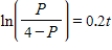 , where t is the time in months. Find
 , the rate at which P grows.
, where t is the time in months. Find , the rate at which P grows.
(Multiple Choice)
4.9/5 (68)
(68) p is the price per unit in dollars and q is the number of units. The monthly demand function is 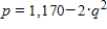 and the supply function before taxation is
 Find what tax per item will maximize the total revenue and use this to find the maximum tax revenue.
and the supply function before taxation is Find what tax per item will maximize the total revenue and use this to find the maximum tax revenue. (Multiple Choice)
4.8/5 (85)
(85) Suppose that the price p (in dollars) of a product is given by the demand function 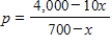 where x represents the quantity demanded. If the daily demand is increase at a rate of 5 units per day, at what rate is the price changing when the demand is 64 units? Round your answer to two decimal places.
 (Multiple Choice)
4.9/5 (81)
(81) 
Filters
- Essay(0)
- Multiple Choice(0)
- Short Answer(0)
- True False(0)
- Matching(0)