



 Chat with AI
Exam 11: Derivatives Continued

Exam 1: Linear Equations and Functions245 Questions
Exam 2: Quadratic and Other Special Functions120 Questions
Exam 3: Matrices230 Questions
Exam 4: Inequalities and Linear Programming119 Questions
Exam 5: Exponential and Logarithmic Functions109 Questions
Exam 6: Mathematics of Finance131 Questions
Exam 7: Introduction to Probability180 Questions
Exam 8: Further Topics in Probability and Data Description114 Questions
Exam 9: Derivatives249 Questions
Exam 10: Derivatives172 Questions
Exam 11: Derivatives Continued139 Questions
Exam 12: Indefinite Integrals120 Questions
Exam 13: Definite Integrals - Techniques370 Questions
Exam 13: A: Definite Integrals - Techniques370 Questions
Exam 14: Functions of Two or More Variables122 Questions
Exam 15: Algebraic Concepts 240 Questions
Exam 15: Algebraic Concepts 374 Questions
Exam 15: Algebraic Concepts 496 Questions
Exam 15: Algebraic Concepts 599 Questions
Select questions type


Write the equation of the line tangent to the curve  at the point
 .
at the point . (Multiple Choice)
4.8/5  (89)
(89) If the demand function for q units of a commodity at p$ per unit is given by 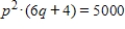 , find the rate of change of quantity with respect to price when p = $20. Round your answer to three decimal places.
 (Multiple Choice)
4.8/5 (69)
(69) Boyle's law for enclosed gases states that at a constant temperature, the pressure is related to the volume by the equation  , where k is a constant. If the volume is increasing at a rate of 2 cubic inches per hour, at what rate is the pressure changing when the volume is 50 cubic inches and k = 9 inch-pounds? Round your answer to three decimal places.
 (Multiple Choice)
4.8/5 (91)
(91) Suppose the weekly demand for a product is given by  and the weekly supply before taxation is given by
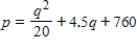 . Find the tax per item that produces maximum tax revenue. Round your answer to the nearest cent.
and the weekly supply before taxation is given by . Find the tax per item that produces maximum tax revenue. Round your answer to the nearest cent. (Multiple Choice)
4.9/5 (70)
(70) The lengths of the edges of a cube are increasing at a rate of 7 ft/min. At what rate is the surface area changing when the edges are 11 ft long?
(Multiple Choice)
4.9/5 (77)
(77)  if


At what x-value does the curve defined by 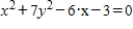 have a horizontal tangent?
 (Multiple Choice)
4.8/5 (82)
(82)  .

p is the price per unit in dollars and q is the number of units. If the daily demand for a product is given by the function  and the daily supply before taxation is
 , find the tax per item that maximizes tax revenue. Round your answer to the nearest cent.
and the daily supply before taxation is , find the tax per item that maximizes tax revenue. Round your answer to the nearest cent. (Multiple Choice)
4.9/5 (77)
(77) 
Assume that x and y are differentiable functions of t. Find  using the given values.
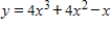 for
 .
using the given values. for .
(Multiple Choice)
4.8/5 (73)
(73) 
Write the equation of the line tangent to the curve  at the point
 .
at the point . (Multiple Choice)
4.8/5 (70)
(70) 
 .

Find dy/dx at the given point without first solving for y. Round your answer to two decimal places.  at

at (Multiple Choice)
4.9/5 (75)
(75) The demand function for a product is given by  , where p is the price per unit in dollars when x units are demanded. Find the second derivative to see whether the rate at which the price is changing at 30 units is increasing or decreasing.
 (Multiple Choice)
5.0/5 (94)
(94) p is the price per unit in dollars and q is the number of units. If the demand and supply functions for a product are  and
 , respectively, find the tax per unit t that will maximize the tax revenue T. Round your answer to the nearest cent.
and , respectively, find the tax per unit t that will maximize the tax revenue T. Round your answer to the nearest cent. (Multiple Choice)
4.8/5 (78)
(78) 
Filters
- Essay(0)
- Multiple Choice(0)
- Short Answer(0)
- True False(0)
- Matching(0)