



 Chat with AI
Exam 1: The Derivative

Exam 1: The Derivative189 Questions
Exam 2: Applications of the Derivative93 Questions
Exam 3: Techniques of Differentiation69 Questions
Exam 4: Logarithm Functions135 Questions
Exam 5: Applications of the Exponential and Natural Logarithm Functions73 Questions
Exam 6: The Definite Integral135 Questions
Exam 7: Functions of Several Variables119 Questions
Exam 8: The Trigonometric Functions128 Questions
Exam 9: Techniques of Integration178 Questions
Exam 10: Differential Equations126 Questions
Exam 11: Taylor Polynomials and Infinite Series132 Questions
Exam 12: Probability and Calculus92 Questions
Select questions type


Calculate the following limit(s) if they exist.
- (2x + 2 Enter your answer as an integer, or "does not exist".
(Short Answer)
4.8/5  (72)
(72) Find the equation of the following line: Parallel to ; (4, 3) on line.
(Multiple Choice)
4.7/5 (82)
(82) Find the slope of the line with the equation y = 4 - 5x.
Enter just an integer.
(Short Answer)
4.8/5 (77)
(77) For the following function g(x), determine whether or not g(x) exists. If so, give the limit. 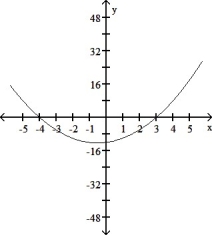
(Multiple Choice)
4.8/5 (82)
(82) Compute , where v = -5 + at t = -1.
Enter just a reduced fraction of form .
(Short Answer)
4.9/5 (79)
(79) Find the slope of the graph of f(x) = 1 + 3x - at x = 5.
Enter just an integer.
(Short Answer)
4.9/5 (90)
(90) A rock is thrown off a cliff. Its distance from the ground below at t seconds is feet. When will it hit the ground?
Enter your answer exactly as: t = a. No units.
(Short Answer)
4.7/5 (76)
(76) Let f(x) = . Compute (3) using limits.
Enter a reduced fraction or an integer.
(Short Answer)
4.9/5 (66)
(66) Find second derivative of y = + at x = 4.
Enter just a fraction of form in lowest terms.
(Short Answer)
4.9/5 (74)
(74) If the cost function for producing a product is find the answer closest to the marginal cost at a production level of 10 units.
(Multiple Choice)
4.9/5 (76)
(76) In the graph of y = f (x), for which values of x is f(x) not differentiable?
Enter your answer exactly in the form: x = a, b, c where a < b < c. (If there are fewer or more terms, separate them with commas in increasing order.) 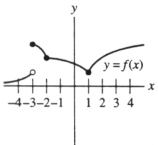
(Short Answer)
4.8/5 (66)
(66) Find the equation of the following line: Perpendicular to 5x = 7 - 8y; y-intercept is -2.
Enter your answer in slope-intercept form with any fractions in the form in lowest terms.
(Short Answer)
4.8/5 (99)
(99) A rock is thrown off a cliff. Its distance from the ground below at t seconds is feet. What is the velocity after 1 second?
Enter just an integer. No units.
(Short Answer)
4.8/5 (76)
(76) Calculate the following limit(s) if they exist.
- 4 Enter your answer as an integer.
(Short Answer)
4.8/5 (89)
(89) A manufacturer's profit from producing x units of a product is given by At what production level(s) will the marginal profit be $9.30 per unit?
Enter just an integer, no units.
(Short Answer)
4.9/5 (78)
(78) Write the word or phrase that best completes each statement or answers the question.
-y = Enter your answer exactly in the form: where P(x) and Q(x) are polynomials in standard form.
(Short Answer)
4.9/5 (75)
(75) 
Filters
- Essay(0)
- Multiple Choice(0)
- Short Answer(0)
- True False(0)
- Matching(0)