



 Chat with AI
Exam 2: Solar Energy to Earth and the Seasons

Exam 1: Essentials of Geography185 Questions
Exam 2: Solar Energy to Earth and the Seasons144 Questions
Exam 3: Earths Modern Atmosphere166 Questions
Exam 4: Atmosphere and Surface Energy Balances129 Questions
Exam 5: Global Temperatures134 Questions
Exam 6: Atmospheric and Oceanic Circulations180 Questions
Exam 7: Water and Atmospheric Moisture144 Questions
Exam 8: Weather157 Questions
Exam 9: Water Resources175 Questions
Exam 10: Global Climate Systems149 Questions
Exam 11: Climate Change141 Questions
Exam 12: The Dynamic Planet181 Questions
Exam 13: Tectonics, earthquakes, and Volcanism165 Questions
Exam 14: Weathering, karst Landscapes, and Mass Movement122 Questions
Exam 15: River Systems153 Questions
Exam 16: Oceans, coastal Processes, and Wind Processes159 Questions
Exam 17: Glacial and Periglacial Landscapes142 Questions
Exam 18: The Geography of Soils135 Questions
Exam 19: Ecosystem Essentials127 Questions
Exam 20: Terrestrial Biomes118 Questions
Select questions type


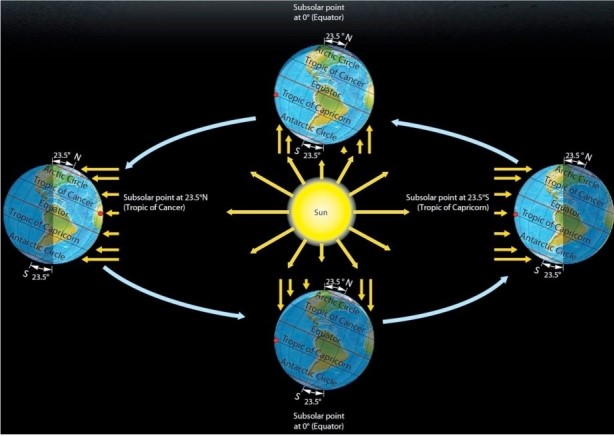 With reference to the figure above,which of the following is true for the June Solstice?
 (Multiple Choice)
4.9/5  (76)
(76) What is the dominant wavelength of energy emitted by the Sun?
(Multiple Choice)
4.9/5 (78)
(78) 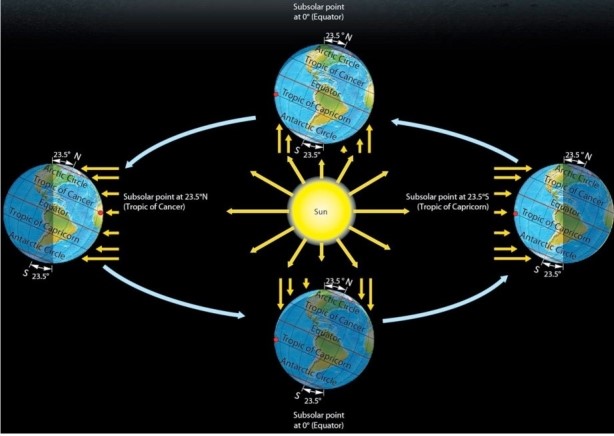 With reference to the figure above,which of the following is true for the December Solstice?
 (Multiple Choice)
4.9/5 (84)
(84) What is the name of the location on the surface of Earth that receives insolation when the Sun is directly overhead? (When this occurs,the rays of the Sun are perpendicular to this surface.)
(Multiple Choice)
4.8/5 (83)
(83) Which of the following is true of the electromagnetic spectrum from the Sun?
(Multiple Choice)
4.8/5 (78)
(78) Which of the following best describes the Milky Way Galaxy in which we live?
(Multiple Choice)
4.8/5 (86)
(86) Which of the following is true regarding the axis of Earth?
(Multiple Choice)
4.8/5 (81)
(81) The seasons are caused by the changing amounts of energy received on Earth as a result of the elliptical orbit.
(True/False)
4.8/5 (66)
(66) Define these terms: thermopause,insolation,solar constant,subsolar point.
(Essay)
4.7/5 (83)
(83) What is the average insolation received by the thermopause when Earth is at its average distance from the sun known as?
(Multiple Choice)
4.8/5 (77)
(77) Which of the following is true regarding rotational velocities at different latitudes?
(Multiple Choice)
4.8/5 (62)
(62) The Milky Way galaxy contains approximately 300 billion stars,of which the Sun is an average sized star.
(True/False)
4.7/5 (75)
(75) Which of the following most accurately describes the distance between Earth and the Sun?
(Multiple Choice)
4.9/5 (75)
(75) 
Filters
- Essay(0)
- Multiple Choice(0)
- Short Answer(0)
- True False(0)
- Matching(0)