



 Chat with AI
Exam 11: Climate Change

Exam 1: Essentials of Geography185 Questions
Exam 2: Solar Energy to Earth and the Seasons144 Questions
Exam 3: Earths Modern Atmosphere166 Questions
Exam 4: Atmosphere and Surface Energy Balances129 Questions
Exam 5: Global Temperatures134 Questions
Exam 6: Atmospheric and Oceanic Circulations180 Questions
Exam 7: Water and Atmospheric Moisture144 Questions
Exam 8: Weather157 Questions
Exam 9: Water Resources175 Questions
Exam 10: Global Climate Systems149 Questions
Exam 11: Climate Change141 Questions
Exam 12: The Dynamic Planet181 Questions
Exam 13: Tectonics, earthquakes, and Volcanism165 Questions
Exam 14: Weathering, karst Landscapes, and Mass Movement122 Questions
Exam 15: River Systems153 Questions
Exam 16: Oceans, coastal Processes, and Wind Processes159 Questions
Exam 17: Glacial and Periglacial Landscapes142 Questions
Exam 18: The Geography of Soils135 Questions
Exam 19: Ecosystem Essentials127 Questions
Exam 20: Terrestrial Biomes118 Questions
Select questions type


What are some examples of positive and negative climate feedback loops?

Free
(Essay)
4.9/5  (76)
(76) Correct Answer: Verified
Answers will vary.An example of a positive feedback loop may be: As air temperatures increase,evaporation increases.Warmer temperatures also increase the capacity to absorb water vapour.More water vapour in the atmosphere accelerates the greenhouse effect.As temperatures increase further,more water vapour can enter the atmosphere,causing temperatures to increase even more.An example of a negative feedback loop may be: As air temperatures increase,evaporation increases,leading to more condensation and cloud formation.Low,thick cloud cover increases the albedo of the atmosphere,thereby having a cooling effect on Earth.
The physical evidence for global climate change is limited,based primarily on conjecture and indirect evidence.
Free
(True/False)
4.7/5 (77)
(77) Correct Answer:Verified
VerifiedFalse
Which is likely the world's largest reserve of carbon-based fuel?
Free
(Multiple Choice)
4.8/5 (68)
(68) Correct Answer:Verified
VerifiedC
Which of the following is an indicator of current climatic warming?
(Multiple Choice)
4.8/5 (80)
(80) The last glacial maximum (LGM)occurred approximately how many years ago?
(Multiple Choice)
4.9/5 (78)
(78) Which is the legally binding international agreement to reduce greenhouse gas emissions?
(Multiple Choice)
5.0/5 (87)
(87) Which of the following correctly pairs what scientists use to study past climates with what scientists use to reconstruct climates that extend back further than our present instrumentation allows?
(Multiple Choice)
4.9/5 (76)
(76) Present atmospheric methane (CH4)concentrations are at approximately how many ppb?
(Multiple Choice)
4.7/5 (76)
(76) Which of the following is not a primary factor contributing to sea-level rise?
(Multiple Choice)
4.7/5 (74)
(74) 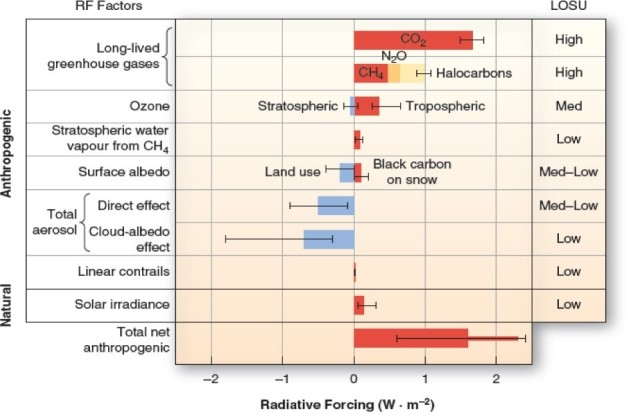 Which of the following has a negative radiative forcing (i.e.cools the planet)?
 (Multiple Choice)
4.7/5 (83)
(83) Carbon dioxide (CO2)is the most abundant natural greenhouse gas.
(True/False)
4.8/5 (72)
(72) For how many years past do ocean sediment cores provide a climate record?
(Multiple Choice)
4.9/5 (82)
(82) Earth's axial tilt varies from 21.5° to 24.5° during a 41 000 year period.
(True/False)
4.8/5 (63)
(63) Sea level is rising more quickly on the east coast of North America than on the west coast.
(True/False)
5.0/5 (79)
(79) More-developed countries (MDCs)currently emit the greatest amount of greenhouse gases per capita.
(True/False)
4.9/5 (75)
(75) Describe methods that individuals and communities are taking to mitigate against climate change.
(Essay)
4.9/5 (72)
(72) 
Filters
- Essay(0)
- Multiple Choice(0)
- Short Answer(0)
- True False(0)
- Matching(0)