



 Chat with AI
Exam 2: Solar Energy to Earth and the Seasons

Exam 1: Essentials of Geography185 Questions
Exam 2: Solar Energy to Earth and the Seasons144 Questions
Exam 3: Earths Modern Atmosphere166 Questions
Exam 4: Atmosphere and Surface Energy Balances129 Questions
Exam 5: Global Temperatures134 Questions
Exam 6: Atmospheric and Oceanic Circulations180 Questions
Exam 7: Water and Atmospheric Moisture144 Questions
Exam 8: Weather157 Questions
Exam 9: Water Resources175 Questions
Exam 10: Global Climate Systems149 Questions
Exam 11: Climate Change141 Questions
Exam 12: The Dynamic Planet181 Questions
Exam 13: Tectonics, earthquakes, and Volcanism165 Questions
Exam 14: Weathering, karst Landscapes, and Mass Movement122 Questions
Exam 15: River Systems153 Questions
Exam 16: Oceans, coastal Processes, and Wind Processes159 Questions
Exam 17: Glacial and Periglacial Landscapes142 Questions
Exam 18: The Geography of Soils135 Questions
Exam 19: Ecosystem Essentials127 Questions
Exam 20: Terrestrial Biomes118 Questions
Select questions type


What is the circle of illumination and why is it important?

Free
(Essay)
4.8/5  (86)
(86) Correct Answer: Verified
The circle of illumination is the dividing line between day and night.Combined with the four factors that cause the seasons,the circle of illumination will influence daylength throughout the year.
What is important about changes in daylength and the altitude of the Sun above the horizon over the course of the year?
Free
(Multiple Choice)
4.8/5 (66)
(66) Correct Answer:Verified
VerifiedC
The electromagnetic spectrum only shows the wavelengths associated with solar radiation.
Free
(True/False)
4.8/5 (74)
(74) Correct Answer:Verified
VerifiedFalse
Intercepted solar energy is called insolation and is measured as the solar constant at the top of the atmosphere.
(True/False)
4.9/5 (87)
(87) The principal outputs from the Sun consist of the solar wind and radiant energy.
(True/False)
4.8/5 (74)
(74) Radiant energy from the Sun is composed primarily of visible light and infrared wavelengths.
(True/False)
4.8/5 (78)
(78) The Solar System,Sun,and Earth formed about 4.6 billion years ago.
(True/False)
4.7/5 (72)
(72) Lower latitudes experience the greatest seasonal variation throughout an average year.
(True/False)
4.9/5 (74)
(74) 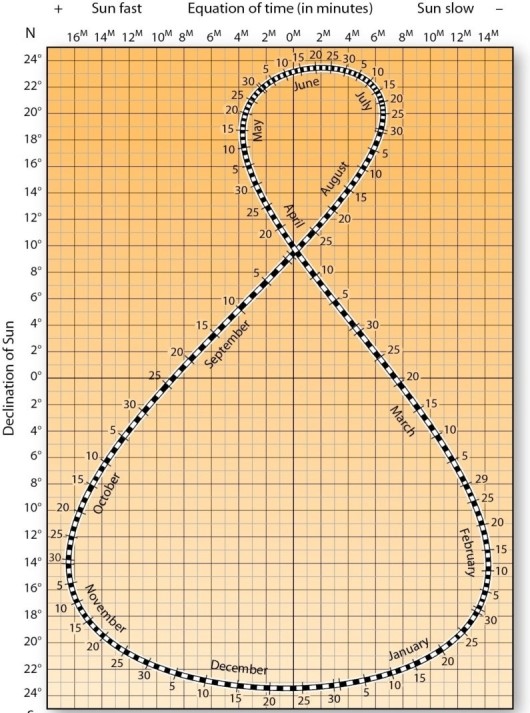 With reference to the figure above,on approximately which dates is the subsolar point 16° S?
 (Multiple Choice)
4.8/5 (71)
(71) Longer autumns and earlier springs caused by climate change have lengthened the growing season in the Canada and the United States.
(True/False)
4.9/5 (81)
(81) The Sun is directly overhead north of 23.5° N latitude twice a year.
(True/False)
4.9/5 (88)
(88) Earth rotates east to west,or clockwise,when viewed from above the North Pole.
(True/False)
4.9/5 (75)
(75) Which of the following characterizes the revolution of Earth?
(Multiple Choice)
4.9/5 (78)
(78) The amount of the solar energy received by a given location varies depending upon the season.
(True/False)
4.9/5 (92)
(92) 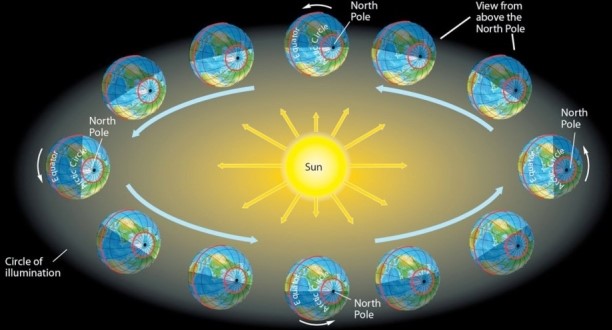 With reference to the figure above,which of the following is true for the March Equinox?
 (Multiple Choice)
4.7/5 (70)
(70) Why did Astronauts deploy a solar wind measuring experiment on the Moon?
(Multiple Choice)
4.9/5 (77)
(77) 
Filters
- Essay(0)
- Multiple Choice(0)
- Short Answer(0)
- True False(0)
- Matching(0)