



 Chat with AI
Exam 11: Climate Change

Exam 1: Essentials of Geography185 Questions
Exam 2: Solar Energy to Earth and the Seasons144 Questions
Exam 3: Earths Modern Atmosphere166 Questions
Exam 4: Atmosphere and Surface Energy Balances129 Questions
Exam 5: Global Temperatures134 Questions
Exam 6: Atmospheric and Oceanic Circulations180 Questions
Exam 7: Water and Atmospheric Moisture144 Questions
Exam 8: Weather157 Questions
Exam 9: Water Resources175 Questions
Exam 10: Global Climate Systems149 Questions
Exam 11: Climate Change141 Questions
Exam 12: The Dynamic Planet181 Questions
Exam 13: Tectonics, earthquakes, and Volcanism165 Questions
Exam 14: Weathering, karst Landscapes, and Mass Movement122 Questions
Exam 15: River Systems153 Questions
Exam 16: Oceans, coastal Processes, and Wind Processes159 Questions
Exam 17: Glacial and Periglacial Landscapes142 Questions
Exam 18: The Geography of Soils135 Questions
Exam 19: Ecosystem Essentials127 Questions
Exam 20: Terrestrial Biomes118 Questions
Select questions type


Which of the following accurately describes 13C/12C ratios of plant materials and their use in climate reconstructions?
(Multiple Choice)
4.8/5  (70)
(70) Which is the primary anthropogenic source of atmospheric carbon dioxide (CO2)?
(Multiple Choice)
4.8/5 (76)
(76) There has been a decrease in multi-year ice,that is,sea ice that survives through two or more summers.
(True/False)
4.8/5 (83)
(83) Since 1880,which two years had the highest land surface temperature?
(Multiple Choice)
4.8/5 (80)
(80) Which of the following is an example of individuals and communities working to mitigate climate change?
(Multiple Choice)
4.8/5 (65)
(65) The Paleocene-Eocene Thermal Maximum (PETM)is characterized by some of the coolest temperatures in Earth's history.
(True/False)
4.8/5 (84)
(84) The United States leads the world in per capita carbon dioxide (CO2)emissions.
(True/False)
4.9/5 (75)
(75) Fossil fuel burning accounts for over how many percent of CO2 emissions?
(Multiple Choice)
4.9/5 (78)
(78) 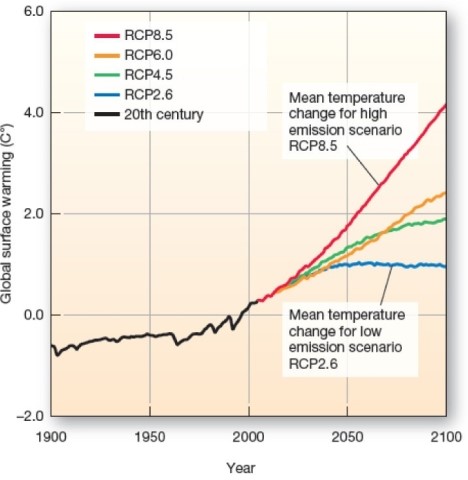 Which scenario predicts the lowest level of warming during the 21st Century?
 (Multiple Choice)
4.8/5 (85)
(85) 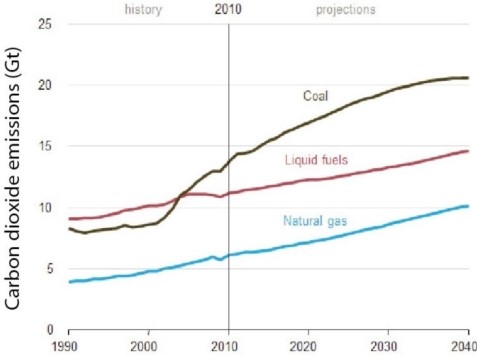 Which describes CO2 emissions since 1990?
As air temperatures increase,evaporation increases.Warmer temperatures also increase the capacity to absorb water vapour.More water vapour in the atmosphere accelerates the greenhouse effect.As temperatures increase further,more water vapour can enter the atmosphere,causing temperatures to increase even more.Which best describes this process?
(Multiple Choice)
4.9/5 (70)
(70) Which of the following correctly lists the climate indicated by a lower 18O/16O ratio in ocean sediment cores and a climate indicated by a higher ocean sediment core 18O/16O ratio?
(Multiple Choice)
4.8/5 (74)
(74) Water vapour (H2O)has a longer residence time in the atmosphere than carbon dioxide (CO2).
(True/False)
5.0/5 (86)
(86) Which of the following is an example of methods used for short-term climate reconstructions?
(Multiple Choice)
4.9/5 (79)
(79) Carbon dioxide (CO2)has a longer residence time in the atmosphere than methane (CH4).
(True/False)
4.8/5 (77)
(77) Methane (CH4)has a higher global warming potential than carbon dioxide (CO2).
(True/False)
4.9/5 (78)
(78) While GCMs are useful for visualization the complex global oceanic-atmosphere circulation,they have had little utility in the study of climate change.
(True/False)
4.8/5 (72)
(72) Carbon dioxide (CO2)residence time in the atmosphere is 7 to 10 years.
(True/False)
4.8/5 (86)
(86) Changes in Earth's orbital configuration may lead to warming temperatures.These warming temperatures,in turn,may lead to the release of both CO2 and CH4.Increases in these gases may further warm the planet.Which best describes this process?
(Multiple Choice)
4.9/5 (79)
(79) The majority of human population growth is now occurring in which of the following?
(Multiple Choice)
4.8/5 (80)
(80) 
Filters
- Essay(0)
- Multiple Choice(0)
- Short Answer(0)
- True False(0)
- Matching(0)