



 Chat with AI
Exam 16: Monetary Policy

Exam 1: The Big Ideas253 Questions
Exam 2: The Power of Trade150 Questions
Exam 3: Supply and Demand135 Questions
Exam 4: Equilibrium- How Supply and Demand241 Questions
Exam 5: Price Ceilings and Floors309 Questions
Exam 6: GDP and the Measurement of Progress205 Questions
Exam 7: The Wealth of Nations and Economic Growth269 Questions
Exam 8: Growth,capital Accumulation155 Questions
Exam 9: Saving,investment,and the Financial System285 Questions
Exam 10: Stock Markets and Personal Finance241 Questions
Exam 11: Unemployment and Labor Force Participation186 Questions
Exam 12: Inflation and the Quantity Theory of Money155 Questions
Exam 13: Business Fluctuations231 Questions
Exam 14: Transmission and Amplification Mechanisms219 Questions
Exam 15: The Federal Reserve System271 Questions
Exam 16: Monetary Policy242 Questions
Exam 17: The Federal Budget- Taxes and Spending167 Questions
Exam 18: Fiscal Policy270 Questions
Exam 19: International Trade192 Questions
Exam 20: International Finance289 Questions
Exam 21: Political Economy and Public Choice304 Questions
Select questions type


If the Fed increases to fight slower real growth after a negative real shock,which of the following should occur?
(Multiple Choice)
4.8/5  (77)
(77) The BEST type of negative shock for the Federal Reserve to respond to is a negative shock to:
(Multiple Choice)
4.8/5 (67)
(67) In the short run,a negative real shock will cause the inflation rate to:
(Multiple Choice)
4.9/5 (77)
(77) During the 1970s,the Fed often reacted to negative oil shocks by decreasing the money supply and focusing on:
(Multiple Choice)
4.8/5 (89)
(89) When hit with a negative real shock,the Fed must pick a policy that chooses between:
(Multiple Choice)
4.9/5 (80)
(80) Which would be an example of running monetary policy by rules?
(Multiple Choice)
4.9/5 (77)
(77) The advocates of discretion for the Fed's role think that the Fed's adjustments on average push the economy in the:
(Multiple Choice)
4.7/5 (75)
(75) Nobel Prize-winner Milton Friedman advocated which of the following as an adequate monetary policy?
(Multiple Choice)
4.8/5 (69)
(69) Monetary policy is much less effective at combating a real shock than a demand shock.
(True/False)
4.8/5 (76)
(76) Some economists argue that the Fed should commit to keeping + fixed at a particular value,say 5%.How would this rule require the Fed to respond in the event of a negative spending shock? A negative real shock?
(Multiple Choice)
4.8/5 (83)
(83) In the short run,a negative real shock will cause output growth to:
(Multiple Choice)
4.9/5 (91)
(91) At the time the Federal Reserve must make a decision,the actual state of the economy may be unknown.
(True/False)
4.8/5 (72)
(72) In response to a negative spending shock,a condition of lower market confidence makes monetary policy easing:
(Multiple Choice)
4.7/5 (73)
(73) The most appropriate monetary policy response to an asset price bubble for a central bank is to:
(Multiple Choice)
4.9/5 (75)
(75) Use the following to answer questions
Figure: Monetary Policy 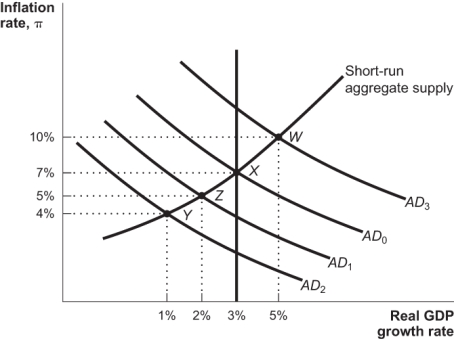 -(Figure: Monetary Policy)Refer to the figure.Assume that the economy is initially at point Y in the graph.In the best case scenario,the Fed will:
 (Multiple Choice)
4.9/5 (86)
(86) The Fed has been unable to offset the effects of negative real shocks with monetary policy.
(True/False)
4.9/5 (87)
(87) To reduce inflation in response to a negative real shock,the Federal Reserve would:
(Multiple Choice)
4.9/5 (84)
(84) 
Filters
- Essay(0)
- Multiple Choice(0)
- Short Answer(0)
- True False(0)
- Matching(0)