



 Chat with AI
Exam 2: The Power of Trade

Exam 1: The Big Ideas253 Questions
Exam 2: The Power of Trade150 Questions
Exam 3: Supply and Demand135 Questions
Exam 4: Equilibrium- How Supply and Demand241 Questions
Exam 5: Price Ceilings and Floors309 Questions
Exam 6: GDP and the Measurement of Progress205 Questions
Exam 7: The Wealth of Nations and Economic Growth269 Questions
Exam 8: Growth,capital Accumulation155 Questions
Exam 9: Saving,investment,and the Financial System285 Questions
Exam 10: Stock Markets and Personal Finance241 Questions
Exam 11: Unemployment and Labor Force Participation186 Questions
Exam 12: Inflation and the Quantity Theory of Money155 Questions
Exam 13: Business Fluctuations231 Questions
Exam 14: Transmission and Amplification Mechanisms219 Questions
Exam 15: The Federal Reserve System271 Questions
Exam 16: Monetary Policy242 Questions
Exam 17: The Federal Budget- Taxes and Spending167 Questions
Exam 18: Fiscal Policy270 Questions
Exam 19: International Trade192 Questions
Exam 20: International Finance289 Questions
Exam 21: Political Economy and Public Choice304 Questions
Select questions type


Comparative advantage is determined by which of the following?

Free
(Multiple Choice)
4.8/5  (87)
(87) Correct Answer: Verified
C
On a production possibilities frontier a trade-off can be illustrated as:
Free
(Multiple Choice)
5.0/5 (89)
(89) Correct Answer:Verified
VerifiedD
The ability of one producer to produce one good or service using fewer inputs than another producer is:
Free
(Multiple Choice)
4.9/5 (77)
(77) Correct Answer:Verified
VerifiedB
Fourteenth-century potters in the Chinese city of Jingdezhen developed the technology to heat a kiln at 1,300 degrees Celsius and produce porcelain,or "china," which was particularly popular in Persia where the Koran forbade serving food on gold or silver and wealthy families were anxious for a legal way to impress their dinner guests.The potters also imported Persian cobalt to create the blue dye for the porcelain (local cobalt was not as bold in color).Which advantage(s)from trade is(are)illustrated in this passage?
(Multiple Choice)
4.8/5 (76)
(76) The development of shipping containers enabled companies to move freight quickly between ships,trucks,and trains by loading a single large container with many different goods and then moving the container.Before the container,freight had to be loaded and unloaded one palette,barrel,or box at a time.What impact did the shipping container have on globalization? Why?
(Multiple Choice)
4.8/5 (82)
(82) Which of the following is least likely a consequence of the division of knowledge?
(Multiple Choice)
4.7/5 (76)
(76) Gains from trade are largest when two parties are similar in terms of opportunity costs of production.
(True/False)
4.8/5 (95)
(95) If it was impossible to have a comparative advantage,there would be no gains from trade.
(True/False)
4.9/5 (78)
(78) Trade refers to the exchange of goods or services between two parties.
(True/False)
4.9/5 (67)
(67) In the Star Trek: Deep Space Nine episode "Treachery,Faith,and the Great River," one of the characters is attempting to repair a spaceship.This is a critical job since there's a war going on,but the war is making it difficult to get the needed parts.An alien named Nog explains how he could obtain them by navigating the Great Material Continuum.He explains:
It binds the universe together ...there are millions upon millions of worlds in the universe,each one filled with too much of one thing and not enough of another.And the Great Continuum flows through them all,like a mighty river,from "have" to "want" and back again.And if we navigate the Continuum with skill and grace,our ship will be filled with everything our hearts desire.
Identify which of the major themes of trade this passage about the Great Material Continuum highlights and explain how it works.
(Essay)
4.9/5 (82)
(82) Employing comparative advantage increases the total satisfaction with what's produced,but not the total amount of what's produced.
(True/False)
4.8/5 (88)
(88) Use the following to answer questions
Figure: PPF Nickel & Textiles 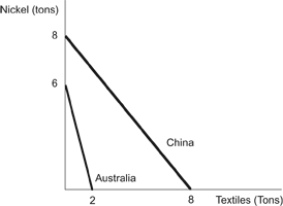 -(Figure: PPF Nickel & Textiles)Refer to the figure.What is the maximum amount of nickel China can produce?
 (Multiple Choice)
5.0/5 (90)
(90) Facilitators of trade (such as Pierre Omidyar,the developer of eBay):
(Multiple Choice)
5.0/5 (80)
(80) Trade leads to increased productivity because trade allows people to specialize.
(True/False)
5.0/5 (69)
(69) Everyone,from the most to the least skilled to the most and least educated,can benefit from trade.
(True/False)
4.7/5 (85)
(85) 
Filters
- Essay(0)
- Multiple Choice(0)
- Short Answer(0)
- True False(0)
- Matching(0)