



 Chat with AI
Exam 16: Monetary Policy

Exam 1: The Big Ideas253 Questions
Exam 2: The Power of Trade150 Questions
Exam 3: Supply and Demand135 Questions
Exam 4: Equilibrium- How Supply and Demand241 Questions
Exam 5: Price Ceilings and Floors309 Questions
Exam 6: GDP and the Measurement of Progress205 Questions
Exam 7: The Wealth of Nations and Economic Growth269 Questions
Exam 8: Growth,capital Accumulation155 Questions
Exam 9: Saving,investment,and the Financial System285 Questions
Exam 10: Stock Markets and Personal Finance241 Questions
Exam 11: Unemployment and Labor Force Participation186 Questions
Exam 12: Inflation and the Quantity Theory of Money155 Questions
Exam 13: Business Fluctuations231 Questions
Exam 14: Transmission and Amplification Mechanisms219 Questions
Exam 15: The Federal Reserve System271 Questions
Exam 16: Monetary Policy242 Questions
Exam 17: The Federal Budget- Taxes and Spending167 Questions
Exam 18: Fiscal Policy270 Questions
Exam 19: International Trade192 Questions
Exam 20: International Finance289 Questions
Exam 21: Political Economy and Public Choice304 Questions
Select questions type


If the Fed reduces to fight inflation after a negative real shock,which of the following should occur?

Free
(Multiple Choice)
4.8/5  (83)
(83) Correct Answer: Verified
B
Use the following to answer questions
Figure: Monetary Policy 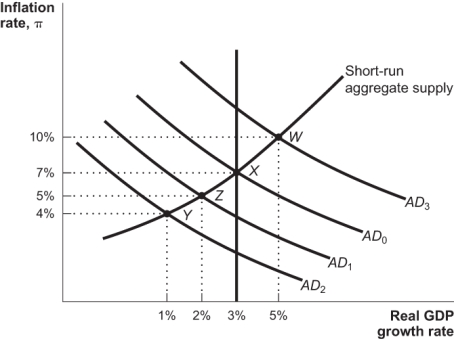 -(Figure: Monetary Policy)Refer to the figure.Assume that the economy is initially at point Y in the graph.If the Fed takes the appropriate action with monetary policy,but banks are slow to lend,then:
Free
(Multiple Choice)
4.8/5 (86)
(86) Correct Answer:Verified
VerifiedC
Low interest rates are a signal that:
Free
(Multiple Choice)
4.8/5 (76)
(76) Correct Answer:Verified
VerifiedA
If a central bank wishes to reduce inflation,it should announce its intentions and follow through with them,thereby using _____ monetary policy.
(Multiple Choice)
4.9/5 (81)
(81) If Alan Greenspan had reduced the money supply to limit the housing bubble,the result would have been a:
(Multiple Choice)
4.9/5 (81)
(81) Which is NOT a tool that the Federal Reserve can use to influence AD?
(Multiple Choice)
4.8/5 (88)
(88) In the AD-AS diagram,an increase in money supply growth causes:
(Multiple Choice)
4.8/5 (76)
(76) In the long run,a negative real shock will cause output growth to:
(Multiple Choice)
4.8/5 (86)
(86) Suppose a central bank targets a fixed rate of inflation.If a negative real shock occurs,then the central bank would use monetary policy to:
(Multiple Choice)
4.9/5 (78)
(78) Disinflation is a decrease in prices,while deflation is a significant reduction in the rate of inflation.
(True/False)
4.7/5 (89)
(89) The Fed could have popped the bubble of the housing boom in the 2000s by:
(Multiple Choice)
4.8/5 (72)
(72) Why is monetary policy not fully effective in combating a negative supply shock?
(Multiple Choice)
4.9/5 (81)
(81) When the Fed responds to a negative spending shock by increasing the money supply,it is using:
(Multiple Choice)
4.9/5 (78)
(78) Use the following to answer questions 50-54:
Figure: Monetary Policy and Demand Shocks  -(Figure: Monetary Policy and Demand Shocks)Refer to the figure.In the figure,assume the initial real growth rate of the economy is 3% when a positive aggregate demand shock shifts the AD curve from AD1 to AD4.As a result of the Fed's policy response,the AD curve shifts to AD3 in the short run.Which of the following is TRUE about the Fed's policy response?
 (Multiple Choice)
4.9/5 (78)
(78) Many economists worry about the Federal Reserve overstimulating the economy because such overstimulation will lead to rising:
(Multiple Choice)
4.9/5 (83)
(83) If the growth rate of the money supply slows,there will be a(n):
(Multiple Choice)
5.0/5 (90)
(90) If the Fed adheres to a strict "money growth rule" of 3% (that is,they keep at 3% no matter what),what happens if velocity growth ( )drops?
(Multiple Choice)
4.8/5 (90)
(90) In the short run,a negative AD shock will cause the growth rate of output to:
(Multiple Choice)
4.9/5 (74)
(74) When people believe that a central bank will stick with its policy,monetary policy is likely to have:
(Multiple Choice)
4.9/5 (71)
(71) In the short run,a monetary contraction leads to increased unemployment because:
(Multiple Choice)
4.8/5 (84)
(84) 
Filters
- Essay(0)
- Multiple Choice(0)
- Short Answer(0)
- True False(0)
- Matching(0)