



 Chat with AI
Exam 16: Monetary Policy

Exam 1: The Big Ideas253 Questions
Exam 2: The Power of Trade150 Questions
Exam 3: Supply and Demand135 Questions
Exam 4: Equilibrium- How Supply and Demand241 Questions
Exam 5: Price Ceilings and Floors309 Questions
Exam 6: GDP and the Measurement of Progress205 Questions
Exam 7: The Wealth of Nations and Economic Growth269 Questions
Exam 8: Growth,capital Accumulation155 Questions
Exam 9: Saving,investment,and the Financial System285 Questions
Exam 10: Stock Markets and Personal Finance241 Questions
Exam 11: Unemployment and Labor Force Participation186 Questions
Exam 12: Inflation and the Quantity Theory of Money155 Questions
Exam 13: Business Fluctuations231 Questions
Exam 14: Transmission and Amplification Mechanisms219 Questions
Exam 15: The Federal Reserve System271 Questions
Exam 16: Monetary Policy242 Questions
Exam 17: The Federal Budget- Taxes and Spending167 Questions
Exam 18: Fiscal Policy270 Questions
Exam 19: International Trade192 Questions
Exam 20: International Finance289 Questions
Exam 21: Political Economy and Public Choice304 Questions
Select questions type


Using monetary policy to deal with aggregate demand shocks is much easier in theory than in practice.Describe three major difficulties that a central bank might face.
(Essay)
4.9/5  (87)
(87) A problem with a monetary rule that requires the Fed to keep money growth constant is:
(Multiple Choice)
4.9/5 (82)
(82) When the price level actually falls,what is the economy experiencing?
(Multiple Choice)
4.9/5 (77)
(77) Increased uncertainty will cause the economy's AD curve to:
(Multiple Choice)
4.7/5 (95)
(95) Monetary authorities in a country say that there have been no recent negative supply shocks.The economy in this country is currently experiencing high inflation and its productive capacity cannot be increased much.Explain how monetary policy could work to address this scenario.Are there any negative consequences of your recommended policy?
(Essay)
4.7/5 (72)
(72) When the Fed reacts to a positive aggregate demand shock,which is likely to make the period of disinflation shorter?
(Multiple Choice)
4.8/5 (92)
(92) When facing a real shock,a central bank will encounter a dilemma that forces it to choose between:
(Multiple Choice)
4.8/5 (89)
(89) What kind of monetary policy rule did Milton Friedman advocate?
(Multiple Choice)
4.8/5 (86)
(86) If the public's demand for holding cash increases,the growth rate of money velocity will:
(Multiple Choice)
4.8/5 (68)
(68) Use the following to answer questions
Figure: Monetary Policy 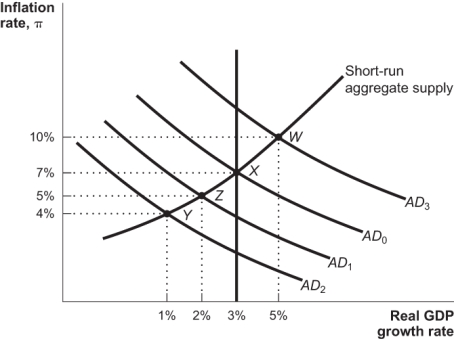 -(Figure: Monetary Policy)Refer to the figure.Assume that the economy is initially at point Y in the graph.If the Fed takes the appropriate action with monetary policy,but overestimates how serious the recession is,then:
 (Multiple Choice)
4.8/5 (88)
(88) If the Fed reacts to a series of negative real shocks by raising money growth every time:
(Multiple Choice)
4.8/5 (77)
(77) Milton Friedman was chair of the Fed in 1980 and quickly brought inflation rates down.
(True/False)
4.7/5 (76)
(76) An increase in the money supply can typically affect the economy with a lag of:
(Multiple Choice)
4.8/5 (81)
(81) Many economists now believe that rising U.S.housing prices in the early 2000s were a bubble.Explain why the Federal Reserve did not pop the bubble.
(Essay)
4.9/5 (84)
(84) If a country's central bank becomes more credible and announces a monetary contraction in advance,then:
(Multiple Choice)
4.7/5 (67)
(67) What is a reason it might be hard for the Fed to restore aggregate demand in the face of a negative demand shock?
(Multiple Choice)
4.8/5 (72)
(72) 
Filters
- Essay(0)
- Multiple Choice(0)
- Short Answer(0)
- True False(0)
- Matching(0)