



 Chat with AI
Exam 8: Growth,capital Accumulation

Exam 1: The Big Ideas253 Questions
Exam 2: The Power of Trade150 Questions
Exam 3: Supply and Demand135 Questions
Exam 4: Equilibrium- How Supply and Demand241 Questions
Exam 5: Price Ceilings and Floors309 Questions
Exam 6: GDP and the Measurement of Progress205 Questions
Exam 7: The Wealth of Nations and Economic Growth269 Questions
Exam 8: Growth,capital Accumulation155 Questions
Exam 9: Saving,investment,and the Financial System285 Questions
Exam 10: Stock Markets and Personal Finance241 Questions
Exam 11: Unemployment and Labor Force Participation186 Questions
Exam 12: Inflation and the Quantity Theory of Money155 Questions
Exam 13: Business Fluctuations231 Questions
Exam 14: Transmission and Amplification Mechanisms219 Questions
Exam 15: The Federal Reserve System271 Questions
Exam 16: Monetary Policy242 Questions
Exam 17: The Federal Budget- Taxes and Spending167 Questions
Exam 18: Fiscal Policy270 Questions
Exam 19: International Trade192 Questions
Exam 20: International Finance289 Questions
Exam 21: Political Economy and Public Choice304 Questions
Select questions type


Which of the following can drive long-run economic growth in the Solow model?
(Multiple Choice)
4.9/5  (83)
(83) Imagine an economy with production function Y = F(K)= and 400 units of capital.If the fraction of output invested in new capital increases from = 0.2 to = 0.5 and the depreciation rate is = .05,what is the new steady-state amount of capital?
(Multiple Choice)
4.8/5 (89)
(89) The "A" term in the production function Y = F(A,K,eL)represents which factor of production in the Solow growth model?
(Multiple Choice)
4.8/5 (77)
(77) The growth rate of developed countries in the past century cannot be fully explained by the simple Solow model without advances in technology.
(True/False)
4.8/5 (86)
(86) Countries on a "catching-up" growth path are growing primarily through:
(Multiple Choice)
4.9/5 (75)
(75) In the Solow model,when investment equals depreciation,the capital stock and output are constant.
(True/False)
4.9/5 (84)
(84) The marginal product of capital diminishes with the addition of more and more capital.
(True/False)
5.0/5 (72)
(72) In the context of the Solow model,new ideas shift both the production function and the investment function upward.
(True/False)
4.9/5 (73)
(73) Which of the following statements correctly differentiates catching-up growth from cutting-edge growth?
(Multiple Choice)
4.8/5 (73)
(73) If we hold ideas,education,and labor constant in the Solow model,then output (GDP)is a function of:
(Multiple Choice)
4.9/5 (75)
(75) If the investment rate ()increases in the Solow model,other things held constant,then capital growth:
(Multiple Choice)
4.8/5 (83)
(83) To maintain growth over very long periods of time,a country must come up with new ideas.
(True/False)
4.9/5 (72)
(72) Imagine an economy with production function Y = F(K)= and 400 units of capital.If the fraction of output invested in new capital is = 0.2,how much new capital will be created in the next period?
(Multiple Choice)
4.8/5 (71)
(71) 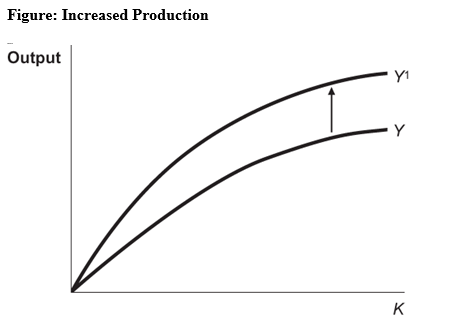 -(Figure: The Solow Model)If the production function shifts from Y1 to Y2 in the accompanying graph of the Solow model,then:
 (Multiple Choice)
5.0/5 (76)
(76) 
Filters
- Essay(0)
- Multiple Choice(0)
- Short Answer(0)
- True False(0)
- Matching(0)