



 Chat with AI
Exam 8: Growth,capital Accumulation

Exam 1: The Big Ideas253 Questions
Exam 2: The Power of Trade150 Questions
Exam 3: Supply and Demand135 Questions
Exam 4: Equilibrium- How Supply and Demand241 Questions
Exam 5: Price Ceilings and Floors309 Questions
Exam 6: GDP and the Measurement of Progress205 Questions
Exam 7: The Wealth of Nations and Economic Growth269 Questions
Exam 8: Growth,capital Accumulation155 Questions
Exam 9: Saving,investment,and the Financial System285 Questions
Exam 10: Stock Markets and Personal Finance241 Questions
Exam 11: Unemployment and Labor Force Participation186 Questions
Exam 12: Inflation and the Quantity Theory of Money155 Questions
Exam 13: Business Fluctuations231 Questions
Exam 14: Transmission and Amplification Mechanisms219 Questions
Exam 15: The Federal Reserve System271 Questions
Exam 16: Monetary Policy242 Questions
Exam 17: The Federal Budget- Taxes and Spending167 Questions
Exam 18: Fiscal Policy270 Questions
Exam 19: International Trade192 Questions
Exam 20: International Finance289 Questions
Exam 21: Political Economy and Public Choice304 Questions
Select questions type


Conditional convergence implies that there is _____ relationship between real GDP per capita and subsequent growth.
(Multiple Choice)
4.9/5  (72)
(72) The level of the capital stock determines the level of output but not its growth rate,at least not in the very long run.
(True/False)
4.9/5 (74)
(74) 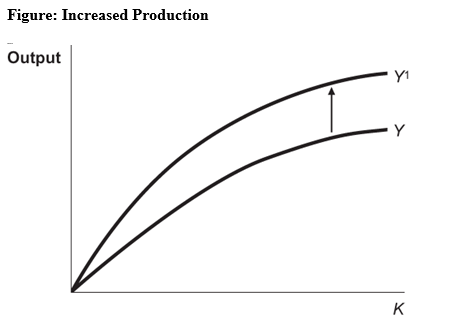 -Figure: Increased Production In the accompanying graph,which of the following events could cause the upward shift of the production function?
 (Multiple Choice)
4.9/5 (68)
(68) Member nations of the Organisation for Economic Co-operation and Development (OECD)with a lower GDP per capita in 1960 experienced what sort of growth during the subsequent 40 years?
(Multiple Choice)
4.9/5 (70)
(70) The concept of diminishing returns explains why China is growing so much faster than the United States.
(True/False)
4.8/5 (84)
(84) The Solow model implies that countries farther away from their steady states will grow faster than countries closer to their steady states.
(True/False)
4.7/5 (87)
(87) Among poor countries,economic growth comes primarily from new ideas,new technologies,or new methods of management.
(True/False)
4.8/5 (80)
(80) If investment is less than depreciation,then the capital stock:
(Multiple Choice)
4.9/5 (72)
(72) If investment is greater than depreciation,an economy will be below its steady state.
(True/False)
4.9/5 (82)
(82) Provided they have the same steady state,the tendency for poorer countries to grow faster than richer countries and thus to converge in income is called:
(Multiple Choice)
4.8/5 (74)
(74) Imagine an economy with production function Y = F(K)= and 400 units of capital.If the fraction of output invested in new capital is = 0.2 and the depreciation rate is = .05,how much total capital will be available in the next period?
(Multiple Choice)
5.0/5 (66)
(66) Better ideas increase output directly because of higher productivity and indirectly because of capital accumulation.
(True/False)
4.9/5 (83)
(83) An increase in the investment rate lowers the steady-state output.
(True/False)
4.9/5 (75)
(75) Growth consists of two types: catching-up growth and cutting-edge growth.
(True/False)
4.9/5 (75)
(75) Imagine an economy with production function Y = F(K)= and 400 units of capital.If the fraction of output invested in new capital is = 0.2 and the depreciation rate is = .05,what is the steady-state amount of capital?
(Multiple Choice)
4.8/5 (81)
(81) 
Filters
- Essay(0)
- Multiple Choice(0)
- Short Answer(0)
- True False(0)
- Matching(0)