



 Chat with AI
Exam 19: International Trade

Exam 1: The Big Ideas253 Questions
Exam 2: The Power of Trade150 Questions
Exam 3: Supply and Demand135 Questions
Exam 4: Equilibrium- How Supply and Demand241 Questions
Exam 5: Price Ceilings and Floors309 Questions
Exam 6: GDP and the Measurement of Progress205 Questions
Exam 7: The Wealth of Nations and Economic Growth269 Questions
Exam 8: Growth,capital Accumulation155 Questions
Exam 9: Saving,investment,and the Financial System285 Questions
Exam 10: Stock Markets and Personal Finance241 Questions
Exam 11: Unemployment and Labor Force Participation186 Questions
Exam 12: Inflation and the Quantity Theory of Money155 Questions
Exam 13: Business Fluctuations231 Questions
Exam 14: Transmission and Amplification Mechanisms219 Questions
Exam 15: The Federal Reserve System271 Questions
Exam 16: Monetary Policy242 Questions
Exam 17: The Federal Budget- Taxes and Spending167 Questions
Exam 18: Fiscal Policy270 Questions
Exam 19: International Trade192 Questions
Exam 20: International Finance289 Questions
Exam 21: Political Economy and Public Choice304 Questions
Select questions type


Use the following to answer questions
Figure: Foreign Trade with a Tariff 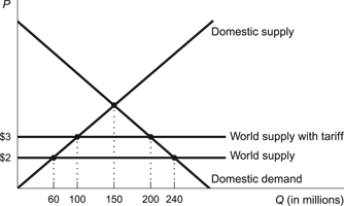 -(Figure: Foreign Trade with a Tariff)Refer to the figure.A $1 tariff generates government revenue of:
 (Multiple Choice)
4.7/5  (83)
(83) Consider the following statements: I.Relative to a no-trade situation,if the United States exported wheat,the U.S.domestic wheat price would rise and domestic production of wheat would expand.
II.Relative to a no-trade situation,international trade causes the prices of all goods to rise.
(Multiple Choice)
4.9/5 (90)
(90) If the world price of cotton is less than the price that would occur domestically without trade,then a country will:
(Multiple Choice)
4.7/5 (71)
(71) There is strong evidence to support the idea that protectionism increases domestic job growth.
(True/False)
4.7/5 (81)
(81) Governments can use tariffs to help domestic firms act like a cartel when selling to international buyers:
(Multiple Choice)
4.7/5 (85)
(85) Lobbyists for many industries argue each of the following,EXCEPT:
(Multiple Choice)
4.9/5 (72)
(72) Because of pressure from Western countries,garment producers in Bangladesh quit employing 30,000 to 50,000 child workers.What happened to these children?
(Multiple Choice)
4.8/5 (95)
(95) Which economic concept best explains why poorer countries have higher concentrations of child labor?
(Multiple Choice)
4.9/5 (76)
(76) The economics of international trade is substantially different from that of ordinary trade.
(True/False)
4.9/5 (90)
(90) According to the supply and demand framework in the text,an increase in import trade tends to ______ domestic production of a good.
(Multiple Choice)
4.8/5 (73)
(73) Because of pressure from the United States,the garment industry in Bangladesh dismissed 30,000 to 50,000 child laborers.This action:
(Multiple Choice)
4.8/5 (73)
(73) Which,if any,of the following conditions for efficient market functioning do tariffs and quotas violate? I.demanders with the highest willingness to pay purchase the supply of goods
II.producers with the lowest costs produce and sell the supply of goods
III.the sum of consumer and producer surplus is maximized
(Multiple Choice)
4.8/5 (81)
(81) Imposing tariffs results in both wasted resources and lost gains from trade.
(True/False)
4.8/5 (78)
(78) If a tariff decreases domestic consumption of a good from 230 million units to 150 million units and raises the domestic price by $1.50,given a linear domestic demand curve and a perfectly elastic world supply curve,what is the value of the unexploited gains from trade caused by decreased domestic consumption?
(Multiple Choice)
4.9/5 (61)
(61) The U.S.price of sugar is higher than the world price of sugar due primarily to a:
(Multiple Choice)
4.8/5 (75)
(75) 
Filters
- Essay(0)
- Multiple Choice(0)
- Short Answer(0)
- True False(0)
- Matching(0)