



 Chat with AI
Exam 19: International Trade

Exam 1: The Big Ideas253 Questions
Exam 2: The Power of Trade150 Questions
Exam 3: Supply and Demand135 Questions
Exam 4: Equilibrium- How Supply and Demand241 Questions
Exam 5: Price Ceilings and Floors309 Questions
Exam 6: GDP and the Measurement of Progress205 Questions
Exam 7: The Wealth of Nations and Economic Growth269 Questions
Exam 8: Growth,capital Accumulation155 Questions
Exam 9: Saving,investment,and the Financial System285 Questions
Exam 10: Stock Markets and Personal Finance241 Questions
Exam 11: Unemployment and Labor Force Participation186 Questions
Exam 12: Inflation and the Quantity Theory of Money155 Questions
Exam 13: Business Fluctuations231 Questions
Exam 14: Transmission and Amplification Mechanisms219 Questions
Exam 15: The Federal Reserve System271 Questions
Exam 16: Monetary Policy242 Questions
Exam 17: The Federal Budget- Taxes and Spending167 Questions
Exam 18: Fiscal Policy270 Questions
Exam 19: International Trade192 Questions
Exam 20: International Finance289 Questions
Exam 21: Political Economy and Public Choice304 Questions
Select questions type


Use the following to answer questions
Figure: Foreign Trade  -(Figure: Foreign Trade)Refer to the figure.What quantity would be produced domestically?
 (Multiple Choice)
4.9/5  (97)
(97) History has shown that one of the most effective tools against child labor is:
(Multiple Choice)
4.9/5 (85)
(85) Use the following to answer questions
Figure: Trade 2 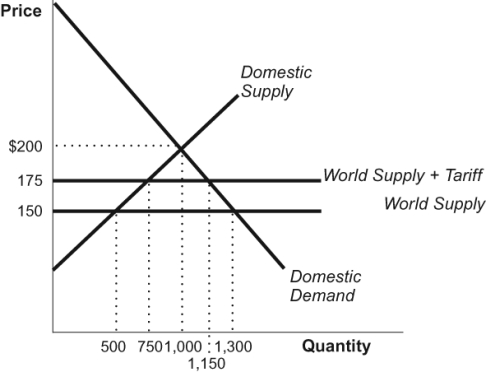 -(Figure: Trade 2)Refer to the figure.In this figure representing the market for oil,what are the total revenues generated by the tariff?
 (Multiple Choice)
4.8/5 (79)
(79) The paradox of trade restrictions on countries with child labor is that:
(Multiple Choice)
5.0/5 (85)
(85) Although domestic consumers gain more from free trade than domestic producers lose,the matter may not be that simple.Why might domestic producers also gain from free trade policies over those that impose tariffs on all goods?
(Multiple Choice)
4.8/5 (71)
(71) Use the following to answer questions
Figure: Foreign Trade 2  -(Figure: Foreign Trade 2)Refer to the figure.What is the dollar value of wasted resources as a result of prohibiting trade in this market?
 (Multiple Choice)
4.9/5 (72)
(72) Which of the following statements is TRUE about the removal of trade barriers?
(Multiple Choice)
4.9/5 (97)
(97) Removing tariffs and quotas will ensure that goods are sold by the low-cost producers and increase the sum of consumer and producer surplus.
(True/False)
5.0/5 (74)
(74) In the case of sugar,moving from a situation of no trade to free trade causes both domestic consumption and production to increase.
(True/False)
4.8/5 (74)
(74) Use the following to answer questions
Figure: Trade 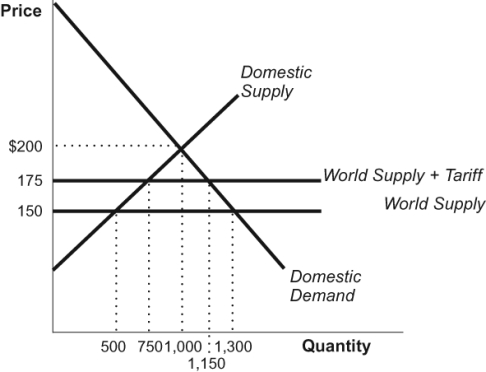 -(Figure: Trade)Refer to the figure.If the world price for the good in this figure were higher than the domestic price,a move to free international trade means that the domestic economy would become:
 (Multiple Choice)
4.9/5 (73)
(73) Use the following to answer questions
Figure: International Trade 4 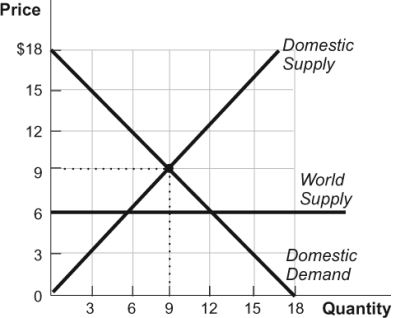 -(Figure: International Trade 4)Refer to the figure.If,in this figure,the government eliminated free trade,producer surplus would:
 (Multiple Choice)
4.7/5 (83)
(83) A tariff ______ the amount of output produced by domestic firms and ______ the amount of goods bought by domestic consumers.
(Multiple Choice)
4.9/5 (82)
(82) Use the following to answer questions
Figure: Foreign Trade
-(Figure: Foreign Trade)Refer to the figure.What quantity would be traded in the absence of any international trade?
-(Figure: Foreign Trade)Refer to the figure.What quantity would be traded in the absence of any international trade? (Multiple Choice)
4.9/5 (87)
(87) Use the following to answer questions
Figure: International Trade 1 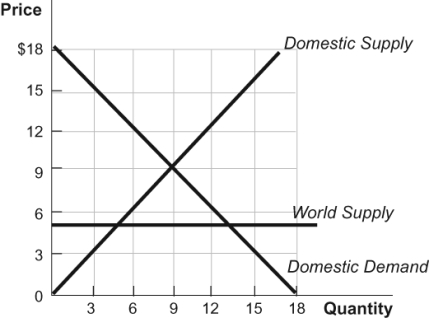 -(Figure: International Trade 1)Refer to the figure.According to the figure,which of the following statements is TRUE?
 (Multiple Choice)
4.8/5 (80)
(80) In a demand and supply diagram,the effects of a tariff and a quota on the supply and demand curves are identical.
(True/False)
4.8/5 (85)
(85) Rising tariffs increase domestic production,but reduce domestic consumption.
(True/False)
4.9/5 (69)
(69) 
Filters
- Essay(0)
- Multiple Choice(0)
- Short Answer(0)
- True False(0)
- Matching(0)