



 Chat with AI
Exam 13: Valuation: Earnings-Based Approaches

Exam 1: Overview of Financial Reporting, Financial Statement Analysis, and Valuation67 Questions
Exam 2: Asset and Liability Valuation and Income Measurement49 Questions
Exam 3: Income Flows Versus Cash Flows: Key Relationships in the Dynamics of a Business55 Questions
Exam 4: Profitability Analysis69 Questions
Exam 5: Risk Analysis63 Questions
Exam 6: Quality of Accounting Information and Adjustments to Reported Financial Statement Data52 Questions
Exam 7: Revenue Recognition and Related Expenses52 Questions
Exam 8: Liability Recognition and Related Expenses61 Questions
Exam 9: Intercorporate Entities55 Questions
Exam 10: Forecasting Financial Statements41 Questions
Exam 11: Risk-Adjusted Expected Rates of Return and the Dividends Valuation Approach30 Questions
Exam 12: Valuation: Cash-Flow-Based Approaches41 Questions
Exam 13: Valuation: Earnings-Based Approaches47 Questions
Exam 14: Valuation: Market-Based Approaches50 Questions
Select questions type


The appropriate discount rate for the residual income model is
(Multiple Choice)
4.9/5  (72)
(72) Accounting principles make accrual accounting earnings closer to the firm's underlying economic performance in a given period than are _________________________.
(Short Answer)
4.7/5 (95)
(95) Over the life of a firm, the capital invested in the firm by the shareholders plus the income of the firm will reflect
(Multiple Choice)
4.8/5 (83)
(83) The ______________________________ valuation model uses expected future net income and the book value of common shareholders' equity as the basis for valuation.
(Short Answer)
4.8/5 (57)
(57) Clean surplus accounting means that net income includes all of the recognized elements of income for the firm for _____________________________________________.
(Short Answer)
4.9/5 (80)
(80) Jones Corp. Use this information to answer the following questions:
At the end of 2005 Jones Corp. developed the following forecasts of net income:
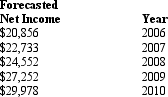 Management believes that after 2010 Jones will grow at a rate of 7% each year. Total common shareholders' was $112,768 on December 31, 2005. Jones has not established a dividend and does not plan on paying dividends during 2006 to 2010, its cost of equity capital is 12%.
What would be Jones' common shareholders' equity at the end of 2009?
Management believes that after 2010 Jones will grow at a rate of 7% each year. Total common shareholders' was $112,768 on December 31, 2005. Jones has not established a dividend and does not plan on paying dividends during 2006 to 2010, its cost of equity capital is 12%.
What would be Jones' common shareholders' equity at the end of 2009? (Multiple Choice)
4.8/5 (85)
(85) The required earnings of the firm equals the product of the required rate of return on common equity capital times the __________________________________________________ at the beginning of the period.
(Short Answer)
4.9/5 (74)
(74) At the beginning of 2007 investors had invested $25,000 of common equity in Giants Corp.and expect to earn a return of 11% per year. In addition, investors expect Giant Corp. to pay out 100% of income in dividends each year. Forecasts of Giant's net income are as follows: 2007 - $3,500
2008 - $3,200
2009 - $2,900
2010 and beyond - $2,750
Using this information what is Giant's residual income valuation at the beginning of 2007?
(Multiple Choice)
4.9/5 (78)
(78) The value of a share of common equity should equal the present value of the _____________________________________________ the shareholders will receive.
(Short Answer)
4.8/5 (67)
(67) Over sufficiently long periods, _________________________ equals free cash flows to common equity.
(Short Answer)
4.8/5 (69)
(69) What are the three arguments economists provide against using earnings as a value-relevant attribute in valuation?
(Essay)
4.8/5 (82)
(82) ____________________ are the fundamental, value-relevant attribute of expected future returns.
(Short Answer)
4.8/5 (88)
(88) Residual income valuation focuses on ____________________ as a periodic measure of shareholder wealth creation.
(Short Answer)
4.9/5 (88)
(88) Jones Corp. Use this information to answer the following questions:
At the end of 2005 Jones Corp. developed the following forecasts of net income:
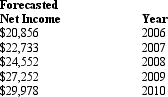 Management believes that after 2010 Jones will grow at a rate of 7% each year. Total common shareholders' was $112,768 on December 31, 2005. Jones has not established a dividend and does not plan on paying dividends during 2006 to 2010, its cost of equity capital is 12%.
Compute the value of Jones Corp. on January 1, 2006, using the residual income valuation model. Use the half-year adjustment.
Management believes that after 2010 Jones will grow at a rate of 7% each year. Total common shareholders' was $112,768 on December 31, 2005. Jones has not established a dividend and does not plan on paying dividends during 2006 to 2010, its cost of equity capital is 12%.
Compute the value of Jones Corp. on January 1, 2006, using the residual income valuation model. Use the half-year adjustment. (Multiple Choice)
4.9/5 (74)
(74) Investors have invested $25,000 in common equity in a company. Given the risk inherent in the company the investors expect to earn a 15 percent return. In addition, the investors expect the company to return all income to investors in the form of dividends. The company is forecasted to earn $4,000 the first year, $5,000 the second year, $4,500 the third year and $3,750 each year after the third year. For this company determine the company's residual income valuation
(Essay)
4.9/5 (80)
(80) Over the life of the firm, the present value of ______________________________, ______________________________, and ____________________ will be the same.
(Short Answer)
4.9/5 (76)
(76) At the beginning of 2007 investors had invested $125,000 of common equity in Jets Corp.and expect to earn a return of 15% per year. In addition, investors expect Jets Corp. to pay out 100% of income in dividends each year. Forecasts of Jet's net income are as follows: 2007 - $41,000
2008 - $35,400
2009 - $33,200
2010 and beyond - $25,000
Using this information what is Jet's residual income valuation at the beginning of 2007?
(Multiple Choice)
4.9/5 (73)
(73) Over the life of a firm, the capital invested in the firm by the shareholders plus the income of the firm will reflect the ______________________________ to the shareholders.
(Short Answer)
4.9/5 (71)
(71) If an analyst expects a firm to generate net income each period exactly equal to required earnings, then the value of the firm will be
(Multiple Choice)
4.7/5 (71)
(71) 
Filters
- Essay(0)
- Multiple Choice(0)
- Short Answer(0)
- True False(0)
- Matching(0)