



 Chat with AI
Exam 13: Valuation: Earnings-Based Approaches

Exam 1: Overview of Financial Reporting, Financial Statement Analysis, and Valuation67 Questions
Exam 2: Asset and Liability Valuation and Income Measurement49 Questions
Exam 3: Income Flows Versus Cash Flows: Key Relationships in the Dynamics of a Business55 Questions
Exam 4: Profitability Analysis69 Questions
Exam 5: Risk Analysis63 Questions
Exam 6: Quality of Accounting Information and Adjustments to Reported Financial Statement Data52 Questions
Exam 7: Revenue Recognition and Related Expenses52 Questions
Exam 8: Liability Recognition and Related Expenses61 Questions
Exam 9: Intercorporate Entities55 Questions
Exam 10: Forecasting Financial Statements41 Questions
Exam 11: Risk-Adjusted Expected Rates of Return and the Dividends Valuation Approach30 Questions
Exam 12: Valuation: Cash-Flow-Based Approaches41 Questions
Exam 13: Valuation: Earnings-Based Approaches47 Questions
Exam 14: Valuation: Market-Based Approaches50 Questions
Select questions type


Accounting earnings numbers provide a basis for valuation because earnings are the primary measure of ______________________________ produced by the accrual accounting system.

Free
(Short Answer)
5.0/5  (83)
(83) Correct Answer: Verified
firm per formance
Jones Corp. Use this information to answer the following questions:
At the end of 2005 Jones Corp. developed the following forecasts of net income:
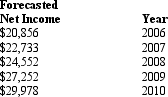 Management believes that after 2010 Jones will grow at a rate of 7% each year. Total common shareholders' was $112,768 on December 31, 2005. Jones has not established a dividend and does not plan on paying dividends during 2006 to 2010, its cost of equity capital is 12%.
What would be Jones' residual income in 2008?
Management believes that after 2010 Jones will grow at a rate of 7% each year. Total common shareholders' was $112,768 on December 31, 2005. Jones has not established a dividend and does not plan on paying dividends during 2006 to 2010, its cost of equity capital is 12%.
What would be Jones' residual income in 2008?Free
(Multiple Choice)
4.8/5 (84)
(84) Correct Answer:Verified
VerifiedC
Investors have invested $25,000 in common equity in a company. Given the risk inherent in the company the investors expect to earn a 15 percent return. In addition, the investors expect the company to return all income to investors in the form of dividends. The company earns $4,000 the first year. For this company determine the following:

Free
(Essay)
5.0/5 (74)
(74) Correct Answer:Verified
Verified
Why is the weighted average cost of capital not used as the discount rate when computing residual income?
(Essay)
4.9/5 (70)
(70) Builder, Inc. is a distributor of tools and building supplies. Management for the company has developed the following forecasts of net income:
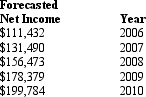 Management expects net income to grow at a rate of 7 percent per year after 2010 and the company's cost of equity capital is 14%. Management has set a dividend payout ratio equal to 25% of net income and plans to continue this policy. Builder's common shareholders' equity at January 1, 2006 is $544,902.
Required:

Management expects net income to grow at a rate of 7 percent per year after 2010 and the company's cost of equity capital is 14%. Management has set a dividend payout ratio equal to 25% of net income and plans to continue this policy. Builder's common shareholders' equity at January 1, 2006 is $544,902.
Required:
(Essay)
4.8/5 (75)
(75) If an analyst expects a firm to generate net income each period exactly equal to required earnings, then the value of the firm will be equal to the ______________________________ of common shareholders' equity.
(Short Answer)
4.9/5 (83)
(83) Assume that a firm had shareholders' equity on the balance sheet at a book value of $1,200 at the end of 2005. During 2006 the firm earns net income of $900, pays dividends to shareholders of $400, and issues new stock to raise $250 of capital. The book value of shareholders equity at the end of 2006 is:
(Multiple Choice)
4.8/5 (94)
(94) Accounting for the book value of common shareholders' equity in a firm can be expressed as follows:
BVt = BVt-1 + ____________________ - Dt.
(Short Answer)
4.9/5 (71)
(71) When debating the issue of whether to use free cash flows or earnings in a valuation model economists sometimes argue that ____________________ can be subject to purposeful management by a firm and thus make them less useful.
(Short Answer)
4.8/5 (75)
(75) Power, Inc. is a distributor of electrical supplies and tools. Management for the company has developed the following forecasts of net income:
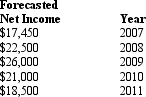 Red Ranger, CFO of Power, Inc. expects net income to grow at a rate of 9 percent per year after 2011 and the company's cost of equity capital is 15%. Management plans to payout all income in dividends and plans to continue this policy into the future. Power's common shareholders' equity at January 1, 2006 is $100,000.
Required:

Red Ranger, CFO of Power, Inc. expects net income to grow at a rate of 9 percent per year after 2011 and the company's cost of equity capital is 15%. Management plans to payout all income in dividends and plans to continue this policy into the future. Power's common shareholders' equity at January 1, 2006 is $100,000.
Required:
(Essay)
4.9/5 (78)
(78) The residual income valuation approach assumes that accounting for net income and book value of shareholders' equity follows ________________________________________.
(Short Answer)
4.8/5 (76)
(76) Currently U.S. GAAP does not follow clean surplus accounting, what are the four dirty surplus items that do not flow through net income?
(Essay)
4.8/5 (78)
(78) Investors have invested $25,000 in common equity in a company. Given the risk inherent in the company the investors expect to earn a 15 percent return. In addition, the investors expect that the company will reinvest all income in projects that will earn 16%. The company is forecasted to earn $6,000 the first year, $5,000 the second year, $5,500 the third year and $6,244 each year after the third year. For this company determine the company's residual income valuation (round all numbers to the nearest dollar).
(Essay)
4.9/5 (68)
(68) If investors have invested $25,000 of common equity in a company and it is determined that the required earnings of the company are $2,250 each period, then investors must expect to earn what return?
(Multiple Choice)
4.9/5 (86)
(86) Clean surplus accounting means that ____________________ include all direct capital transactions between the firm and the common equity shareholders.
(Short Answer)
4.8/5 (86)
(86) Assume that a firm's book value at the beginning of the year is $12,500 and that the firm reports net income of $3,200 and pays dividends of $1,100. What will the firm's book value at the end of the year?
(Multiple Choice)
4.7/5 (79)
(79) 
Filters
- Essay(0)
- Multiple Choice(0)
- Short Answer(0)
- True False(0)
- Matching(0)