



 Chat with AI
Exam 14: Valuation: Market-Based Approaches

Exam 1: Overview of Financial Reporting, Financial Statement Analysis, and Valuation67 Questions
Exam 2: Asset and Liability Valuation and Income Measurement49 Questions
Exam 3: Income Flows Versus Cash Flows: Key Relationships in the Dynamics of a Business55 Questions
Exam 4: Profitability Analysis69 Questions
Exam 5: Risk Analysis63 Questions
Exam 6: Quality of Accounting Information and Adjustments to Reported Financial Statement Data52 Questions
Exam 7: Revenue Recognition and Related Expenses52 Questions
Exam 8: Liability Recognition and Related Expenses61 Questions
Exam 9: Intercorporate Entities55 Questions
Exam 10: Forecasting Financial Statements41 Questions
Exam 11: Risk-Adjusted Expected Rates of Return and the Dividends Valuation Approach30 Questions
Exam 12: Valuation: Cash-Flow-Based Approaches41 Questions
Exam 13: Valuation: Earnings-Based Approaches47 Questions
Exam 14: Valuation: Market-Based Approaches50 Questions
Select questions type


A firm's value-to-book and market-to-book ratios may differ from one for a number of reasons. Discuss how a successful internally funded research and development program would create a situation where the value-to-book and market-to-book ratios differ from one.
(Essay)
4.7/5  (84)
(84) Market multiples capture ____________________ valuation per dollar of book value or per dollar of earnings.
(Short Answer)
4.8/5 (72)
(72) Which of the following is not a reason why price-earnings ratios would differ across firms?
(Multiple Choice)
4.8/5 (86)
(86) Strictly speaking, the price-earnings ratio assumes that firm value is
(Multiple Choice)
4.7/5 (83)
(83) Companies value-to-book and market-to-book ratios may differ due to accounting reasons. An example of an accounting reason that would create a difference is
(Multiple Choice)
5.0/5 (78)
(78) The ______________________________ represents the value of the firm, based on book value of equity and forecasts of expected future earnings, in the absence of discounting for risk.
(Short Answer)
4.9/5 (87)
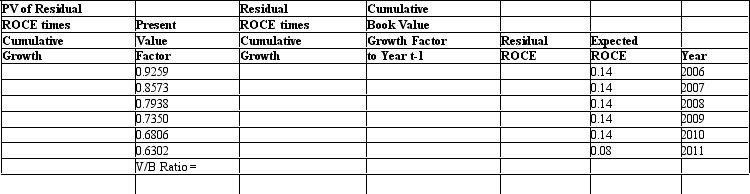
(87) Assume an analyst is evaluating a firm with $1,000 of book value of common equity and a cost of equity capital equal to 8 percent. Assume that the analyst forecasts that the firm will earn ROCE of 14 percent until year 2011, when the firm will start earning ROCE equal to 8 percent. The company pays no dividends and will not engage in any stock transactions. Use this information to complete the following table and calculate the firm's value-to-book ratio.
(Essay)
4.8/5 (101)
(101) Firms with low P/E ratios tend to have current residual income that is greater than
(Multiple Choice)
4.9/5 (78)
(78) What information can a PEG ratio provide about a company's stock price? What does a PEG ratio greater than mean? less than one?
(Essay)
4.9/5 (88)
(88) 
Filters
- Essay(0)
- Multiple Choice(0)
- Short Answer(0)
- True False(0)
- Matching(0)