



 Chat with AI
Exam 13: Investments and Long-Term Receivables

Exam 1: The Demand for and Supply of Financial Accounting Information89 Questions
Exam 2: Financial Reporting: Its Conceptual Framework87 Questions
Exam 3: Review of a Companys Accounting System146 Questions
Exam 4: The Balance Sheet and the Statement of Shareholders Equity112 Questions
Exam 5: The Income Statement and the Statement of Cash Flows151 Questions
Exam 6: Cash and Receivables149 Questions
Exam 7: Inventories: Cost Measurement and Flow Assumptions123 Questions
Exam 8: Inventories: Special Valuation Issues148 Questions
Exam 9: Current Liabilities and Contingencies128 Questions
Exam 10: Property, Plant, and Equipment: Acquisition and Subsequent Investments105 Questions
Exam 11: Depreciation, Depletion, Impairment, and Disposal143 Questions
Exam 12: Intangibles105 Questions
Exam 13: Investments and Long-Term Receivables140 Questions
Exam 14: Financing Liabilities: Bonds and Notes Payable171 Questions
Exam 15: Contributed Capital154 Questions
Exam 16: Retained Earnings and Earnings Per Share111 Questions
Exam 17: Advanced Issues in Revenue Recognition113 Questions
Exam 18: Accounting for Income Taxes108 Questions
Exam 19: Accounting for Postretirement Benefits98 Questions
Exam 20: Accounting for Leases149 Questions
Exam 21: The Statement of Cash Flows107 Questions
Exam 22: Accounting for Changes and Errors130 Questions
Exam 23: Time Value of Money Module121 Questions
Select questions type


On January 1, 2014, the Z Corporation acquired a 20% interest in D Company by purchasing 4,800 shares of its 24,000 outstanding shares of common stock. The acquisition price was $30 per share. On the date of purchase, D Company's net assets were as follows: 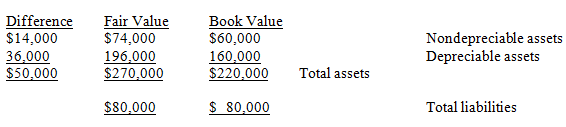 During 2014, D Company earned income of $70,000 and paid dividends of $18,000. The depreciable assets have a ten-year remaining life and no residual value.
Required:
Prepare all of the journal entries on Z Corporation's books to record the acquisition and subsequent events in 2014 related to the investment in D Company.
During 2014, D Company earned income of $70,000 and paid dividends of $18,000. The depreciable assets have a ten-year remaining life and no residual value.
Required:
Prepare all of the journal entries on Z Corporation's books to record the acquisition and subsequent events in 2014 related to the investment in D Company. (Essay)
4.9/5  (90)
(90) David, Inc. used the equity method of accounting for its investment in Russell Company. At December 31, 2014, the investment balance was $4,500 after all adjustments were recorded. The following is additional information:  What was the January 1, 2014 balance in Investment in Russell Company?
 (Multiple Choice)
4.8/5 (90)
(90) When transferring investments between categories, unrealized holding gains for securities transferred from trading to available-for-sale
(Multiple Choice)
4.9/5 (68)
(68) What is a derivative financial instrument, provide two examples and list one concept involving derivative?
(Essay)
4.7/5 (84)
(84) The carrying value of held-to-maturity debt securities is the
(Multiple Choice)
4.8/5 (87)
(87)  Required:
1)Prepare journal entries to record the preceding information.
2) What is the unrealized holding gain or loss and where is it reported on the 2014 financial statements?
Required:
1)Prepare journal entries to record the preceding information.
2) What is the unrealized holding gain or loss and where is it reported on the 2014 financial statements? (Essay)
4.8/5 (79)
(79) Warren, Inc. purchased a $400,000 life insurance policy on the company president on January 1, 2017. The premium that was paid on January 1 amounted to $11,600. In the first year, cash surrender value increased by $900 and dividends received by Warren from the insurance company for the year amounted to $300. What was Warren's insurance expense for 2017?
(Multiple Choice)
4.7/5 (80)
(80) For a minority active investment, a company should disclose the investor's accounting policies with respect to equity method of investments.
(True/False)
4.8/5 (75)
(75) Dividends that are declared at year-end but not received on investments in securities held for sale or trading should be recognized when
(Multiple Choice)
4.9/5 (80)
(80) Significant influence of another company generally occurs when the investor owns between 25% to 45%, due to this relationship the investor is required to issue consolidated financial statements.
(True/False)
4.8/5 (85)
(85) With consolidation, control generally occurs when the investor owns what percentage of the voting stock of the investee?
(Multiple Choice)
4.9/5 (68)
(68) Which of the following methods of accounting for investments is appropriate when the investor controls the investee?
(Multiple Choice)
4.8/5 (89)
(89) Which of the following securities are reported at their amortized cost on the balance sheet date?
(Multiple Choice)
4.8/5 (66)
(66) A transfer from the trading category into any other category does not require any accounting because unrealized holding gains or losses have already been recognized.
(True/False)
4.8/5 (73)
(73) On October 1, 2014, the Sun Company acquired 9% bonds of Jack's Company with a face value of $400,000 for $412,000 plus accrued interest. Interest is payable on June 30 and December 31. How would Sun record the initial bond investment to be held-to-maturity?
(Multiple Choice)
4.9/5 (78)
(78) What three steps are necessary to evaluate whether or not an investment is impaired?
(Essay)
4.9/5 (76)
(76) Vermont Cheese Company has a $5,000,000, 7% bank loan from National Bank. On January 1, 2014, the bank loan has three years to maturity. Vermont enters into a three-year interest rate swap with Cheese Investments with a $5 million notional. The agreement calls for Vermont to receive a fixed interest rate of 7% and pay a variable rate based on LIBOR at the beginning of the year. Payments are to be made for the net amount at each year-end. At the beginning of 2014, the LIBOR rate is 6.75%. The three-year fixed rate at the end of 2014 is 9%.
Required:
Prepare the journal entries for Vermont Cheese Company for the bank loan and derivative for 2014. (Round answers to the nearest dollar)
(Essay)
4.9/5 (94)
(94) On July 1, Sleepy, Inc. purchased 100 of Rabbit Co.'s 6%, $1,000 bonds. The bonds, which pay interest on March 1 and September 1, were purchased at 102 plus accrued interest to yield 4%. The investment was classified as held-to-maturity securities. Effective interest amortization is used.
Required:
Prepare journal entries for
a.July 1
b.September 1
c.December 31
(Essay)
4.9/5 (91)
(91) Permanent value declines in available-for-sale securities should be
(Multiple Choice)
4.8/5 (87)
(87) 
Filters
- Essay(0)
- Multiple Choice(0)
- Short Answer(0)
- True False(0)
- Matching(0)